
Reality
The Reality Advantage: Why reality franchises keep finding a way back
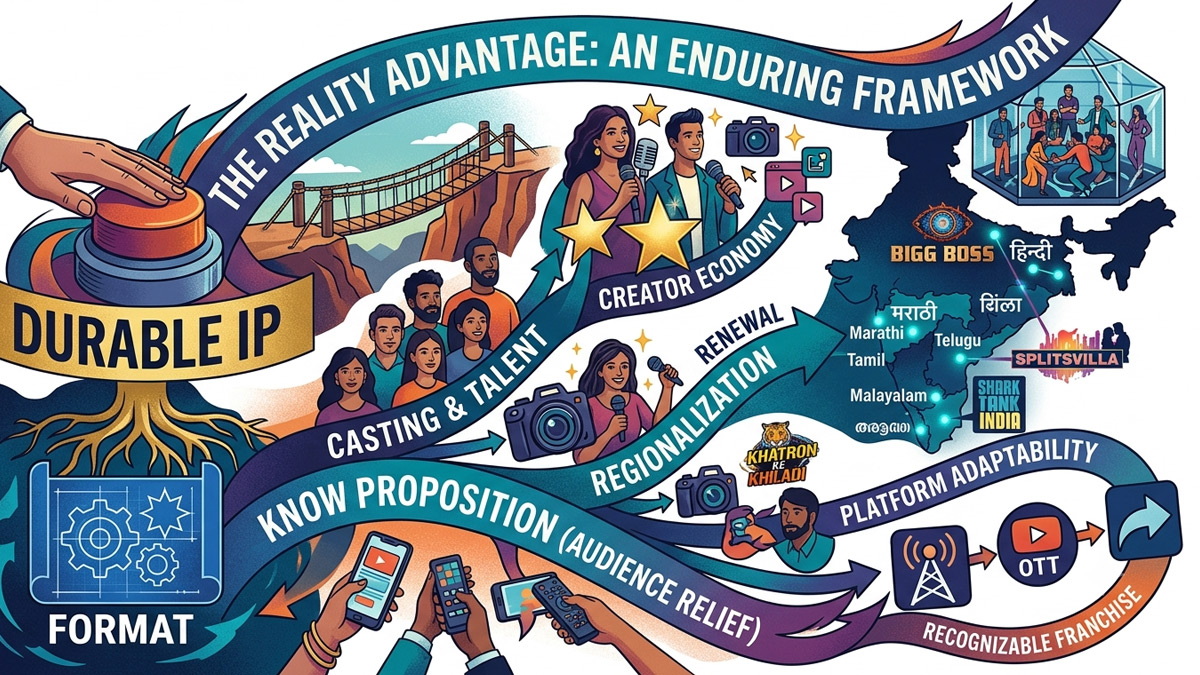
From Bigg Boss and Khatron Ke Khiladi to Splitsvilla and Shark Tank India, reality franchises have become some of the most durable properties in Indian entertainment. Their strength is not simply familiarity. It lies in their ability to turn a successful format into a repeatable media asset — one that can generate new seasons, talent, regional versions and platform extensions without having to reinvent the business every time.


MUMBAI: The entertainment business has always been built around the search for the next big thing. Every new season brings fresh shows, new formats and another attempt to find a property that can capture an audience and stay relevant long enough to justify the investment.
But there is another business imperative running alongside that search: finding intellectual property that can keep working.
This is where reality entertainment has developed a particularly strong proposition. Some of India’s most recognisable television properties have survived for years, despite repeated changes in contestants, locations, challenges and even the way audiences consume them. Bigg Boss, Khatron Ke Khiladi, Splitsvilla and Shark Tank India are all examples of formats whose basic propositions remain familiar while their individual seasons can look very different.
For a media company, that distinction matters. A new show begins with uncertainty. An established franchise begins with a known proposition, an existing audience relationship and a body of information about what has worked before.
That does not make the next season a guaranteed success. It does, however, change the nature of the risk.
A known proposition in an uncertain market
Launching an entertainment property involves more than producing the programme. A broadcaster or platform has to establish the concept, attract an initial audience and persuade viewers to make it part of their routine. Marketing has to explain what the programme is before it can sell why people should watch it.
A recognised reality franchise starts with some of that work already done.
Audiences may not know the contestants or what will happen during a new season, but they understand the basic proposition. That familiarity can make a new launch easier to communicate and gives the business a historical reference point when making programming decisions.
Previous seasons provide information about audience behaviour, scheduling, production requirements and commercial interest. The broadcaster is still taking a fresh bet, but it is a bet informed by the experience of earlier editions.
This makes established reality IP particularly useful in a fragmented entertainment market. The economics are not simply about producing another season; they are about having an asset whose audience proposition has already been established.
The challenge then shifts from discovery to renewal.
Keeping the format alive without breaking it
That renewal is where the best reality franchises distinguish themselves.
A format has to remain recognisable enough for audiences to know what they are returning to, while changing enough to avoid becoming predictable. The central mechanics provide continuity; the people and circumstances provide the variation.
Bigg Boss can change its contestants and house dynamics. Khatron Ke Khiladi can introduce different challenges and locations. Splitsvilla can rebuild its cast and relationship dynamics. Shark Tank India can introduce a new group of entrepreneurs and products.
The format remains the framework, but the material inside it changes.
This is also why casting is so important to the longevity of reality programming. In a scripted series, characters are created by writers and controlled by the narrative. In reality, personalities arrive with their own histories, ambitions, relationships and unpredictability.
A new cast can therefore make an old format feel new without requiring the production team to construct an entirely different entertainment proposition.
That is the difference between a franchise and a formula. A formula simply repeats what worked last time. A durable franchise knows which elements audiences value and which ones need to evolve.
The assets that accumulate around a franchise
The value of a long-running reality property also extends beyond the current season.
Years of programming create an archive of contestants, performances, memorable moments and cultural references. As viewing becomes increasingly platform-agnostic, that archive can have a life beyond its original broadcast window. Older episodes can find audiences on streaming services, while individual moments can be recirculated through short-form video and social platforms.
The franchise also accumulates people.
Reality television has become an important route through which personalities enter the wider entertainment and creator economy. A contestant can emerge from a season with an audience of their own and subsequently work across television, digital content, endorsements, acting, hosting or entrepreneurship.
That creates a talent pipeline around the IP. The programme gets new personalities every season, while some of those personalities carry the visibility of the programme into other parts of the entertainment market.
The same applies to hosts. In long-running formats, a host can become part of the property’s identity and provide continuity between seasons. When the contestants change but the audience still recognises the person steering the programme, the franchise retains another piece of its identity.
Over time, therefore, a successful reality property can accumulate several layers of value: the format itself, the archive, the talent associated with it and the personalities who become synonymous with it.
One format can become several businesses
The ability to adapt a reality format across markets gives the underlying IP another advantage, particularly in India.
Bigg Boss demonstrates how a single franchise can develop across multiple languages while allowing each edition to build its own contestants, audience dynamics and cultural identity. The format remains recognisable, but it does not have to be identical in every market.
That makes regionalisation more than a programming exercise. It can turn one piece of intellectual property into a portfolio of properties.
The same logic applies to platforms. A franchise does not necessarily have to remain confined to the environment in which it first became successful. Television, streaming, social content and other digital extensions can give the same property different ways of reaching audiences.
For media companies, this flexibility matters because the underlying asset becomes less dependent on one distribution model.
A reality format that can travel across languages, platforms and audience segments has more potential commercial life than one whose success depends entirely on a single market or scheduling slot.
The recurring event is part of the value
There is also strategic value in simply knowing that a franchise can return.
A major reality property can become a recurring event in a broadcaster’s programming calendar. Its return creates a natural promotional cycle, from the announcement of a new season and speculation around the cast to the launch, weekly developments and finale.
That predictability can be useful to the wider business.
Programming teams have an established tentpole. Marketing teams have a familiar property to build around. Production teams have experience with the format. Audiences have a reason to return to the channel or platform.
The uncertainty remains where it should: inside the entertainment.
Who will emerge as the breakout personality? Which contestants will connect with viewers? Which moments will dominate conversation? Which new twists will work?
The business has a known framework while the audience gets an unpredictable season.
That combination is difficult to manufacture from scratch.
The value increasingly sits in the IP
This is why the distinction between a successful season and a successful franchise is becoming more important.
A season has a defined beginning and end. A franchise can keep creating opportunities after the finale.
For format owners and production companies, that can mean licensing and adaptation opportunities. For broadcasters and streaming platforms, it can mean recurring programming and a deeper relationship with an established audience. For talent, it can provide a continuing route into the wider entertainment ecosystem.
The economics consequently shift from one-off programming towards IP development.
The most valuable question is no longer simply whether a show can deliver one successful season. It is whether the underlying proposition is strong enough to support another season, another language, another platform or another generation of viewers.
That is a very different way of looking at entertainment investment.
It also explains why the ownership and control of formats can matter as much as the success of individual broadcasts. The company that owns a durable concept potentially owns the ability to keep finding new expressions for it.
What eventually kills a franchise
Longevity, however, is not guaranteed.
Reality franchises can become victims of overexposure. Audiences can lose interest if casting becomes predictable, mechanics stop evolving or the programme no longer reflects the culture around it. A franchise that mistakes familiarity for an excuse not to change can quickly turn its biggest advantage into its biggest weakness.
There is also a limit to how far a property can stretch.
Regional versions, spin-offs, digital extensions and new seasons only add value when there is a genuine audience proposition behind them. Expansion for its own sake can dilute a franchise rather than strengthen it.
The real test is therefore not whether a format can return.
It is whether audiences still have a reason to care when it does.
That is why the strongest reality franchises are constantly negotiating between continuity and change. They preserve the central promise that made the property valuable, while allowing each new edition to respond to different personalities, cultural moments and audience expectations.
From a television show to a long-term media asset
The enduring strength of reality television is ultimately less about repetition than about what repetition makes possible.
A successful format can reduce some of the uncertainty associated with launching a new property. Its accumulated audience knowledge can inform future seasons. Its contestants can become talent. Its hosts can become part of the brand. Its archive can continue circulating. Its format can move into new languages and markets. Its identity can survive changes in distribution.
Each of those elements can add value to the same underlying IP.
That is why the most successful reality franchises are difficult to categorise as simply television shows. They are recurring pieces of intellectual property with the potential to generate programming, talent and commercial opportunities over a much longer period.
The media industry’s search for the next hit will never disappear. New formats are essential because audiences eventually demand something different. But the economics of entertainment also reward properties that can keep renewing themselves.
Reality has an unusual advantage here.
Its stories are temporary, but its framework can endure.
The contestants leave. The next cast arrives. The location changes. The challenges evolve. The audience moves between screens. The format adapts to a new market.
And yet the franchise remains recognisable.
That ability to absorb change without losing its identity is what allows a reality property to return year after year.
The real reality advantage, then, is not simply that audiences come back. It is that the business can keep building on what it has already created.






