Television
Television is transforming, not shrinking, says FICCI-EY report
The FICCI-EY report finds Connected TV surging to 40 million weekly homes and ad revenues up 42 per cent, even as linear television posts its fourth consecutive year of revenue decline

MUMBAI: The living room is being rewired. India’s television industry added households, broke audience records and watched its advertising revenues fall for the fourth year running, all at the same time. That apparent contradiction sits at the heart of the FICCI-EY Media and Entertainment Report 2026, released on Monday, and it tells you almost everything you need to know about where India’s most-watched medium is headed.
Total TV households rose to 193 million in 2025, up from 190 million in 2024 and 186 million in 2023, and the report projects the number will cross 200 million within two years. The growth, however, is not where the old industry would recognise it. Free TV expanded from 45 million households in 2023 to 53 million in 2025, with FreeDish alone accounting for the entire free segment. Pay TV and Connected TV combined stood at 140 million, but linear Pay TV shed 11 million subscriptions, losing them to Connected TV and Free TV. The audience is not leaving television. It is leaving the bill.
Connected TV is the story within the story. India had approximately 68 million Connected TV households in 2025, of which around 40 million were active on a weekly basis, a sharp jump from 30 million active homes in 2024. The engine behind that growth is straightforward: India now has over a billion broadband subscriptions and nearly 60 million broadband-enabled homes. When the infrastructure is there, the screen follows.

Advertisers have noticed. Connected TV advertising revenues grew 42 per cent in 2025 to reach Rs 99 billion, driven by brands chasing affluent, measurable households on a premium large screen. The appeal is not hard to explain. Connected TV offers the storytelling canvas of television combined with the targeting precision of digital, a combination that is reshaping media buying strategies across the industry. Digital advertising now accounts for 63 per cent of total ad spend in India, and Connected TV occupies the most coveted corner of that ecosystem. By 2028, Connected TV ad revenues are projected to reach Rs 164 billion, growing at around 18 per cent annually. Combined linear and Connected TV advertising revenues, which held stable at Rs 362 billion in 2025, could reach Rs 377 billion by 2028.
The supply side is shifting too. The total number of television channels rose to 956 in 2025, up from 936 in mid-2024, but the composition tells the real story. Free-to-air channels climbed from 581 to 621, now accounting for 65 per cent of all channels. Pay TV channels, meanwhile, fell from 363 to 335. News accounts for 36 per cent of all channels, general entertainment for 25 per cent and movies for 13 per cent. Within Pay TV, general entertainment and movie channels together make up 51 per cent of the segment.
Distribution is consolidating fast. Multi-system operators declined from 1,702 in December 2020 to just 818 by September 2025, as consolidation and the migration to digital platforms hollowed out the middle of the market. GTPL Hathway operationalising India’s second HITS licence was among the infrastructure developments the report flagged as signalling continued evolution in the sector.
From a consumption standpoint, linear TV viewership dipped marginally but average weekly reach held steady at around 745 million, a figure that most global media markets would envy. Entertainment, music and movies accounted for 80 per cent of viewership, with audiences under 50 driving 81 per cent of consumption. Non-Hindi content maintained a strong position, contributing over 50 per cent of total viewership, while sports viewership increased during the year.
The money, though, is moving in the wrong direction for traditional television. Linear TV revenues fell 9.2 per cent in 2025, the fourth consecutive annual decline. Total TV revenues dropped from Rs 710 billion in 2023 to Rs 617 billion in 2025 and are projected to fall further to Rs 535 billion by 2028. Advertising revenues slid from Rs 312 billion in 2023 to Rs 263 billion in 2025, hit by an 11.5 per cent drop in ad volumes as brands shifted budgets to point-of-sale advertising and the BCCI ban on real-money gaming advertisements bit into sports broadcasting. Subscription revenues fell 8.3 per cent despite a 2.4 per cent increase in average revenue per user to Rs 288 gross of taxes. Distribution revenues dropped from Rs 398 billion to Rs 354 billion over the same period.
The report is unambiguous on one point: television is not shrinking, it is transforming. Bundled offerings, integrating Pay TV with IPTV and broadband services, are expected to accelerate. Interactivity will deepen. Broadcasters will push harder on free-to-air strategies, particularly given the scale of FreeDish. And the report projects that by 2030, total television subscriptions across pay TV, free TV and Connected TV will reach 212 million, even as smartphones continue to dominate overall screen time.
The Connected TV households are projected to exceed 90 million by 2028, with around 67 million weekly active users. Interactive formats, gamification and shoppable TV, where viewers purchase directly through the screen, are expected to gain traction, turning passive consumption into a transactional act.
India’s television industry is not facing a reckoning. It is facing a reorganisation. The households are there, the audiences are there and the appetite is undimmed. What is changing is who captures the money when the screen lights up. Right now, the answer is increasingly Connected TV. In four years, it will be overwhelmingly so.






GECs
Samsung TV Plus launches Kings of Comedy channel
New free FAST channel brings iconic Hindi comedy shows to millions of Samsung Smart TV owners.
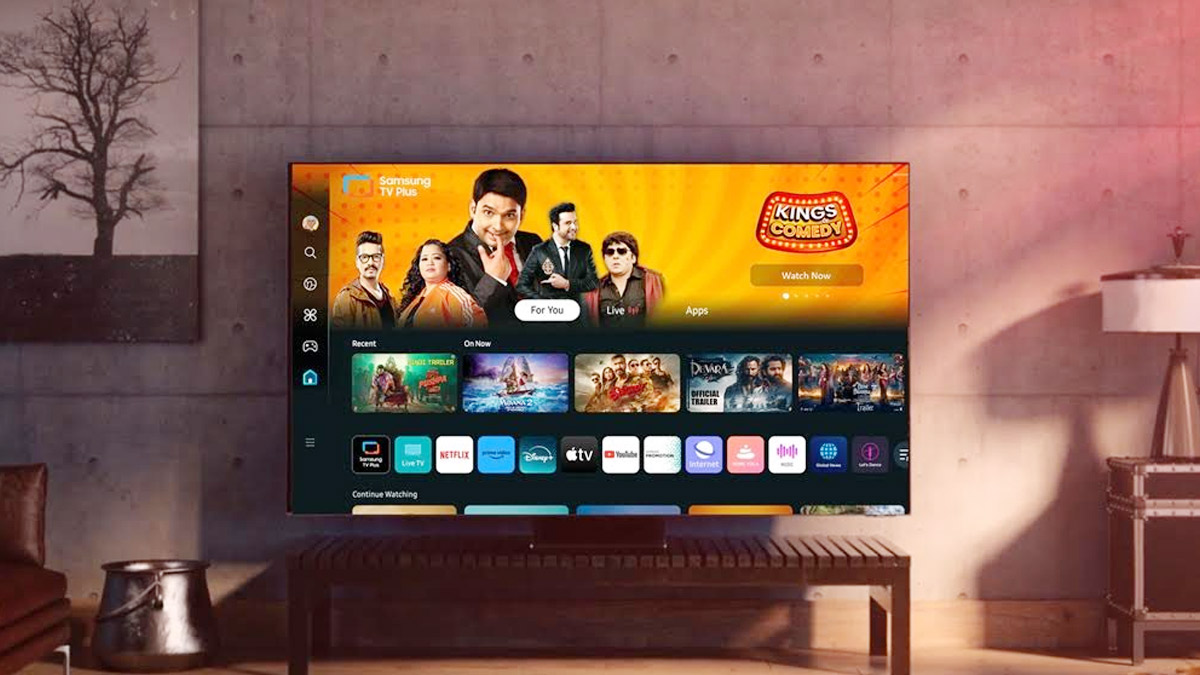
MUMBAI: Samsung TV Plus has just turned up the laughter volume and it’s completely free. The leading free ad-supported streaming television (FAST) service in India has launched Kings of Comedy, a premium comedy channel featuring some of the country’s most beloved primetime shows. Available exclusively on Samsung TV Plus, the channel delivers back-to-back hits including Comedy Nights with Kapil, Khatra Khatra Khatra, and Comedy Nights Bachao, with no login or subscription required.
The launch marks a milestone for free streaming in India, offering audiences a dedicated comedy destination directly from their Samsung TV home screen. It arrives as Samsung TV Plus India celebrates its 5th anniversary, during which the service has grown its monthly active users by 42 per cent and more than doubled its total viewing hours. The platform now offers over 180 free channels across 14 languages.
Samsung TV Plus India general manager and head of business development Kunal Mehta said, “Comedy is the heartbeat of Hindi entertainment, and Kings of Comedy brings together the shows Indians already love, completely free on their Samsung TV. Our focus remains the same take the content people know and make it effortless to access.”
Globally, Samsung TV Plus has surpassed 100 million monthly active users across more than 4,500 channels, solidifying its position as one of the world’s leading free streaming services.
Kings of Comedy is now available on all compatible Samsung Smart TVs. For viewers seeking non-stop laughter without any cost, this new channel delivers a royal treat proving that sometimes the best entertainment really does come with no strings (or subscriptions) attached.







