GECs
IBDF chief Avinash Pandey calls for lighter regulation and stronger IP protection
At CII Big Picture Summit 2026, Pandey flags piracy, regulatory imbalance and weak content monetisation


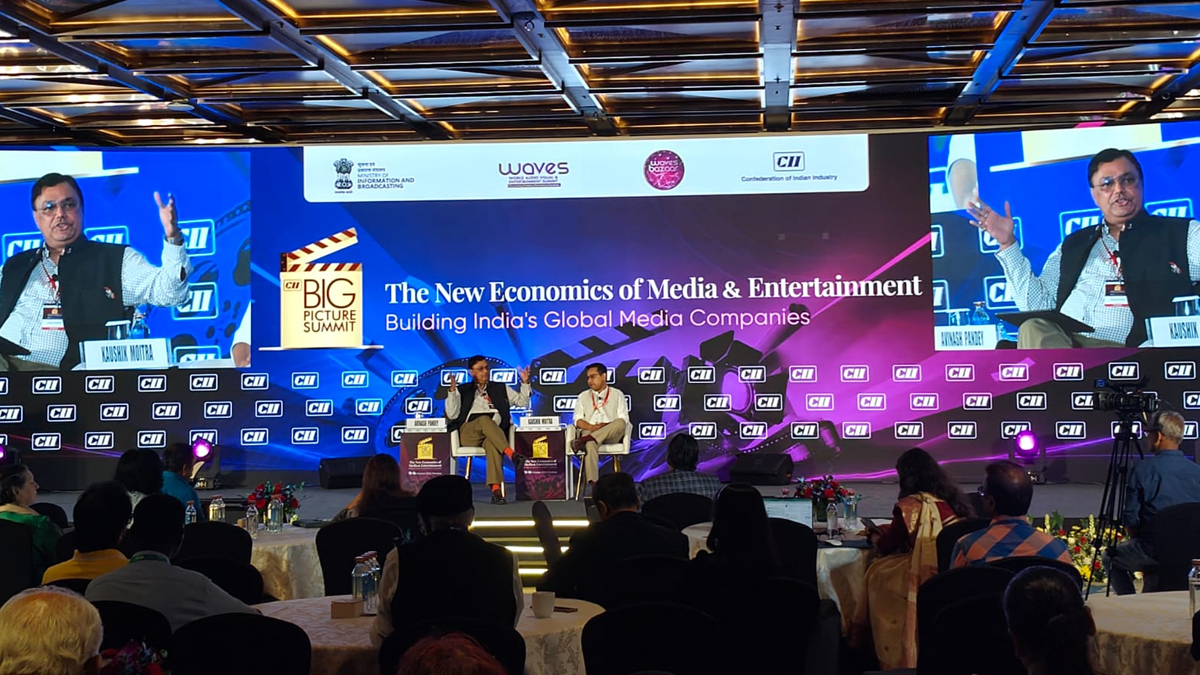
MUMBAI: India’s media industry is rich in stories, but the business of protecting and paying for them remains a story of its own. At the CII Big Picture Summit 2026, Indian Broadcasting and Digital Foundation (IBDF) secretary general Avinash Pandey called for stronger intellectual property (IP) protection, action against content piracy and greater commercial freedom for broadcasters, arguing that the industry needs an enabling government rather than one that dictates its business decisions.
Speaking during the signature session, ‘Who Owns the Audience? Who Owns the Value?’, Pandey highlighted the challenges facing broadcasters in an increasingly fragmented media economy, where content travels across television, digital platforms and informal distribution networks, but the returns do not always reach those who own and create it. The session, moderated by Barucha & Partners practice lead for regulatory and IP Kaushik Moitra, examined who controls the audience relationship and how value is distributed among broadcasters, platforms, distributors and creators.
One of Pandey’s strongest concerns was piracy, which he said was causing financial losses across news, music, films and sports. He pointed to instances of content being made available on Telegram before or around its official release, as well as operators allegedly distributing broadcasters’ signals without authorisation. He also cited pirated streaming services operating through devices sold in markets such as Canada and the United States, including products available through Amazon.
For rights holders, the consequences go beyond lost subscriptions. Broadcasters and producers spend substantial sums acquiring or creating content, only to see unauthorised services make it available without compensating the people who paid for the rights or invested in production.
“Imagine the amount of money that a creative guy is losing, whether it is music, movie, news, sports,” Pandey said, pointing to the cost of acquiring sports broadcast rights while viewers may be able to watch the same content for free through illegal streams.
He argued that India needed a stronger understanding of the economics of piracy, clearer government responses to complaints and more severe penalties for content theft. He also called for a stronger culture of IP protection, saying the ability to establish ownership over an idea was fundamental to attracting investment and allowing creators to monetise their work.
Beyond piracy, Pandey questioned the extent of government intervention in the broadcasting business. Drawing on a principle he said he had encountered during his time at Harvard Business School, he stressed the importance of collaboration between government, educational institutions and private businesses in driving progress.
In his view, the government’s role should be to enable the industry through a supportive ecosystem, research and collaboration rather than dictate commercial decisions. He cited India’s regulation of television channel pricing as an example, arguing that the country was unusual in determining the prices at which individual channels could be offered to viewers.
He also referred to earlier rules governing the number of minutes of advertising that could run on channels, arguing that such decisions should not be the government’s concern. Instead, he suggested that regulators should assess the sector through broader indicators such as consumer access, content consumption and overall industry revenue.
To illustrate his point, Pandey recalled a meeting with former US Federal Communications Commission chairman Ajit Pai, who served during the first Donald Trump administration. According to Pandey, Pai described how his performance was assessed through indicators including the availability of bandwidth to consumers, the volume of content streamed and the sector’s overall revenue.
Pandey said India could adopt a similar approach, with the government focusing on the growth of the media and entertainment sector rather than determining what businesses charge, whom they sell to or how they structure commercial agreements.
He also questioned the requirement for contracts between broadcasters and multi-system operators (MSOs) to be uploaded to a website, arguing that agreements between private parties often contain confidential commercial information. Such requirements, he said, could restrict the freedom businesses need to negotiate and operate.
Pandey also raised concerns about what he described as an uneven regulatory environment for traditional broadcasters and digital platforms. Television businesses must navigate a complex distribution chain involving satellite uplinking, MSOs, direct-to-home operators, headend-in-the-sky (HITS) networks and local cable operators, alongside content-related requirements.
He argued that digital platforms face a different regulatory environment, particularly in relation to content. Broadcasters, he said, must comply with established mechanisms for handling complaints and displaying information about where viewers can raise concerns.
Pandey asked the audience whether they had noticed such complaint information on over-the-top (OTT) platforms, contrasting it with the notices regularly displayed on television news channels. His argument was not that digital platforms should necessarily face more regulation, but that broadcasters should receive comparable treatment and greater commercial and creative freedom.
“I am saying, give the broadcasters the same level playing field, regulate us less, give us more commercial freedom, and give us more creative freedom,” he said.
Pandey maintained that the broadcasting industry had the talent to contribute significantly to India’s media and entertainment ambitions, pointing to filmmakers, actors and television personalities who had emerged from the sector. He said closer collaboration through IBDF and other industry bodies could help build a stronger ecosystem for future growth.
The discussion returned repeatedly to the question of who owns an idea and how that ownership translates into commercial value. Pandey described the protection of intellectual property as a weak area in India, arguing that creators needed greater certainty that their ideas would not be copied before they had an opportunity to develop and monetise them.
He cited a conversation with a representative of Lionsgate at an alumni gathering to contrast the approach he had encountered in the United States with what he described as common practice in India. According to Pandey, creators in the US can register an idea before seeking investment, establishing a clearer basis for ownership and subsequent monetisation.
In India, he argued, ideas are often discussed at industry forums before formal protection is established, leaving room for others to replicate them and creating disputes that ultimately end up in court.
Pandey called for a more structured approach to protecting IP, helping creators secure investment and ensuring that the value generated by content reaches those who own the rights. Such an environment, he suggested, would give investors greater confidence that successful projects could generate returns without prolonged uncertainty over ownership.
The issue also extends to the commercial use of content beyond its original distribution. Pandey cited the use of television programming, films and sports broadcasts in hotels and bars, where content can help attract customers and encourage spending on food and beverages.
He argued that broadcasters should be compensated when content acquired for individual viewing is used commercially to entertain a wider audience. He said the matter was being contested in court, adding that the industry needed to work together to establish fairer arrangements for such use.
The session also brought questions from the audience about the challenges facing filmmakers and independent content creators. One filmmaker argued that India lacked a clear and accessible funding ecosystem for film and documentary production, contrasting it with support structures available in countries such as South Korea and across Europe.
The filmmaker said funding in India could involve a confusing mix of equity and debt, while creators also faced difficulties navigating fragmented and unstructured networks. The audience member cited regional funding arrangements in parts of Europe, including Wales and Scotland, and asked what the government was doing to support Indian creators.
Pandey said Indian films and actors were among the country’s strongest ambassadors abroad, helping shape international perceptions of India. However, he argued that government support should focus on creating conditions in which creators could access funding and protect their IP, rather than directly financing private projects.
He said creators needed an environment in which they could establish ownership of their ideas, attract investors and develop projects without being held back by avoidable administrative and commercial obstacles. Smaller filmmakers and exhibitors, he added, should not be disadvantaged simply because they lack the backing of a large banner.
His response placed the emphasis on enabling private investment, strengthening ownership rights and removing barriers that can make it difficult for smaller players to compete.
The discussion also moved to the changing boundaries of journalism, with an audience member arguing that the growing number of people publishing videos and reels had blurred the distinction between professional journalism and independent content creation.
The participant called for a more structured approach to journalism, saying that creators who follow media ethics can find themselves competing with people who publish material without comparable editorial processes.
Pandey acknowledged the distinction between traditional newsrooms and independent digital content. He said television news typically passes through newsroom processes before publication, whereas individuals can broadcast live from almost anywhere without a comparable editorial filter.
He recalled that the industry had previously approached the government about the possibility of labelling different forms of news content, drawing a comparison with labelling requirements for AI-generated material. However, he said defining what constituted a structured newsroom would be difficult, particularly as individual creators could develop substantial research capabilities and increasingly sophisticated operations.
Pandey rejected the idea of licensing everyone who wished to practise journalism, describing such a move as a potential infringement of freedom of expression. He also referred to the existing system of government accreditation for journalists, which provides accredited journalists access to certain official press events.
He argued that the challenge was global and could not be resolved simply by drawing a rigid line around who could call themselves a journalist. In his view, audiences were capable of assessing competing accounts and forming their own opinions, even in an environment where misinformation and conflicting narratives circulate.
The session concluded with a broader call for stakeholders to work together on issues ranging from piracy and IP protection to commercial freedom and the treatment of content across distribution channels.
Pandey urged the creative community, broadcasters, platforms and policymakers to collaborate in building an ecosystem that supports content creation and ensures that commercial exploitation is matched by fair compensation.
Moitra also stressed the importance of collective action, suggesting that the industry should approach the government with a shared agenda rather than leave individual businesses to tackle structural problems on their own.
The central question of the session who owns the audience and who captures the value therefore extended beyond audience measurement or platform economics. It touched on the rights of creators, the bargaining power of distributors, the rules governing broadcasters and the ability of Indian media businesses to turn creative output into sustainable revenue.
For Pandey, the answer begins with stronger IP protection, a tougher response to piracy and a regulatory framework that enables the industry to grow without unnecessarily constraining its commercial and creative choices.