News Broadcasting
Get set for 9/11 anniversary coverage bombardment on news channels


The anniversary of the most significant event of last year “9/11” (11 September) is a few days away and all the news channels are gearing up for it. The picture is different though on the non-news Indian channels which do not see the event as being part of their priority list. When contacted by indiantelevision.com, big broadcasters like Star and Zee said that as of now no specials had been lined up. Contrast this with the situation in the US with the four blind mice of American television NBC, CBS, FOX and ABC unveiling plans over a month in advance.
 |
A Delhi based producer who does news and current affairs based programming for one of the news channels does not think that the 9/11 anniversary should be hyped up by Indian channels as the event is too US-centric.
He says, “Have US channels done much or anything on Indian disasters‘ anniversaries? What about tragic events like the Bhopal gas tragedy? It‘s also to be seen what channels like CNN and BBC do on 13 December, a year after the heinous attack on the Indian parliament or does it at all find mention in their news bulletins.”
That is one argument. The fact is that all the news channels are keyed up and ready to go as far as the event is concerned. As far as the “purely Indian” channels are concerned, both 24-hour Hindi news channels Zee News and Aaj Tak are putting together programming for the day. The focus for Aaj Tak will be on how life as changed one year after the attack on America. Zee News has 50 special packages planned.

 |
Star News, for which NDTV provides content, is covering 9/11 through a feed from promoter Rupert Murdoch‘s Fox Network while CNBC India will get its from the parent NBC Network.
While not many ads are expected to be seen in the global feed, it will be business as usual with full commercial time in India. “There will be ads because it is not breaking news,‘‘ Haresh Chawla, CEO, CNBC India, has been quoted as saying. Chawla says the whole day would be devoted to 11 September and its impact on business in India.
It is not surprising to see though, that a bulk of the programming load in India is being done by the likes of BBC World, CNN, Discovery and National Geographic.
CNN‘s concentration is on the ceremonials being performed within the US. The documentaries airing also focus on the country and foreigners are only tackled as to how living in the US has changed for them. BBC‘s coverage however, has a more global focus. It takes into account what the sentiment of people residing in Kabul, Jerusalem, Cairo are like.
 |
Discovery‘s coverage is perhaps the most varied and interesting of the lot. Through a series of specials it examines different kinds of terrorism – be it religious or backed by the state, so that the viewer gets an overall perspective of the evolution of this kind of activity.
National Geographic moves on a different track altogether. The focus of its coverage is on how dogs played a crucial role in rescue efforts in the aftermath of 9/11, sniffing out survivors trapped beneath the rubble and helping relief teams dig out the dead.







News Broadcasting
News18 India launches Command Centre war explainer with Arya
New show shifts from debates to decoding global conflicts and impacts
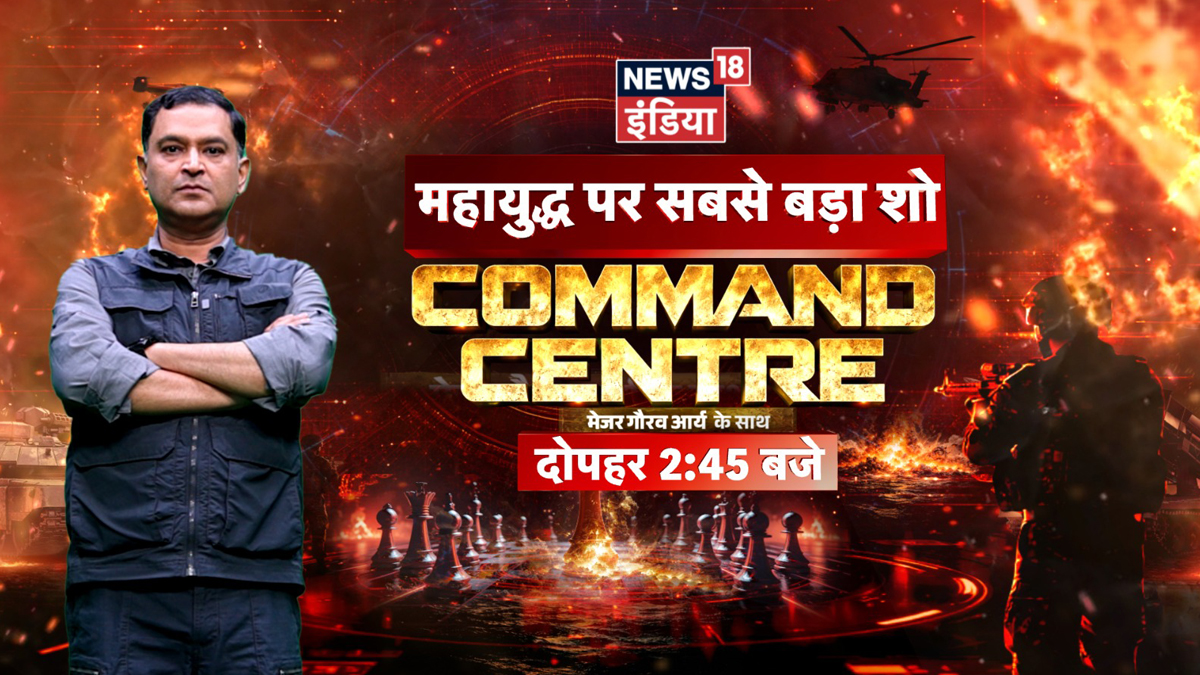
MUMBAI: News18 India has rolled out a new war-focused programme, Command Centre, featuring Gaurav Arya, as it looks to offer viewers a sharper, more grounded take on global conflicts amid rising tensions in West Asia.
Positioned as an “insider war room”, the show moves away from conventional panel debates and instead focuses on explaining military developments, decoding strategy and connecting global events to their everyday impact, from fuel prices to economic shifts.
The format leans heavily on visuals and data. The studio has been designed like a command hub, complete with large LED war maps, real-time graphics and an alert system to track developments as they unfold.
At the centre of it all is Arya, who brings his military background to simplify complex war strategies for viewers. His signature line, “Seedhi baat samjhiye”, anchors the show’s promise of clarity over noise.
News18 India managing editor Jyoti Kamal said, “Command Centre, featuring Major Gaurav Arya is designed to deliver accurate insights and a clear perspective on how evolving conflicts impact everyday life, from household budgets to national security. With expert voices analysing every development in real time, the show goes beyond headlines to decode what’s happening now, what it means, and what could come next.”
Echoing the intent, Gaurav Arya added, “In times of war, confusion is the biggest threat. With News18 India’s Command Centre, we are bringing viewers inside the war room, decoding strategies, tracking every escalation, and explaining, in the simplest terms, what it means for India and for every household. Seedhi baat samjhiye, this is where you understand not just what is happening, but what happens next.”
The weekday show will air in the afternoon slot and will also feature Gaurav Shukla, adding to its editorial depth.
With its mix of analysis, visuals and a clear focus on impact, the show reflects a broader shift in news consumption. Viewers are no longer just watching events unfold, they are looking to understand what those events mean for them.







