News Broadcasting
Disruptions are a necessary evil


CANNES: We live in times of fast changing technology where more often than not, the only way to keep pace is to unlearn what we’ve just learnt and re-adapt ourselves to the transformation.
Exactly the point Deluxe Media Europe senior director, sales and business development Darren Baker was trying to drive home when he said: “Every time you think you have learnt everything, you have to adapt and learn again. The need is to adapt quickly and learn again.”
Baker was addressing a gathering at Verriere Grand Audi Level one at the Palais on day two of Mipcom.

“The important thing is to learn quickly and react to the disruption,” he further stressed.
Referring to cinema, TV, VCR, DVD, BluRay and now VOD as techniques used for disruptions, Baker said that while the disruptive nature of some technological shifts was immediately evident, in other cases, it became clear only through tracking the patterns of adoption.
Speaking of one too many portals in the content supply chain, he said: “The consumer wants the content, the content provider wants to provide the content and the portals are ready to carry them. But then there are too many contracts. There needs to be a disruption here.”
Not just portals, he also pointed out that there are just too many schemes and updates. “By the time the consumer is happy that they have got all the programmes, the portal updates its software and the consumer has to change the entire system yet again,” he said.
In his view, the proliferation of vendors too posed a problem. “If you have a large number of vendors, you should reduce them,” he advised buyers.
Offering his take on successful disruptions, he said: “There is a need for constant improvement in every company. A fresh approach is always welcome and refreshing the digital policy every few months also helps,” adding that with every four year old ignoring television and moving towards mobile and social media, “companies need to be open to disruptions”.






News Broadcasting
Network18 channels lead YouTube news viewership in March 2026
CNN-News18, News18 India and CNBC channels top categories with record views
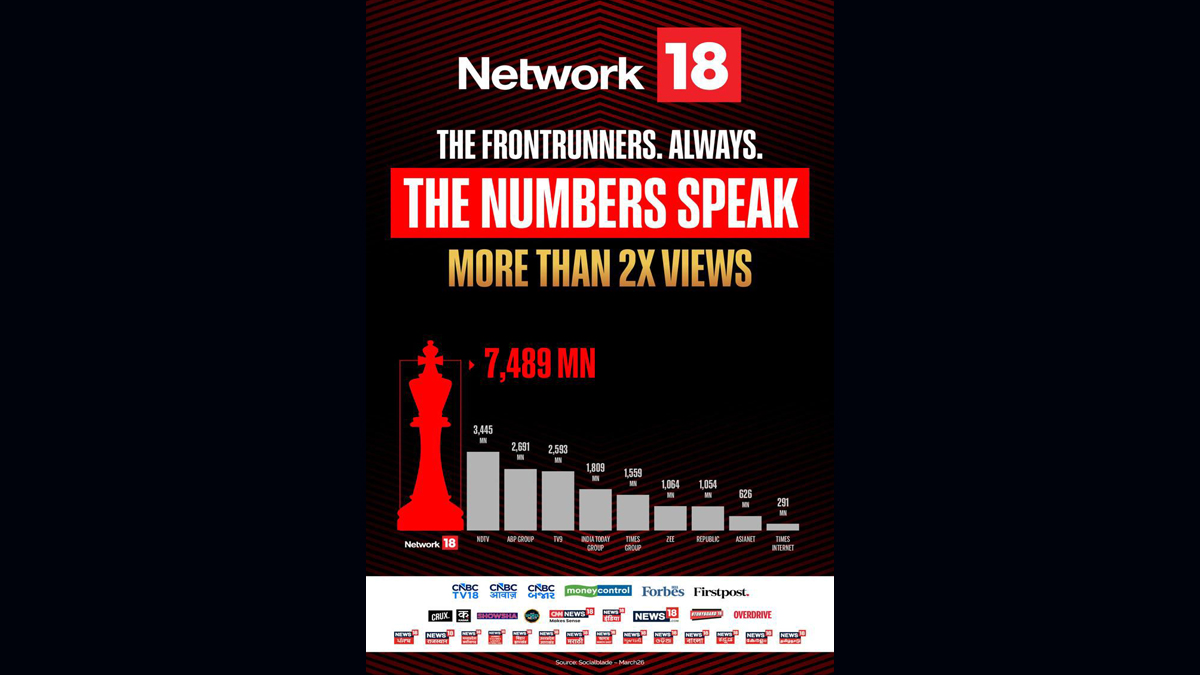
MUMBAI: When the world hit refresh on breaking news, Network18’s channels were already streaming ahead. As geopolitical tensions and war-driven headlines fuelled a surge in global news consumption, the network’s digital playbook delivered big clocking record Youtube viewership across English, Hindi and business news categories in March 2026.
At the forefront was CNN-News18, which emerged as the clear leader in the English news segment with 130 million live and video-on-demand views. The channel edged past competitors such as Times of India (126.5 million), Times Now (101.1 million), India Today (88.2 million) and NDTV (77.5 million), according to Databeings data for March.
In the Hindi news arena, News18 India delivered a commanding performance, racking up a staggering 3,297 million views on YouTube. The channel comfortably outpaced NDTV India, which recorded 3,119 million views, underlining its deep reach and consistent engagement with mass audiences, as per Playboard data.
The network’s dominance wasn’t confined to general news. In the Hindi business segment, CNBC Awaaz topped the charts with 92 million views, narrowly ahead of Zee Business (90 million) and well ahead of ET Now Swadesh (57 million). Meanwhile, its English counterpart CNBC-TV18 posted a strong 58 million views, reinforcing the network’s cross-category strength.
The spike in viewership reflects a broader shift in audience behaviour, with viewers increasingly turning to digital platforms particularly Youtube for real-time updates and in-depth coverage during high-intensity news cycles. For Network18, the numbers signal more than just scale; they underline the effectiveness of a multi-platform strategy that blends speed, credibility and continuous coverage.
In a month where the news never paused, it seems viewers chose to stay tuned where the stream never stopped.






