
Hardware
SEMICON India Day 2 records 25 semiconductor deals and collaborations
12,000 visitors join 600 plus exhibitors as India deepens semiconductor push


MUMBAI: The chip is no longer just on the drawing board, with SEMICON India 2026 turning its second day into a busy circuit of deals, collaborations and technology announcements. Day 2 of SEMICON India 2026 saw 25 announcements and partnerships spanning semiconductor manufacturing, materials, logistics, chip design, advanced packaging, power electronics and workforce development, as India’s semiconductor ambitions moved further from plans towards products and production.
The event, being held at Yashobhoomi in New Delhi until 19 September, drew nearly 12,000 visitors on its opening day, with most coming from the industry. The exhibition features more than 600 exhibitors, including around 300 international companies, while the overall event is expected to attract around 50,000 visitors from 52 countries. It also features more than 400 executives, over 150 speakers, six country pavilions and 12 state booths, alongside a Startup Pavilion, Innovation Showcase, Student Hackathon and Workforce Development Pavilion.
Addressing the media, Union Minister for Electronics and IT Ashwini Vaishnaw said participation was even stronger on the second day, with substantial business-to-business engagement, agreements being concluded during meetings and strong attendance at the conference sessions.
Country participation has also widened, with more than 30 companies each from Japan and Singapore taking part in their respective pavilions, alongside companies from South Korea and European countries including Belgium, the Netherlands and Sweden.
Vaishnaw said the participation reflected growing global interest in expanding semiconductor-related activity in India, while investment discussions at the event indicated that companies were looking at scaling their commitments based on their ability to execute projects.
The supply chain was one of the major themes, with the India Semiconductor Mission signing an MoU with Nippon Express Holdings to strengthen semiconductor logistics infrastructure covering logistics, warehousing, customs and related supply-chain requirements.
Tata Electronics also announced a series of collaborations. Its partnership with INOX Air Products will focus on locally sourcing high-purity gases, while its agreement with Sumitomo Chemical will work towards domestic production of high-purity wet chemicals and advanced materials for front-end semiconductor manufacturing.
With Kelington Engineering, Tata Electronics will work on gas distribution systems, high-purity piping and process-tool hook-up for fab readiness, including training local partners. Its agreement with Enomoto will target advanced packaging through joint R&D and localisation of lead-frame manufacturing.
C-MET Pune and Hindalco Industries will work on scaling critical raw materials for semiconductors, while Tata Electronics and L&T Semiconductor Technologies will explore manufacturing L&T semiconductor products at Tata’s fab and OSAT facilities, beginning with consumer-grade camera modules.
Power electronics also took centre stage. MeitY, the Ministry of Power and POWERGRID will work on indigenising Silicon Carbide power modules for Voltage Source Converter-based HVDC transmission systems, with a pilot planned at POWERGRID’s 1,000 MW Pusauli project in Bihar.
L&T Semiconductor Technologies announced collaborations with Virtual Forest for power electronics solutions for air-conditioning and solar-powered systems, Newen Systems for Silicon Carbide power modules for renewable energy systems and AI data centres, and Fimer India for Insulated Gate Bipolar Transistors for renewable energy applications.
It will also work with Capital Power Systems on IoT modules for smart meters, beginning with an indigenous 4G communication module.
Deep-tech funding and skills formed another major strand of the day’s announcements. The India Deep Tech Alliance reported investments of $263 million across 56 Indian deep-tech companies.
SEMI and IDTA will develop the India Semiconductor Academy, an industry-led national skilling platform with partners including Cadence, CG Semi, Dixon Technologies, Micron Technology, Synopsys, 3D Glass Solutions, UC San Diego and IIT Kanpur.
NIELIT signed agreements with Siemens EDA for semiconductor design education, Tata Electronics for developing an industry-ready ATMP workforce, Singapore Polytechnic International for semiconductor education and India-Singapore cooperation, and IESA, as well as SEMI University, for workforce development, training and certification.
NIELIT and SCL also launched an indigenous 0.8-micron open-source Process Design Kit on the NIELIT eChipHub platform, aimed at widening access to chip design for students and innovators.
On the manufacturing side, Kaynes Semicon and IndieSemiC announced an OSAT collaboration covering qualification, assembly and testing of QFN and BGA advanced packages, along with customised SiP development. Kaynes Semicon, Microchip Technology and GridCrest Technologies will explore an end-to-end India pathway for energy-metering SoCs, while Kaynes Semicon and United BC Team will develop a phased roadmap for advanced intralogistics and lights-off semiconductor manufacturing.
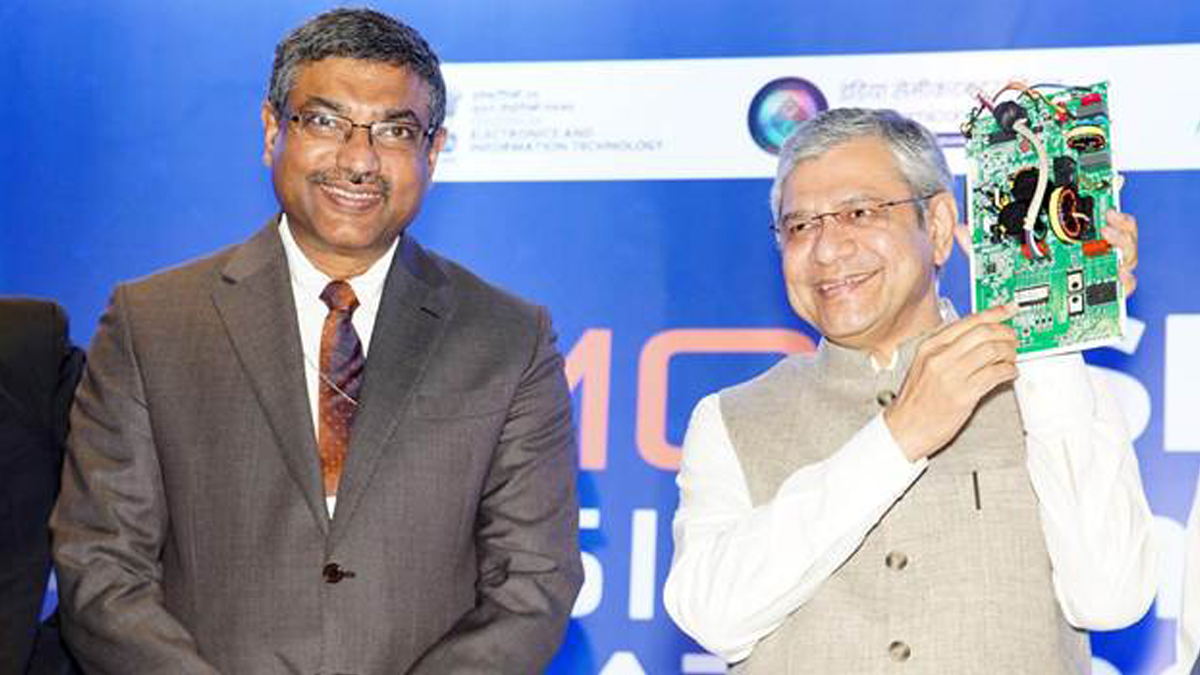
IndieSemiC and C-DAC meanwhile launched the ISC-VEGA-SOM, described as India’s first indigenous System-on-Module. It integrates C-DAC’s VEGA Thejas32 processor with IndieSemiC’s globally certified LoRa-RF module and was developed under C-DAC’s Industry Support Centre initiative.
The announcement was highlighted by Vaishnaw as an example of Indian chip design moving towards commercial products, with semiconductors developed in the country beginning to make their way into final products.
The final collaboration of the day saw Silvaco and C-DAC’s ChipIN Centre agree to provide advanced TCAD tools to DLI-onboarded startups and MSMEs, alongside C-DAC research and training initiatives.
Sustainability also made its way into the semiconductor conversation. Vaishnaw highlighted extensive water recycling in semiconductor fabs and closed-loop cooling systems in data centres as examples of resource-efficient infrastructure that will become increasingly important as both industries scale.
Taken together, the 25 announcements covered everything from gases and chemicals entering the fab to chips, packaging, logistics, power systems and the people needed to build them. With the event bringing together more than 600 companies, 52 countries and a projected 50,000 visitors, SEMICON India 2026 is putting India’s semiconductor story on a much larger circuit.






