Hardware
A study to understand the low offtake of Set-Top-Boxes in Chennai


TV Pulse 2005, the annual research initiative put together by the Joint Industry Body (JIB) and Tam Media, series continues with the paper – A study to understand the low offtake of Set-Top-Boxes in Chennai. The paper has been put together by IMRB-PQR and TAM Media Research.
Chennai became the first city to implement the Conditional Access System (CAS) in September, 2003. However, the phenomenon has still not caught on in the city with the penetration of the Set Top Boxes (STB) still reeling at 2-3 per cent mark.

Being a market in which over 70 per cent of viewership is accounted for by free to air (FTA) channels. Chennai was also a market that had the least potential of getting affected. TAM Media Research had come out with its views on how the CAS phenomenon would affect TV viewing behaviour in the city just before CAS came into effect.
Similarly, post the implementation of CAS, there was a need to understand the ef fect of CAS on TV viewing behaviour and reasons for the low penetration of STBs in the Chennai market.
Research Objectives
Understanding the reasons for the low offtake of STBs in Chennai and exploring the reasons for the same
Understanding the viewing experience of households that purchased STB
Research Methodology
Qualitative: A study done by Probe Qualitative Research (PQR), IMRB using Focus Group Discussions
Findings
The entire purchase process was studied through the qualitative study done by IMRB PQR to understand the elements that went behind the investment and the postpurchase reactions.
STB Purchase process
First Reactions Consideration Trigger Purchase Post Purchase
First Reactions
The general reaction on display from all the family members was that of restriction as a result of channel choices getting limited to only the FTA channels.
“I felt really bad. Most of my channels were gone”.
The pinch of an extra investment and further monthly outgo for subscription for favourite channels was felt most by the decision makers in the family.
“We have to pay 500 and the channels can even increase their cost. It is costly.”
“We have been made the guinea pigs for the CAS experiment. We have to shell out the hefty sum”
Consideration
The promoters of the decision to buy the STB were youngsters while the fathers were procrastinating the purchase consideration as they wanted to adopt a wait & watch policy The question lingering in the minds of the CWE (Chief Wage Earner) was “What if CAS is rolled back”? The mothers in the families were largely indifferent as most of the popular Tamil general entertainment channels were FTA. However, the disappointment of not having access to certain pay channels among youngsters & the elder males was elicited clearly though the following statements:
“We lost complete interest in watching TV” (Youngsters)
“Serials are there in other channels also… so wives did not miss much … But for us, all was gone” (Men)
Trigger
The most obvious trigger was to restore the original TV viewing dynamics and the youngster exerted pressure on their parents to buy the STB
“Children were creating too much of fuss” “Children kept asking for NGC”
Purchase
The purchase decision was left largely to the CWE/father in the family The CWE in most cases believed that the best source for buying the STB was the cable operator himself.
“He knows the best … he has been in this line for so many years now”
The decision makers were not aware about any of the brands of STB existing in the marketplace.
“In this these are no brands”
However, there was a clear recollection of various channel packages offered from most of the decision makers.
“You have to decide which package will be suitable … there is platinum, gold, silver , different areas have different packages”
The main concerns raised while evaluating the purchase were related to the quality and ease of service
“We were worried that what if it does not give us the channels?”
“What if the picture quality is bad?”
“Will it be complicated to operate” (Women)
Post purchase
A sense of relief was observed amongst households that bought the STIB and the respondents, especially the males also mentioned about the enhancement in viewing experience in terms of picture qual ity and transmission.
“What was taken away is now back. We are able to see what we like”.
“The picture quality is better No grains … natural finish”.
The women who were largely apprehensive about the process of operating the new remote for the STB were also found quick to adjust to the new mechanism.
“Children have taught us, and it easy now.
The key post purchase reaction:
Contrary to Popular belief, there was a clear lack of peer pressure. This came across from various FGDs (Focused Group Discussions) as consumers felt that they were being made the guinea pigs for the experiment and the stance of the government on the CAS policy may rolled back anytime, making their investment futile. Therefore, the reaction was one of getting ridiculed by the peers and this acted as a deterrent to the STB of f take in the city.







Hardware
India clears Rs 1.6 lakh crore semiconductor projects under Semicon India
Ten projects cleared as production begins and design ecosystem gathers pace
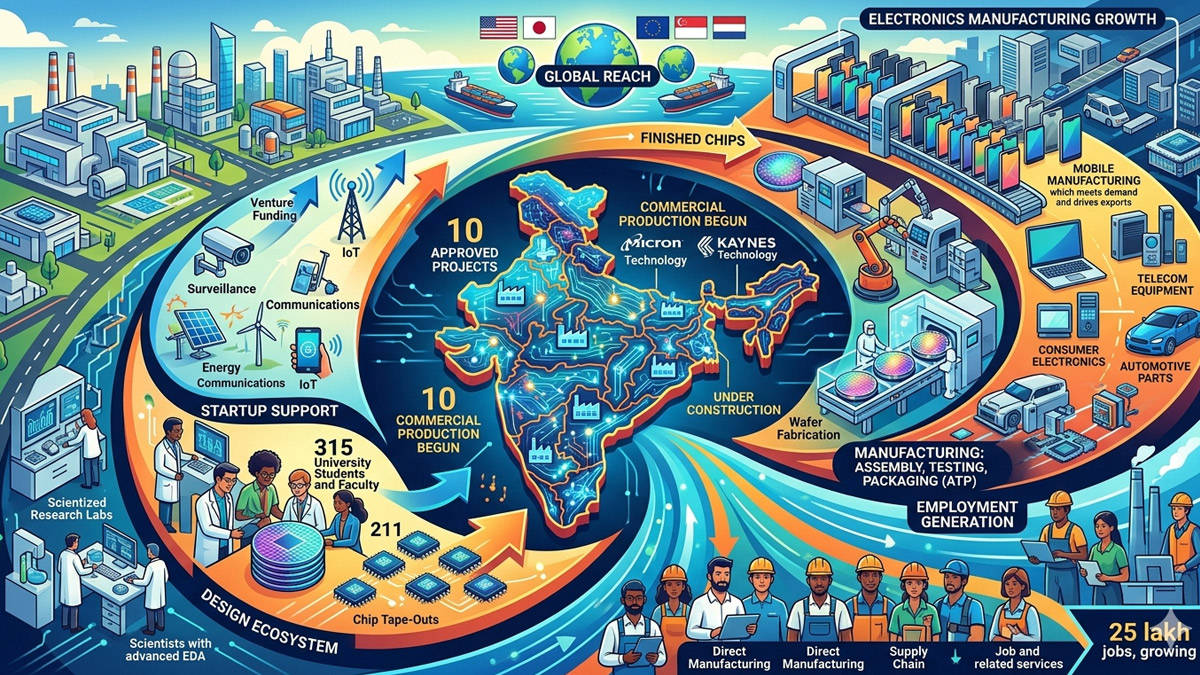
NEW DELHI: India’s push to become a global electronics powerhouse is gaining momentum, with the Semicon India Programme driving the creation of a full-fledged semiconductor ecosystem from design to manufacturing.
Launched in 2022, the programme aims to build capabilities across the entire value chain, including chip design, fabrication, assembly, testing and packaging. In just four years, the government has approved 10 semiconductor projects with a combined investment commitment of around Rs 1.6 lakh crore.
Two of these facilities have already begun commercial production, including units led by Micron Technology Inc. and Kaynes Technology India Limited. Two more plants are expected to go live later this year, signalling that India’s chip ambitions are moving from blueprint to factory floor.
The broader electronics manufacturing story has also seen sharp growth over the past decade. Production has jumped from roughly Rs 1.9 lakh crore in 2014-15 to about Rs 12 lakh crore in 2024-25, while exports have surged nearly eightfold. Mobile phone manufacturing, once heavily import-dependent, now meets almost all domestic demand and has become a major export driver.
Alongside manufacturing, the government is investing heavily in design capabilities. Through access to advanced chip design tools provided free to 315 universities, students and researchers have clocked over 200 lakh hours of usage. This effort has already resulted in 211 chip tape-outs from 75 institutions.
Support for startups is also picking up pace. Twenty-four chip design projects have been approved, targeting sectors such as surveillance, energy, communications and IoT. Of these, 14 companies have collectively raised over Rs 650 crore in venture funding, while several designs have progressed to fabrication, including at advanced nodes.
To strengthen supply chains, India has also signed semiconductor cooperation agreements with countries including the United States, Japan, the European Union, Singapore and the Netherlands. These partnerships aim to reduce global dependencies while boosting domestic capabilities.
The employment impact is equally significant. The electronics sector now supports an estimated 25 lakh jobs, with mobile manufacturing alone accounting for nearly half. As more semiconductor units come online under the India Semiconductor Mission, indirect job creation across supply chains is expected to rise further.
Sharing these updates in Parliament, Ministry of Electronics and Information Technology minister of state Jitin Prasada underscored the government’s focus on building a resilient, end-to-end semiconductor ecosystem.
With factories taking shape, designs moving to silicon and investments flowing in, India’s semiconductor story is steadily shifting gears from ambition to execution.






