Satellite Launches
Skyroot’s Vikram-1 lifts off, marking India’s private space milestone
Mission Aagaman launches India’s first private orbital rocket with six payloads aboard



MUMBAI: The countdown paused, but India’s private space ambitions did not. After a brief hold just minutes before launch, Skyroot Aerospace’s Vikram-1 thundered into the skies from the Satish Dhawan Space Centre in Sriharikota, ushering in a landmark chapter for India’s commercial space industry and signalling the country’s growing ambitions in the global launch market.
The 22-metre-tall rocket lifted off at 12.05 pm on Saturday, July 18, after engineers resolved a temporary pause in the final stages of the countdown. Around 10 minutes before the scheduled launch, Vikram-1 had entered its Automated Launch Sequence (ALS), during which onboard software independently monitors every system and executes the countdown through to ignition. However, with just five minutes remaining before lift-off, Skyroot announced a planned hold to carry out additional checks.

The Automated Launch Sequence was later restarted, paving the way for a successful launch that marked the maiden flight of India’s first privately developed orbital launch vehicle.
Developed by Hyderabad-based Skyroot Aerospace, Vikram-1 is the first orbital-class rocket to be completely designed, developed and launched by an Indian private company. Named after Dr Vikram Sarabhai, the father of India’s space programme, the vehicle represents a major milestone in the country’s efforts to open the space sector to private enterprise.
The launch, aptly named Mission Aagaman—meaning arrival—symbolises the arrival of India’s private sector in the highly competitive global satellite launch business. While ISRO has built India’s reputation as a leading spacefaring nation over the past five decades, Vikram-1 marks the beginning of a new era where private companies will increasingly play a role in developing launch vehicles and offering commercial launch services.
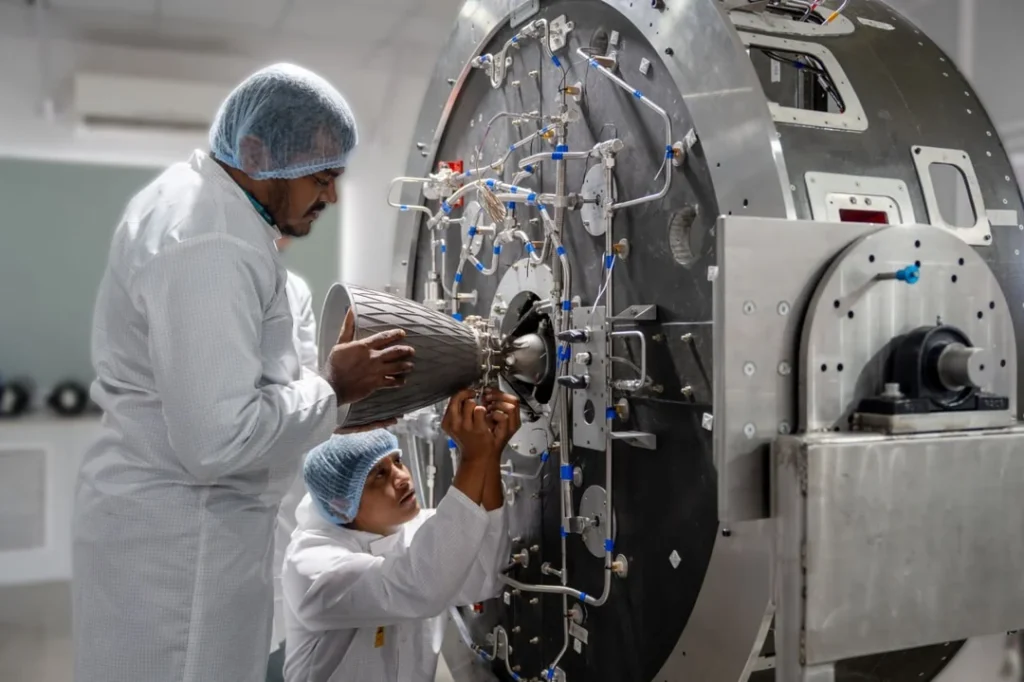
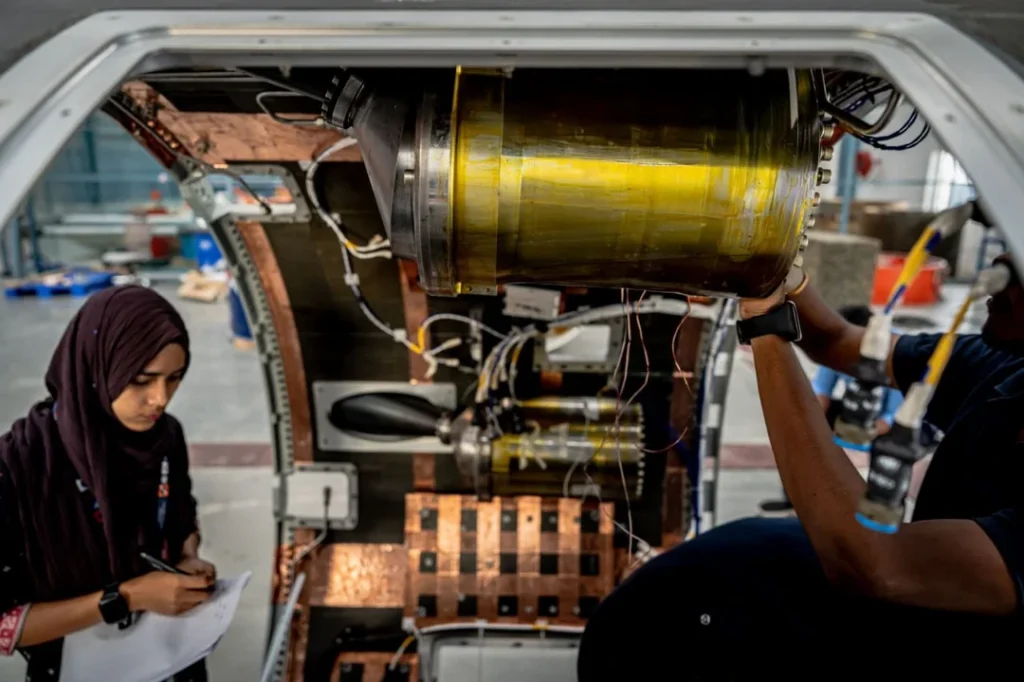
Built with an all-carbon composite structure, Vikram-1 incorporates several technologies developed entirely in-house by Skyroot. The vehicle is powered by 100 per cent 3D-printed engines, high-thrust solid-fuel rocket boosters, and an advanced liquid Orbital Adjustment Module, reflecting the company’s focus on reducing manufacturing time while improving efficiency and reliability.
Standing 22 metres tall with a diameter of 1.7 metres, Vikram-1 has been designed to carry payloads weighing up to 350 kg to Low Earth Orbit (LEO). For its maiden mission, the rocket is targeting an orbit of 450 kilometres with a 60-degree inclination.
Unlike a commercial satellite deployment mission, Mission Aagaman is primarily a technology demonstration flight. Its objective is not only to achieve a successful lift-off and safe tower clearance but also to validate every critical subsystem during flight. The mission will progress through 14 separate flight phases over 15.46 minutes, generating valuable performance data that will help Skyroot refine the vehicle before commencing routine commercial launches.
The rocket carried six technology demonstration payloads, reflecting the growing ecosystem of India’s private space industry. These include Solaras from Grahaa Space, Embrace from Cosmoserve Space, SCOPE, developed by Skyroot Aerospace itself, and uD3PP and mD3RN from Germany’s Dcubed. The payload manifest also includes “Cosmic Bloom”, an artwork created by Cosmos Diamonds, and a micro-art tribute by Ajay Kumar Mattewada, highlighting the increasing convergence of science, technology and art in space missions.
Adding a symbolic touch to the mission, Vikram-1 also carried a handwritten postcard from Prime Minister Narendra Modi, along with hundreds of postcards sent by well-wishers from across the world, turning the flight into a celebration of India’s expanding space aspirations.
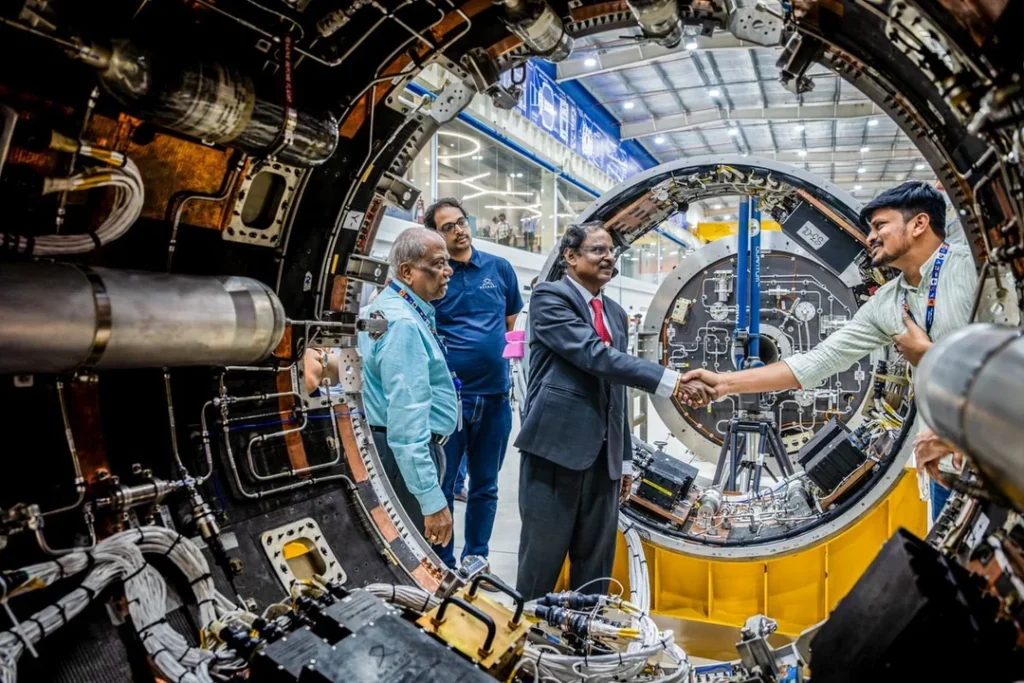
Before the launch, Skyroot received launch authorisation from the Indian National Space Promotion and Authorisation Centre (IN-SPACe), the regulatory body established to facilitate and oversee private participation in India’s space sector. The company confirmed that all stages of the vehicle had been successfully integrated and stacked on the launch pad, while comprehensive vehicle checks, telemetry tests and tracking radar interface validations had also been completed.
Speaking ahead of the launch, Pawan Kumar Chandana, Co-founder and Chief Executive Officer of Skyroot Aerospace, described the mission as the culmination of years of engineering and testing. He noted that although Vikram-1 had undergone exhaustive ground testing, only an actual flight could validate how the rocket performs under real-world conditions. The data gathered from Mission Aagaman, he said, will be instrumental in improving future vehicles and establishing a higher launch cadence.
Mission Aagaman also marks Skyroot’s second major milestone after Vikram-S, which became the first private rocket to reach space from Indian soil during a successful suborbital mission on November 18, 2022. Building on that achievement, the company plans to undertake one or two more orbital demonstration missions before transitioning to full-fledged commercial launch operations.
Vikram-1 itself represents several technological firsts for India. It is the country’s first privately developed orbital launch vehicle, the first all-carbon composite orbital rocket, the first orbital vehicle powered by a fully 3D-printed engine, and features India’s longest monolithic carbon-composite rocket stage. It also incorporates ultra-low-shock pneumatic stage separation systems, a technology designed to minimise stress on satellites during deployment.
The launch also carries historical resonance. It took place exactly 46 years after India’s landmark SLV-3 mission, which successfully placed the Rohini (RS-1) satellite into orbit from the same launch site on July 18, 1980. That mission made India the sixth nation capable of launching satellites into orbit independently. Nearly half a century later, Vikram-1 marks another watershed moment this time demonstrating that India’s space ambitions are no longer driven solely by government agencies but increasingly by a vibrant private sector determined to compete on the global stage.
For Skyroot Aerospace, Mission Aagaman is more than just a rocket launch. It is a proving ground for indigenous technology, a stepping stone towards commercial launch services, and perhaps most significantly, a sign that India’s private space race has truly left the launch pad.