Jobs
Women saw higher wage growth than men in 2025: Govt data
Salaried, casual and self-employed women still earn far less than men despite stronger income growth, government data shows


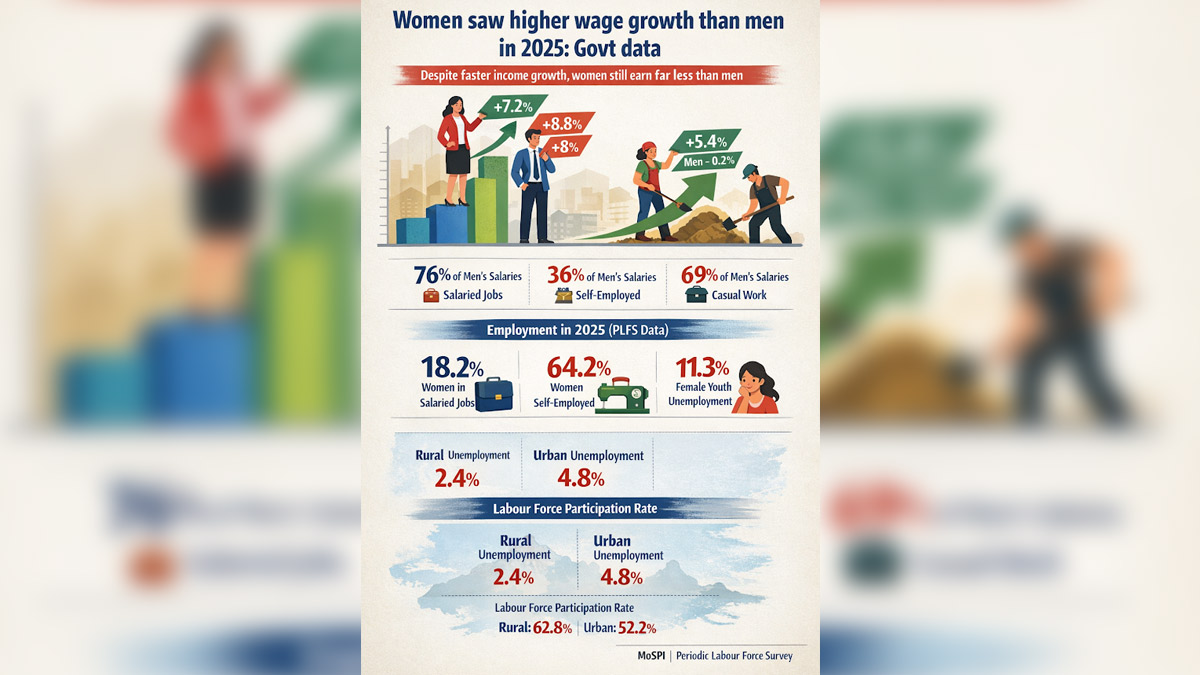
New Delhi: Women in India saw faster wage growth than men across most job categories in 2025, but the gender pay gap remains stubbornly wide, according to the latest Periodic Labour Force Survey (PLFS) released by the government.
Data from the Ministry of Statistics and Programme Implementation (MoSPI) shows women’s earnings rising across the board:
- Salaried jobs: up 7.2 per cent versus 5.8 per cent for men
- Self-employment: up 8.8 per cent versus 8 per cent for men
- Casual labour: up 5.4 per cent while men’s earnings fell 0.2 per cent
Despite the gains, women still earn only 76 per cent of men’s salaries in salaried roles, 69 per cent in casual work, and just 36 per cent in self-employment, highlighting persistent structural disparities.
The survey also shows a slow shift towards better-quality work. The share of women in salaried jobs rose to 18.2 per cent in 2025 from 16.6 per cent, while self-employment dropped to 64.2 per cent. Casual labour edged up slightly to 17.6 per cent. Overall salaried employment increased to 23.6 per cent of total employment from 22.4 per cent.
Rural unemployment dipped to 2.4 per cent, urban unemployment to 4.8 per cent, and youth unemployment fell to 9.9 per cent, though female youth unemployment rose to 11.3 per cent. Labour force participation remained mixed, with rural LFPR declining to 62.8 per cent and urban LFPR steady at 52.2 per cent.
The government estimates 616 million people were employed in 2025, including 416 million men and 200 million women.
A slowdown in the informal economy adds pressure, with wage growth at 3.9 per cent, new establishments dropping to 5.85 million, and job creation falling to 7.45 million. Since many women work in informal and self-employed segments, this leaves them exposed to income volatility and limited social protection.
Faster earnings growth may help households, but the pay gap and concentration in low-paying roles continue to restrict women’s financial independence. The slow rise in salaried employment is a silver lining, offering potential for stable incomes and formal benefits.