Education
Skills that click: How innovation contests are switching on student ingenuity beyond India’s metro hubs
From Baramulla to Bhiwadi, design thinking is helping students solve real problems, one bright idea at a time


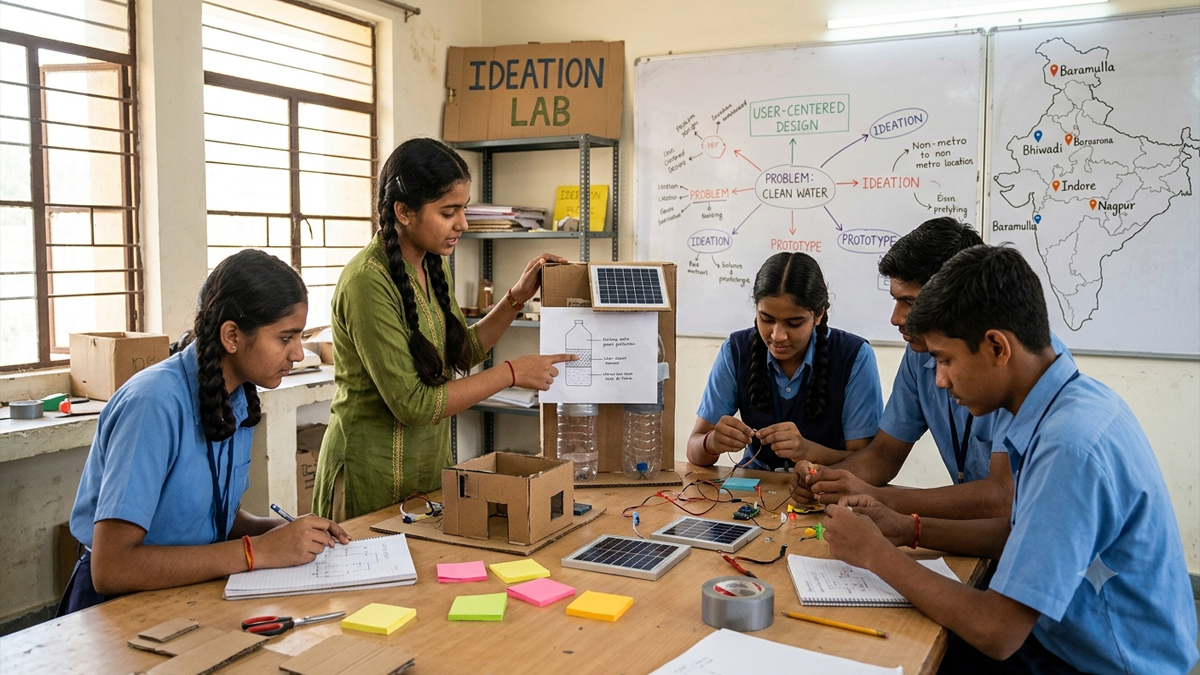
NEW DELHI: India’s innovation story is no longer confined to its big-city postcodes, and that is sparking some seriously clever thinking. As design competitions and innovation programmes travel further from the country’s traditional startup hubs, students in smaller towns and cities are getting hands-on with design thinking, picking up skills that go well beyond a single project or prize. The shift is turning classrooms into idea labs, and the results suggest a generation of young innovators is learning to think like problem solvers first and inventors second.
Here are five skills now taking root in this expanding ecosystem.
- Human centric problem solving
Good innovation starts with listening, not building. At Government Degree College, Baramulla, student Zamin Anayat Lone learned this firsthand while working through the empathise and define stages of the design thinking process. By closely examining gaps in emergency response systems and the everyday needs of her community, she shaped the idea for an AI-powered SOS application, one rooted in a clearly understood problem rather than a flashy concept.
- Applying STEM to real world challenges
Innovation challenges give students a chance to test classroom theory against real-world mess. At MSME Technology College, Bhiwadi, Veeru Kumar Verma looked at how artificial intelligence and real-time data systems could ease parking woes in fast-growing towns, a neat reminder that STEM has plenty to offer civic life, not just labs and lectures.
- Entrepreneurial thinking
Bright sparks rarely turn into real ventures without a nudge from mentors and a few honest trial runs. For Mohammad Atif of Kongu Engineering College, Erode, entrepreneurship stopped being a textbook chapter and became a structured, step-by-step process, thanks to consistent mentorship and the chance to stress-test his ideas.
- Collaborative mindset
Two heads, it turns out, really are better than one. At New Era School, Ghaziabad, students Disha Garg and Rashi Sharma worked through empathy mapping and stakeholder analysis together to develop an AI-enabled application for India’s digital delivery ecosystem. Their experience underlined a simple truth: solutions built on shared perspectives tend to hold up better than ones built alone.
- Purpose driven innovation
Perhaps the most valuable lesson design thinking teaches is restraint, chasing relevance over reinvention. At Shoolini University, Solan, Class XII student Mahek focused squarely on solving one specific community challenge rather than reaching for an abstract, attention-grabbing idea.
A wider shift in India’s innovation story
Together, these examples point to something bigger than five individual projects. India’s innovation ecosystem is gradually moving from simply encouraging participation to nurturing long-term problem-solving ability. Structured programmes across the country are increasingly pairing design thinking with sustained mentorship, giving students the support they need to take promising ideas further than a classroom presentation.
One such initiative is Samsung Solve for Tomorrow, which is running design thinking workshops across 100 cities in 2026. The programme introduces students to human-centred problem-solving before selecting standout teams for structured mentorship to refine and develop their ideas further.
With Samsung marking 30 years in India, the company says it is scaling up the programme’s ambition, reaffirming its long-term commitment to the country’s innovation journey and the broader vision of #DigitalIndia.
As these stories show, India’s next wave of innovators may not all come from its biggest cities, but increasingly, that hardly seems to matter.