Education
24.69 crore students and a 58.4 per cent enrolment gap: NITI Aayog’s latest report worry policymakers
14.71 lakh schools, 24.69 crore students and a 2047 vision shape reform roadmap

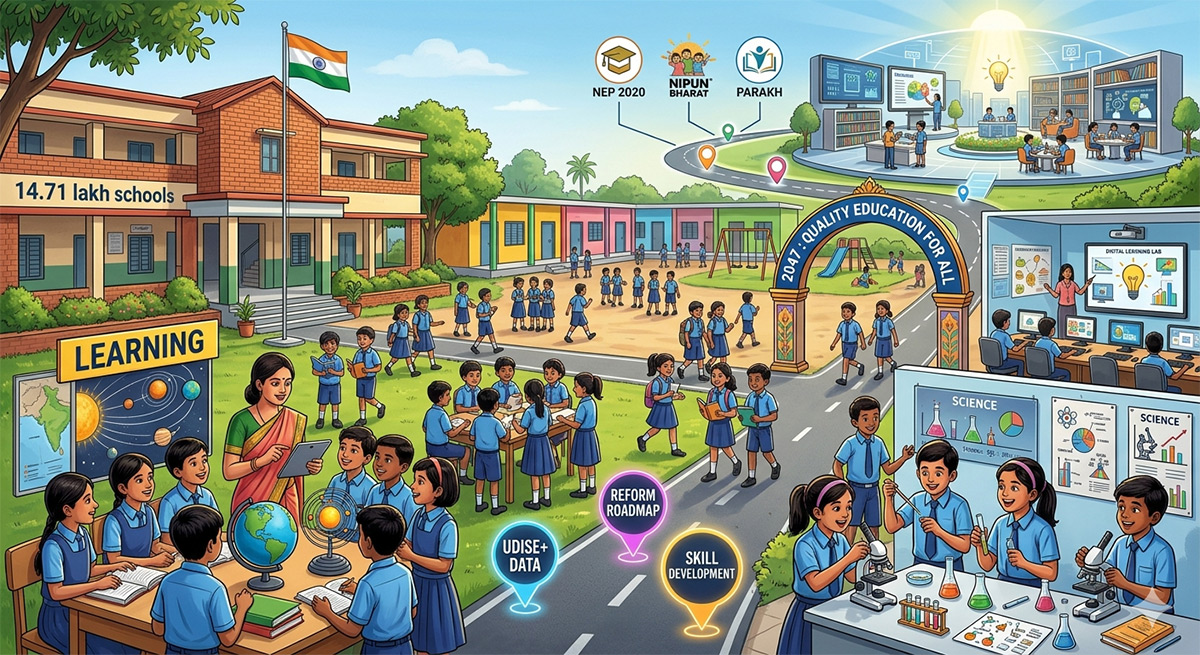
NEW DELHI: India’s school education system today stretches across 14.71 lakh schools, teaches 24.69 crore students and employs nearly 1.01 crore teachers, but a new report released by NITI Aayog says the country’s next big education challenge is no longer about getting children into classrooms, but ensuring they actually learn well once they are there.
Released by Suman Bery and Nidhi Chhibber on 6 May, the report titled School Education System in India: Temporal Analysis and Policy Roadmap for Quality Enhancement presents a detailed 10-year analysis of Indian schooling from 2014-15 to 2024-25.
The study draws on data from UDISE+ 2024-25, PARAKH Rashtriya Sarvekshan 2024, National Achievement Survey 2017 and 2021, and ASER 2024. It was also shaped by a national consultation held by NITI Aayog on 28 February 2025 at the Dr Ambedkar International Centre in New Delhi, attended by more than 150 participants, including state education secretaries, SCERT directors, district collectors, NGOs and global agencies such as UNESCO and UNICEF.
The report notes that India now operates the largest school education system in the world. Of the 14.71 lakh schools in operation, 10.13 lakh are government-run, 3.39 lakh are private schools, 79,349 are government-aided institutions and 39,219 fall under other categories.
Government schools account for 68.1 per cent of all schools and educate 12.15 crore students, while private schools account for 23.1 per cent of institutions and teach 9.58 crore students. Government-aided schools educate 2.47 crore students, while institutions under “other” categories teach 47.24 lakh students.
On the teaching side, the country has 51.49 lakh teachers in government schools, 39.62 lakh teachers in private schools, 7.57 lakh teachers in aided schools and 2.52 lakh teachers in other institutions.
The report traces how India’s school network expanded rapidly in the first half of the last decade. The total number of schools rose from 15.16 lakh in 2014-15 to a peak of 15.58 lakh in 2017-18 before beginning a gradual decline linked to school consolidation and rationalisation exercises. By 2022-23, the number had dropped to 14.66 lakh before stabilising around 14.71 lakh in 2024-25.
The document says India has largely achieved near-universal access at the primary stage, but major gaps remain at higher levels. The Gross Enrolment Ratio at the higher secondary level stands at 58.4 per cent nationally, exposing continuing drop-offs after secondary school.
Transition rates remain uneven across stages, especially from upper primary to secondary and secondary to higher secondary. The report identifies these transition years as the biggest “leak points” in the education pipeline.
Dropout rates have improved over the decade, but the report warns that social and economic vulnerabilities still force many children, especially in rural and disadvantaged communities, out of school before Class 12.
The infrastructure story, however, is one of the brighter chapters.
Over the past decade, schools with functional electricity, boys’ toilets, girls’ toilets, computers, internet access, ramps and smart classrooms have all increased significantly across states and Union Territories. The report uses dozens of state-level heat maps and comparisons to show the pace of change between 2014-15 and 2024-25.
Digital infrastructure has seen one of the fastest jumps. Schools with computers, internet connectivity and smart classrooms have expanded sharply over the decade, although smaller and remote schools continue to lag behind.
The report also highlights rising inclusion indicators. Girls’ Gross Enrolment Ratios have improved steadily across primary, upper primary, secondary and higher secondary levels. SC and ST enrolment has also strengthened across stages over the last 10 years.
Infrastructure for children with special needs has also improved. More schools now have ramps and CwSN-friendly toilets compared to 2014-15, though implementation remains uneven across states.
On learning outcomes, the report says India is beginning to recover from pandemic-era setbacks.
Using findings from ASER, NAS and PARAKH, the study points to improvements in foundational literacy and numeracy after Covid-19 disruptions, especially among younger students. Reading and arithmetic scores in Grades 3, 5, 7 and 8 have shown signs of improvement over the past few years.
At the foundational stage, the report measures competencies in language and mathematics. At the preparatory stage, it expands to language, mathematics and “The World Around Us”, while middle-stage assessments include language, mathematics, science and social science.
The report notes that students are increasingly able to complete basic reading and arithmetic tasks, but conceptual understanding and inference skills remain weak. Rural areas, tribal communities and economically disadvantaged households continue to record lower learning outcomes.
The study also captures India’s growing digital learning culture. Separate sections examine smartphone ownership and usage by gender, digital safety awareness and the percentage of students able to perform digital tasks in 2024.
Teacher deployment remains another major concern.
The report flags continued teacher vacancies in government schools and highlights the existence of single-teacher schools and zero-enrolment schools in some regions. It also analyses Pupil Teacher Ratios across school stages and states.
Government expenditure on education as a share of GDP also comes under review. The report compares central and state government spending trends over the years and reiterates the long-standing recommendation of allocating 6 per cent of GDP to education, first proposed in the National Policy on Education 1968.
The policy roadmap itself is extensive.
The report identifies 11 major challenges across systemic and academic areas. Systemic issues include fragmented schooling structures, infrastructure gaps, governance weaknesses, teacher management issues and rising dependence on private education. Academic challenges include weak foundational learning, curriculum-learning mismatches, gaps in student wellbeing, problems in Early Childhood Care and Education and shortcomings in vocational education.
To tackle these, the report lays out 13 broad recommendations, divided into eight systemic reforms and five academic reforms.
The eight systemic recommendations include composite schools, evidence-based school rationalisation, school complexes, infrastructure strengthening, governance reforms, district and state task forces, stronger school management committees, teacher capacity building, digital learning expansion and equity-focused interventions.
The five academic recommendations focus on pedagogy reforms, competency-based assessments, holistic education, vocational integration, ECCE strengthening and AI-driven teaching innovation.
In total, the report proposes 33 implementation pathways spread across short-term, medium-term and long-term timelines. It also introduces more than 125 measurable Performance Success Indicators to track progress at central, state and local levels.
A strong emphasis has been placed on AI and digital readiness. The report recommends integrating artificial intelligence into classroom learning, teacher support systems and educational administration as India prepares students for future workplaces shaped by automation and emerging technologies.
The report also revisits the long arc of Indian education reform, from the Mudaliar Commission of 1952 and Kothari Commission of 1964-66 to the National Policies on Education of 1968 and 1986, the launch of Sarva Shiksha Abhiyan in 2001, the Right to Education Act of 2009 and finally National Education Policy 2020.
It notes that NEP 2020 replaced the old 10+2 system with a 5+3+3+4 curricular structure covering ages 3 to 18 and positioned foundational literacy and numeracy as a national mission through NIPUN Bharat Mission.
The report says India’s ambition of becoming a Viksit Bharat by 2047 will depend heavily on whether its schools can move from enrolment-focused expansion to learning-centred transformation.
Its concluding message is clear: India has spent decades building classrooms across the country. The next decade, it suggests, will determine whether those classrooms can truly build capability, creativity and confidence at scale.