I&B Ministry
Govt unveils AI training, creator platform and free TV upgrades
A national AI training push, a citizen creator platform and set-top-box-free television form the centrepiece of the information ministry’s digital content drive

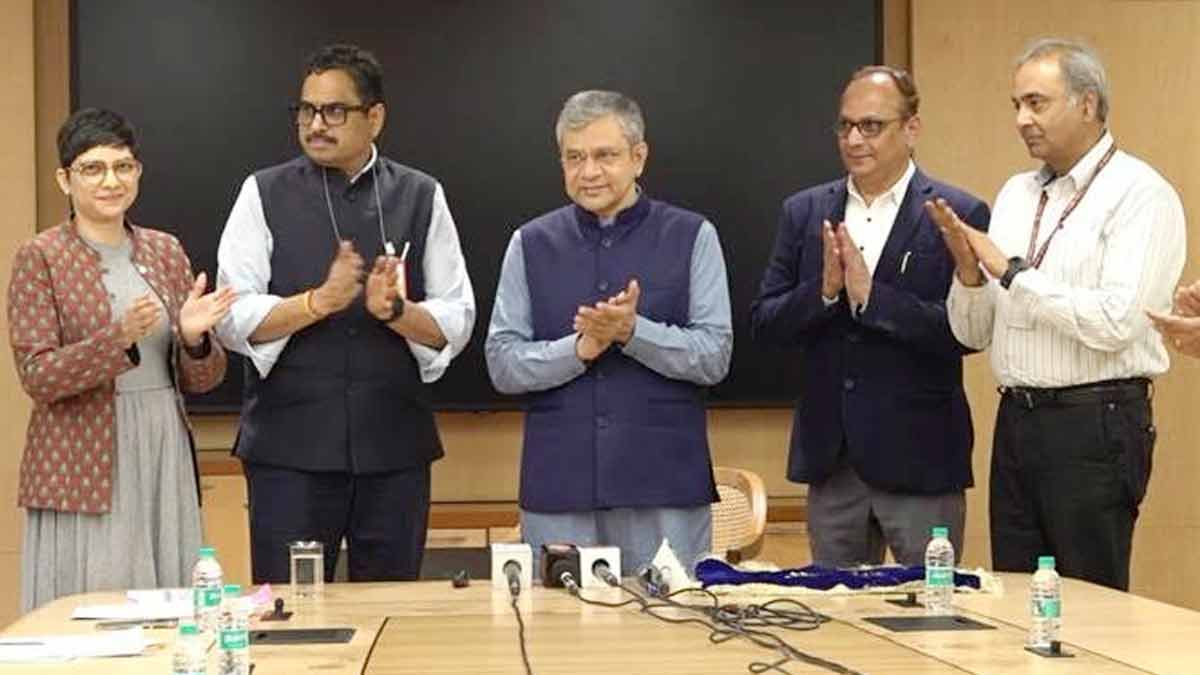
NEW DELHI India’s union minister for information and broadcasting, Ashwini Vaishnaw, has unveiled three initiatives in one go – an AI skilling programme, a homegrown creator platform and upgraded free-to-air television access – in a push to turbocharge the country’s media and digital content ecosystem before the competition does it for him.
The centrepiece is a National AI Skilling Programme, built in partnership with Google and YouTube, that aims to train around 15,000 creators, media professionals and young people – entirely free of cost. Delivered through the Indian Institute of Creative Technologies, the programme runs in two phases: the first takes participants through foundational AI learning via online modules; the second puts them through advanced, hands-on training in animation, visual effects, gaming and media technology. The goal is unambiguous – make India a global hub for digital innovation, not merely a consumer of it.
The second initiative, MyWAVES, lands on the WAVES OTT platform as a space for ordinary citizens to create, upload and share content in multiple Indian languages. Short videos, episodic content, wider participation – the ministry frames it as a deliberate pivot from passive consumption to active creation, with the ‘Create in India’ challenge sitting at its heart. For the legion of aspiring creators outside Mumbai and Bengaluru, it could matter.

The third move is the most prosaic but perhaps the most consequential for the masses: televisions equipped with in-built satellite tuners and an advanced electronic programme guide (EPG) will allow viewers to watch DD Free Dish channels directly, without a separate set-top box. In remote and underserved areas where every rupee counts and infrastructure is patchy, removing that hardware barrier is no small thing.
Vaishnaw framed the package as an expression of prime minister Narendra Modi’s vision of democratising technology. “These initiatives align with making technology more affordable and accessible for citizens,” he said, pointing to the set-top-box rollout as proof that access need not come with a premium.
Information and broadcasting secretary Sanjay Jaju was characteristically policy-precise: “The three initiatives reflect a unified policy direction – building capabilities, expanding opportunities, and ensuring wider access to quality content.” YouTube India’s managing director, also present at the launch, struck a bullish note, arguing that artificial intelligence has the potential to unlock new opportunities for creators by enhancing storytelling and expanding audience reach.
The ministry situates all three moves within its broader ‘Orange Economy’ agenda – promoting the creative sector as an economic engine – while simultaneously reinforcing Prasar Bharati’s public broadcasting mandate and building a digitally skilled workforce for the media and entertainment industry.
India is not short of ambition when it comes to the creator economy. What it has historically been short of is infrastructure, affordability and scale. If 15,000 AI-trained creators, a multilingual OTT platform and a set-top-box-free television rollout can chip away at all three at once, Vaishnaw may have just handed India’s media sector its most consequential upgrade in years. The industry will be watching the execution just as closely as it applauded the announcement.







I&B Ministry
Devinder Kumar appointed Prasar Bharati chief vigilance officer
Senior IOFS officer to serve three-year term with Level-13 pay scale
MUMBAI: The Centre has appointed Devinder Kumar as the chief vigilance officer of Prasar Bharati, formalising a key oversight role within India’s public broadcasting network.
The appointment was cleared through an official order issued by the Department of Personnel and Training under the Ministry of Information and Broadcasting. Kumar, a senior Indian Ordnance Factory Service officer, will initially serve a tenure of three years or until further government orders, whichever comes earlier.
As chief vigilance officer, Kumar will be responsible for overseeing vigilance and compliance functions within Prasar Bharati, ensuring transparency and accountability across the organisation’s operations.
The role carries a Level-13 pay scale under the central government structure, translating to a salary range between Rs 1,23,100 and Rs 2,15,900. The compensation aligns the position with other senior administrative roles across government departments.
Kumar’s appointment follows due process, including a recommendation from the Central Vigilance Commission, which vets candidates for such critical oversight positions.
Currently serving under the Department of Defence Production, Kumar has been directed to be relieved of his existing duties with immediate effect to assume his new role.
The move comes as Prasar Bharati continues to strengthen its governance framework, with the CVO position playing a central role in maintaining institutional integrity. Kumar’s appointment is expected to bolster internal oversight at a time when accountability remains firmly in focus across public sector organisations.







