Hardware
Nagra highlights new growth opportunities and IP strategies for pay-TV at Communicasia 2016


Comprehensive showcase of latest content protection and cloud/IP technologies enable a secure, engaging and everywhere pay-TV experience for consumers
Cheseaux, Switzerland And Singapore – May 24, 2016 – Nagra, a Kudelski Group (SIX:KUD.S) company and the world’s leading independent provider of content protection and multiscreen television solutions, will be at Communicasia 2016, From May 31-June 3 In Singapore, highlighting new growth opportunities and IP-based strategies designed to help the region’s pay-TV operators deliver a secure, engaging and everywhere experience to consumers. Nagra will be located on booth 1H-214, along with Kudelski Group subsidiaries Conax and Smardtv, at the Marine Bay Sands convention.
“Pay-TV Operators, particularly in the asia-pacific region, are at the crossroads of exciting new opportunities to reach consumers on any screen, anytime and anywhere, as well as engage into a more interactive viewer relationship,” said Stéphane Le Dréau, Nagra’s general manager for Southeast Asia. “Largely driven by the accelerated adoption of IP-based delivery networks, these opportunities also bring about new technical challenges – from content protection to the consumer experience – where Nagra is uniquely positioned to help. We look forward to unveiling our latest innovations and demonstrating how service providers can embrace the new IP environment.”

Nagra’s technology showcase will feature the award-winning intuiTV solution, a managed cloud-based platform that can be configured with a full line-up of premium content and advanced TV services featuring live TV, VOD, SVOD services (like Netflix and YouTube), PVR/nPVR, social TV and other standard TV features such as search and recommendation (including voice) – all accessible via an innovative streaming device, ‘swipe-to-tune’ user interface and a contextual, programmable e-ink remote control.
Visitors will also learn about Nagra’s growing footprint in the Asia-Pacific region and see latest deployments of the MediaLive Suite, including OpenTV 5 connectware and Nagra’s set-top box reference solution for Netflix which was recently deployed at StarHub in Singapore. Such innovations have enabled operators to deploy next generation services – from basic to more advanced – and expand their offering by enabling them, for instance, to seamlessly integrate SVOD services in their content line-up through a single user interface and TV input.
New developments in content protection will complement the showcase and feature anyCAST’s unique adaptive security concept which comprehensively addresses all devices and use cases for a new generation of enhanced content, featuring connected security, 4K content protection and watermarking. Nagra anyCAST gives pay-TV service providers the industry’s largest and most trusted range of conditional access (CAS) and digital rights management (DRM) solutions. Using a single Security Services Platform, Nagra anyCAST seamlessly controls an entire range of cardless, card-based, embedded and two-way connected secure clients as well as 3rd-party DRMs, enabling any service provider to create the perfect security solution for their network or combination of networks.






Hardware
India clears Rs 1.6 lakh crore semiconductor projects under Semicon India
Ten projects cleared as production begins and design ecosystem gathers pace
NEW DELHI: India’s push to become a global electronics powerhouse is gaining momentum, with the Semicon India Programme driving the creation of a full-fledged semiconductor ecosystem from design to manufacturing.
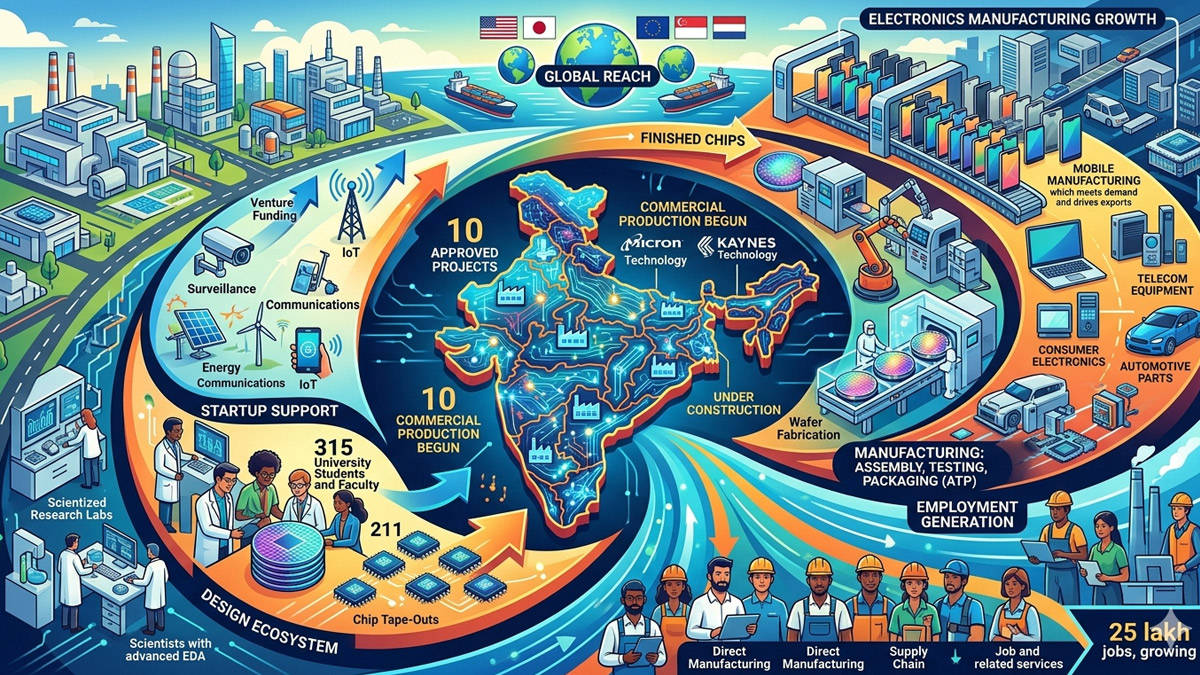
Launched in 2022, the programme aims to build capabilities across the entire value chain, including chip design, fabrication, assembly, testing and packaging. In just four years, the government has approved 10 semiconductor projects with a combined investment commitment of around Rs 1.6 lakh crore.
Two of these facilities have already begun commercial production, including units led by Micron Technology Inc. and Kaynes Technology India Limited. Two more plants are expected to go live later this year, signalling that India’s chip ambitions are moving from blueprint to factory floor.
The broader electronics manufacturing story has also seen sharp growth over the past decade. Production has jumped from roughly Rs 1.9 lakh crore in 2014-15 to about Rs 12 lakh crore in 2024-25, while exports have surged nearly eightfold. Mobile phone manufacturing, once heavily import-dependent, now meets almost all domestic demand and has become a major export driver.
Alongside manufacturing, the government is investing heavily in design capabilities. Through access to advanced chip design tools provided free to 315 universities, students and researchers have clocked over 200 lakh hours of usage. This effort has already resulted in 211 chip tape-outs from 75 institutions.
Support for startups is also picking up pace. Twenty-four chip design projects have been approved, targeting sectors such as surveillance, energy, communications and IoT. Of these, 14 companies have collectively raised over Rs 650 crore in venture funding, while several designs have progressed to fabrication, including at advanced nodes.
To strengthen supply chains, India has also signed semiconductor cooperation agreements with countries including the United States, Japan, the European Union, Singapore and the Netherlands. These partnerships aim to reduce global dependencies while boosting domestic capabilities.
The employment impact is equally significant. The electronics sector now supports an estimated 25 lakh jobs, with mobile manufacturing alone accounting for nearly half. As more semiconductor units come online under the India Semiconductor Mission, indirect job creation across supply chains is expected to rise further.
Sharing these updates in Parliament, Ministry of Electronics and Information Technology minister of state Jitin Prasada underscored the government’s focus on building a resilient, end-to-end semiconductor ecosystem.
With factories taking shape, designs moving to silicon and investments flowing in, India’s semiconductor story is steadily shifting gears from ambition to execution.






