English Entertainment
IBC Innovation Awards Shortlist Announced: IP, 4K and OTT Amongst Industry Trends Tackled by Entrants


London, United Kingdom
The shortlist for the IBC2016 Innovation Awards has been announced. The nine finalists are from six countries, as far apart as China and the USA. Each reflects the way that technological advances are boosting the creativity and efficiency of the content industry.
That is what lies at the heart of the IBC Innovation Awards: the application of the latest technology in the real-world. This year this translates to making content more engaging for viewers, offering new functionality in delivery and discovery, and helping creators work more efficiently.

“The IBC Innovation Awards are unique because we judge on the benefits each entry delivers to the end user,” said Michael Lumley, Chair of the judging panel. “Ultimately, the award is handed over on stage not to a company developing the newest widgets but to the broadcaster or media company which benefits from a real collaborative process to develop the best possible solution.
“That gets tougher to judge each year,” Lumley added. “This year’s finalists represent the state of the art in some of the hottest topics, like online delivery and Ultra HD content.”
There are three categories in the IBC Innovation Awards programme, for the best applications of technology in content creation, content management and content delivery. This year three projects have been shortlisted for each category, but the winners will not be announced until the IBC Awards Ceremony, at 18:30 on Sunday 11 September.
Content Creation
Two of the three finalists in content creation increase viewer engagement in sports television, although in very different ways. BT Sport wanted to add even more impact when it won the rights to cover European Champions League football, and added very sophisticated augmented reality elements to its studio coverage, including a signature shot flying over a map of Europe to the stadiums hosting each game. Working in a huge and largely black studio was a challenge for camera tracking company Ncam, who worked with Moov, RT Software and Timeline TV to create a solution.
Point of view cameras for sports are not new, but Pylon Camera, developed by ESPN, takes it to a new level. Replacing corner posts in the high impact sport of American football, Pylon Cam has to have crush impact zones to avoid injuring players, while still delivering multiple views from each pylon. The pictures are not only sensational, they have helped referees judge critical touchdowns in key games. Technology partners include BSI and Gilman.
The third finalist is the remarkable live IP studio built by the EBU and housed at VRT Sandbox in Brussels. Using open standards, it demonstrates interconnectivity between equipment from multiple vendors. More to the point, it shows that a real, working, uncompromised production studio can be built around IP workflows for live television. The long list of technology partners includes Axon, D&MS, Dwesam, EVS, Genelec, Grass Valley, Lawo, LSB, Nevion, Tektronix and Trilogy.
Content Management
Just as critical as creating excellent content is managing it to create compelling viewing. MoovIT Production Services was faced with the challenge of shooting the Endemol Shine Germany reality show Wild Island on two secluded islands off the coast of Central America, but hosting the post production in Cologne, Germany, to get the show to air. Working with EditShare, a remote workflow allowed the content to be secured in a hostile environment with an unpredictable power supply, and edited in Germany, saving 50% on standard time and resources.
Ketnet, the children’s channel from VRT in Belgium, has been transformed into an interactive, curated online experience. The first app was aimed at two to five year olds, and concentrated on stimulating educational experiences rather than simply offering programmes and clips. The solution was developed by local company Small Town Heroes, and proved an immediate success, with young viewers spending 50% of their time playing.
The third finalist takes us back to reality television, this time in China for Tencent Video’s production ‘The 15 of Us’. The difference is that Tencent is a video portal rather than a conventional channel, and wanted to make all 120 HD cameras and two 360˚ cameras available at all times – 3,000 hours of content a day for a full year. They worked with technology partner Grass Valley to manage the content for editing, packaging and approval.
Content Delivery
BT Sport has a second spot on the shortlist, this time for a delivery solution. In 2015 it launched BT Sport Ultra HD, and since then have produced a large number of sporting events in 4K, including football, rugby, MotoGP, squash and NBA basketball. The company worked with its outside broadcast partner Timeline Television to build Europe’s first Ultra HD 4K truck, including cameras from Sony and a SAM switcher.
Swisscom is looking forward to a future where much television may be viewed on demand rather than on a linear schedule, and considered how it could help consumers discover the content they like. Working with ThinkAnalytics, it developed a new user experience which allows users to browse through all the content shown on more than 250 television channels, with personalised recommendations, and all working seamlessly over Switzerland’s four languages.
For the final nominee the judges returned to sports once more, this time to UEFA, the European football governing body. Recognising that football fans want much more than just simple coverage of the game, UEFA worked with technology partners deltatre, EVS and the EBU to develop its Next Generation Services Project, delivering a host of additional content from data feeds to multiple angles and linked second screen experiences, allowing rights-holding broadcasters to build viewer engagement for the Champions League.
Ceremony
The winners of the IBC2016 Innovation Awards are a closely guarded secret until the awards ceremony, which takes place during IBC2016 at 18:30 on Sunday 11 September, in the Auditorium of the Amsterdam RAI.
This lively and fast-paced show includes some audience surprises and highly entertaining offerings as well as the presentation of all of IBC’s awards, including the Judges’ Prize – also in the gift of the same panel of international editors and consultant who selected the Innovation Awards – and the IBC International Honour for Excellence.
The ceremony is free to all IBC visitors and always proves a popular event.
Judging Panel
The IBC Innovation Awards are judged by an international panel:
Michael Lumley (Chair)
Carolyn Giardina (USA)
David Crawford (UK)
Dick Hobbs (UK)
Fergal Ringrose (Ireland)
Phil Sandberg (Australia)
Vijaya Cherian (UAE)







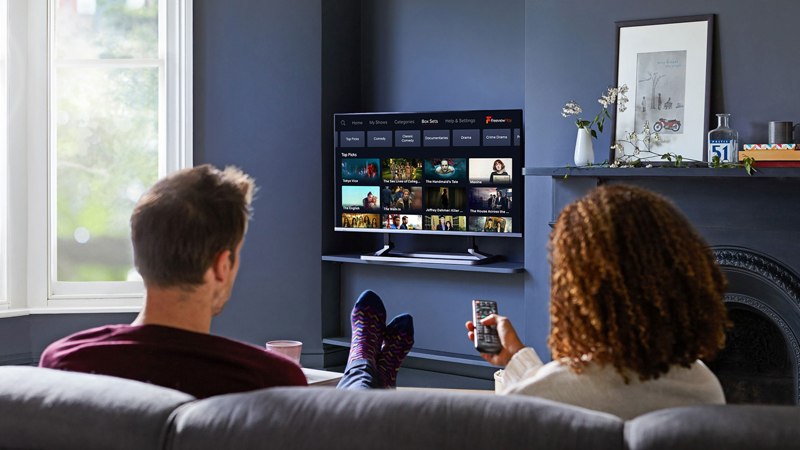
UK: The aerial is losing its grip. As broadband becomes the default way Britons watch television, the UK is edging towards a decisive, and divisive, question: should Freeview be switched off by 2034? The issue, highlighted in reporting by The Guardian, has exposed deep fault lines over access, affordability and the future of public service broadcasting.
For nearly 25 years, Freeview has delivered free-to-air television from the BBC, ITV, Channel 4 and Channel 5 to almost every corner of the country. Even now, it remains the UK’s largest TV platform, used in more than 16m homes and on around 10m main household sets. Yet the same broadcasters that built it are now pressing for its closure within eight years.
Their case rests on a structural shift in viewing. Smart TVs, superfast broadband and the Netflix-led streaming boom have pulled audiences online. Advertising economics have followed. By 2034, the number of homes using Freeview as their main TV set is forecast to fall from a peak of almost 12m in 2012 to fewer than 2m, making digital terrestrial television, or DTT, increasingly costly to sustain.
But critics say the rush to switch off risks abandoning those least able, or least willing, to move online.
“I don’t want to be choosing apps and making new accounts,” says Lynette, 80, from Kent. “It is time-consuming and irritating trying to work out where I want to be, to remember the sequence of clicks, with hieroglyphics instead of words. If I make a mistake I have to start again.”
Lynette is among nearly 100,000 people who have signed a “save Freeview” petition launched by campaign group Silver Voices. She fears the government is about to “take [Freeview] away from me and others who either don’t like, can’t afford, or can’t use online versions”.
Official figures underline the fault lines. A report commissioned by the Department for Culture, Media and Sport estimates that by 2035, 1.8m homes will still depend on Freeview. Ofcom’s analysis shows those households are more likely to be disabled, older, living alone, female, and based in the north of England, Wales, Scotland and Northern Ireland.
Freeview is owned by the public service broadcasters through Everyone TV, which also operates Freesat and the newer streaming platform Freely. After two years of review, DCMS is expected to set out its position soon, drawing on three options proposed by Ofcom: a costly upgrade of Freeview’s ageing technology; maintaining a bare-bones service with only core PSB channels; or a full switch-off during the 2030s.
The broadcasters have rallied behind the third option. They argue that 2034 is the logical cut-off, when transmission contracts with network operator Arqiva expire. By then, they say, the cost of broadcasting to a dwindling audience will far outweigh the returns from TV advertising.
Ofcom agrees a crunch point is approaching. In July, the regulator warned of a “tipping point” within the next few years, after which it will no longer be commercially viable for broadcasters to carry the costs of DTT.
Others see risks beyond economics. Questions remain over whether internet TV can reliably deliver emergency broadcasts, such as the daily Covid updates, in the way that universally available DTT can. The UK radio industry has also warned that an internet-only future for TV could push up distribution costs and force some radio stations off air if PSBs no longer share Arqiva’s mast network.
“It is a political hot potato,” says Dennis Reed, founder of Silver Voices, who says he has “dissociated” his organisation from the government’s stakeholder forum, which he believes is “heavily biased” towards streaming.
The Future TV Taskforce, representing the PSBs, counters that moving online could “close the digital divide once and for all”. “We want to be able to plan to ensure that no one is left behind,” a spokesperson says, adding that rising DTT costs could otherwise mean cuts to programme budgets.
The numbers show the scale of the challenge. Of the 1.8m Freeview-dependent homes projected for 2035, around 1.1m are expected to have broadband but not use it for TV. The remaining 700,000 are forecast to lack a broadband connection altogether.
Veterans of the analogue switch-off, completed in 2012 after 76 years, recall similar fears of “TV blackout chaos”. Around 6 per cent of households were labelled “digital refuseniks”, yet a targeted help scheme and a national campaign, fronted by a robot called Digit Al voiced by Matt Lucas, delivered a largely smooth transition.
This time, the BBC is less keen to foot the bill. Tim Davie, the outgoing director general, has said the corporation should not fund a comparable support programme for a Freeview switch-off.
Research for Sky by Oliver & Ohlbaum suggests that with early awareness campaigns and digital inclusion measures, only about 330,000 households would ultimately need hands-on help ahead of a 2034 shutdown.
Meanwhile, viewing habits continue to fragment. Audience body Barb says 7 per cent of UK households no longer own a TV set, choosing to watch on other devices. In December, YouTube overtook the BBC’s combined channels in total UK viewing across TVs, smartphones and tablets, albeit measured at a minimum of three minutes.
That shift may accelerate. YouTube has recently blocked Barb and its partner Kantar from accessing viewing session data, limiting transparency just as online platforms consolidate power.
“When the government chose British Satellite Broadcasting as the ‘winner’ in satellite TV it was Rupert Murdoch’s Sky instead that came out on top,” says a senior TV executive quoted by The Guardian. “There already is such an outsider ready to be the winner in the transition to internet TV; it is YouTube.”
Freeview’s future now hangs on a familiar British dilemma: modernise fast and risk exclusion, or protect universality and pay the price. Either way, the aerial’s days as king of the living room look numbered.







