Press Release
Brazilian Coach Luiz Felipe Scolari leaps ahead in online popularity;emerges as the most searched coach on Google

MUMBAI: FIFA World Cup is well underway and the host country, Brazil, has notched up their first win, beating Croatia on the opening day of the 2014 FIFA World Cup. Joy, excitement and thrill – the feeling is ubiquitous among the fans during each battle; as their favourite teams and players play in the biggest football tournament in 2014.
Roaming anxiously on the side-lines, formulating and implementing strategy and tactics on a real-time basis and commanding the team, the national coach plays a key role in enabling optimal performance by his team and more importantly ensuring the only thing that matters – a win!

Naturally the media and fans interest and attention on national coaches is almost as much as it is on the players. With the World Cup now well underway, Google search trends reveal some interesting insights on some of the top national coaches in tournament history.
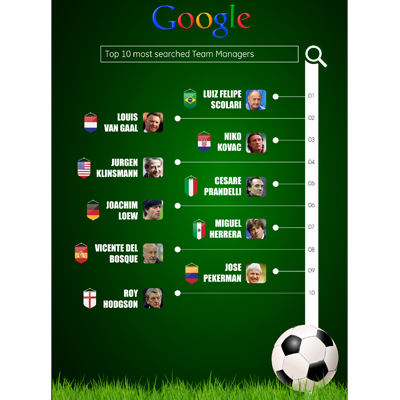
Based on Google search trends for past two weeks, here’s a list of the 10 coaches who are being searched by fans.
Looking to build on the success of last year’s Confederations Cup triumph, Brazilian coach Luiz Felipe Scolari remains the most searched among the coaches of all the teams participating in the 2014 FIFA World Cup on Google. Luiz is serving a second spell as Brazil’s manager after winning the World Cup with them in 2002.
Netherland’s Coach Louis van Gaal is no doubt one of the finest managers in world football. Staging a humiliating defeat in the group match against Spain, he has already impressed football fans both offline and online taking the no. 2 spot on the list.
Coratian Coach Niko Kovac appointed last October has been successful in getting the right connect with the fans and players. Kovac who stood at third position on search popularity appeared in three World Cups as a player and captained Croatia in 2006.
The US men’s soccer national team may not be among the top 10. However US team’s Jurgan Klinsmann is the fourth most searched coach with his constant attempt to overhaul this USA side. Appointed in 2011 as the Coach of the USA national football team, Klinsmann was a key member of the West Germany side that won the 1990 World Cup.
Following their group stage exit in the 2010 World Cup, Italy has worked a long way under Coach Cesare Prandelli. Ranking fifth on the search populairty chart he recently signed a two-year contract extension that will take him through to Euro 2016 with the team.
Others leading coaches who peaked on the online front with high search popularity included Joachim Low, Coach German Football team followed by Mexico’s national coach Miguel Herrera and Spanish coach Vicente del Bosque. Colombian Coach Jose Pekerman and English Coach Roy Hodgson.
Interestingly, the coaches largely do not hail from the countries they are coaching. Eighteen of the 32 teams have coaches from their own country. Fourteen teams are in the hands of foreigners.








Bali is full of memorable moments, and some of them involve animals. Temple monkeys tug at bags, beach dogs nap near sunbeds, and cats wander into cafés like they own the place. Most interactions are harmless, but a bite or scratch can change the day quickly, because you may need immediate medical care and follow-up treatment. This is where Bali travel insurance becomes more than a box to tick.
In this article, you will explore whether animal bite treatment is insured, the exclusions, and the steps to claim easily in Bali.
Why Animal Bites in Bali Need Special Attention
Bites are not only about the visible wound. Insurers and doctors both treat them as medical events that can pose an infection risk, especially when the bite breaks the skin.
A scratch that looks small in the moment can still lead to:
● A doctor’s examination and wound cleaning
● Medicines and dressings
● Follow-up consultations if the doctor advises observation or further care
From an insurance perspective, this matters because claims are usually assessed on medical necessity and documentation, not on how dramatic the injury appears in a photo.
How International Travel Insurance Looks at an Animal Bite
Most travel policies are built around emergency medical expenses for unexpected illness or accidental injury abroad. A bite or scratch usually fits the accidental injury bucket, but coverage is rarely blanket.
In many plans, the following may be considered if a doctor prescribes them and bills and medical notes support them:
● Consultation and outpatient treatment
● Emergency care and procedures, such as wound dressing or stitches, if clinically required
● Prescribed medicines and investigations
● Hospitalisation if the treating doctor confirms it is needed
Common Reasons Claims Get Reduced or Rejected
This is the part travellers often miss. Insurers usually do not deny claims because an animal was involved. Claims become difficult when the event looks avoidable, the reporting is delayed, or the paperwork is weak.
Avoidable-Risk Situations Insurers Scrutinise
Policies commonly exclude or limit claims linked to unsafe conduct or preventable exposure. For animal bites, scrutiny may increase if the incident appears connected to:
● Provoking, feeding, or trying to handle wild animals
● Ignoring warning signs at tourist spots
● Being intoxicated at the time of the incident
● Activities that a policy lists as excluded or restricted
The takeaway is simple: if your own description sounds like a risky choice rather than a sudden accident, the insurer may challenge it.
Delays, Missing Papers, and Policy Conditions
Even when your incident is genuinely accidental, claims can still stall due to basics such as:
● Not informing the insurer or assistance partner within the required time
● Missing itemised bills, prescriptions, or clinical notes
● No proof of travel dates or passport entry details when requested
● Submitting only pharmacy slips without a doctor’s consultation record
International travel insurance is paperwork-driven. If you document it well, you reduce the chance of avoidable back-and-forth.
What to Do If You Are Bitten or Scratched in Bali
Your health comes first, always. But a few sensible steps can protect your recovery and keep your insurance file clean.
Medical Steps That Help You and Your Claim
Act fast, stay calm, and get proper care before worrying about bills.
● Clean the wound promptly and seek medical care, even if it seems minor
● Follow the doctor’s advice, including follow-ups if recommended
● Avoid self-medicating in place of a clinical assessment, because insurers often ask for a doctor’s report
Claim Notes and Documents to Collect
Keep these handy; they’ll save time and avoid follow-up questions later.
● Doctor’s notes that mention the nature of injury, treatment given, and advised next steps
● Prescriptions and pharmacy invoices
● Itemised hospital or clinic bills
● A brief written note of where and when it happened, while it is still fresh in your mind
Final Word
Animal bites in Bali are not rare, and they are not always dramatic, which is exactly why travellers underestimate them. Many travel policies can cover bite-related medical treatment when it is accidental and medically necessary, but the outcome depends on your policy terms and the quality of your documentation. If you buy cover thoughtfully, keep the assistance number handy, and respond sensibly if an incident happens, you give yourself the best chance of both good medical care and a smoother claim experience.







