News Broadcasting
Zeel’s Amit Goenka awarded 21st Century Icon Awards at House of Lords


Mumbai: Zeel president – digital business and platforms Amit Goenka was awarded the 21st Century Icon Awards at House of Lords, London for his contribution to the growth of the media & entertainment Industry.
Organized by Squared Watermelon Ltd, the 21st Century Icon Awards are organised every year to support and promote the next generation of inspiring leaders as well as offer them a platform to showcase their achievements in their respective fields. Goenka was chosen in the “Outstanding Media & Entertainment Award” category for pioneering the digital business at Zee.
Goenka has been instrumental in spearheading the growth of Zee5, the company’s streaming platform and “catapulting the company into its next phase of growth, by aggressively expanding its footprint in the international arena and driving data and technology to build a truly robust consumer experience across digital screens.”

“Winning in the Outstanding Media & Entertainment category is not just a recognition of our success, it is a firm testament of the consistent hard work put in by our teams. Together, we have built the digital businesses and platforms of Zee Entertainment to be at the forefront of ushering in the next era of entertainment for new-age consumers across connected devices,” said Goenka. “At Zee, our sharp focus is on creating engaging content supported by parallel investments in technology and talent, leading to a robust offering and delightful consumer experiences across languages. I am confident that our digital businesses are well poised for immense success in the future and such acknowledgements will further fuel our passion and the strife for higher growth and success going forward.”
Squared Watermelon president and chief executive officer Tarun Ghulati and co-founder and chief creative officer Preeti Rana said the 21st Century Icon Awards endeavour to appreciate and bring forth the next generation of business leaders who have played a major role in transforming their company. “Amit Goenka is a prolific business personality who is a role model for the next generation of leaders and it is our honour to recognise his contribution to the business fraternity and add his name to our prestigious list of past winners,” Ghulati said.
Conducted annually, the prestigious 21st Century Icon Awards judges business leaders on attributes such as personal integrity, impact, spirit, financial acumen, influence and community along with humbleness.






News Broadcasting
UDF poised to return to power in Kerala, says Manorama-CVoter survey
Massive opinion poll projects shift in Kerala politics ahead of 2026 Assembly elections.
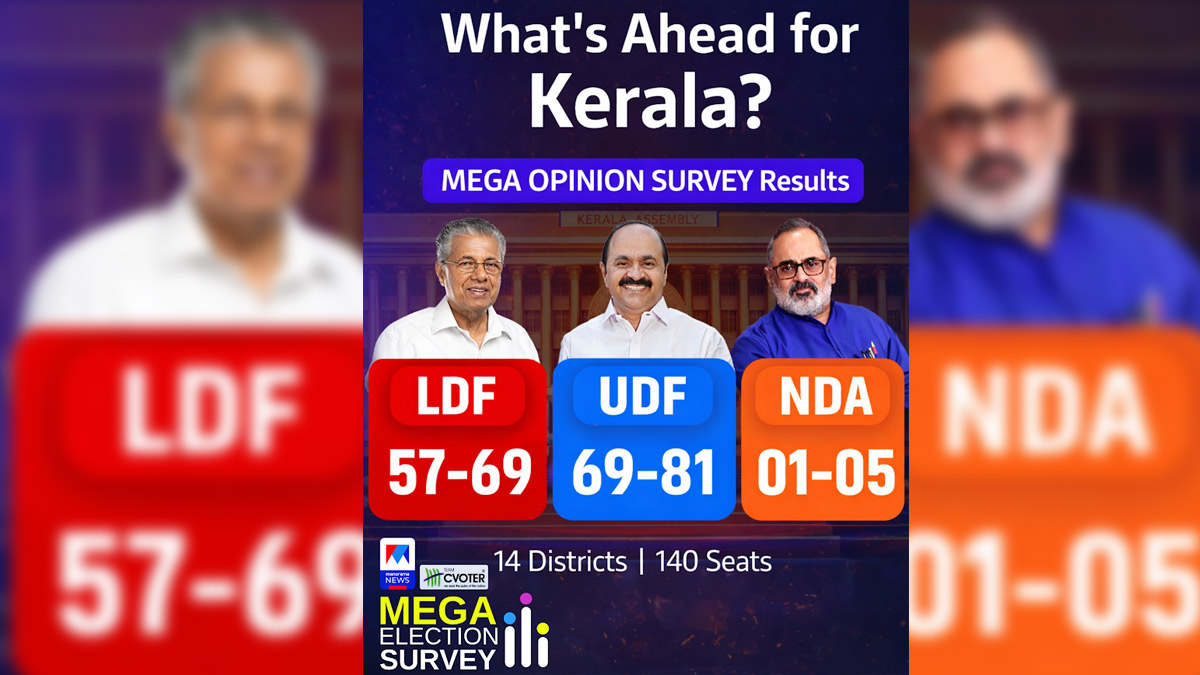
MUMBAI: The winds of change appear to be blowing through Kerala’s political landscape and this time, they seem to favour the United Democratic Front. A comprehensive mega opinion survey conducted by Manorama News in partnership with CVoter projects a potential comeback for the UDF in the upcoming Kerala Legislative Assembly Elections 2026. The survey, covering all 140 constituencies with a massive sample size of nearly 90,000 respondents, predicts the UDF could win between 69 and 81 seats.
The ruling Left Democratic Front (LDF) is expected to secure 57 to 69 seats, a significant drop from the 99 seats it won in the 2021 elections. This would mean the LDF losing 30 to 42 of its sitting seats. Meanwhile, the National Democratic Alliance (NDA), which drew a blank in 2021, is projected to open its account with 1 to 5 seats.
Region-wise, the UDF is expected to make strong gains in Malabar, winning 25 to 34 out of 48 seats, and in Central Kerala, where it could bag 29 to 33 out of 53 seats. In South Kerala, the LDF is likely to retain an edge with 21 to 25 seats, while the UDF may improve to 12 to 16 seats. The NDA could pick up 1 to 3 seats in the southern region.
The survey was conducted between 14 and 26 March 2026, with additional tracker and snap polls carried out from December 2025 to March 2026. A total of 89,693 respondents participated, ensuring representation across all demographics and social segments.
Manorama News has a strong track record of accuracy, with its previous projections closely matching the actual results of the 2019 and 2024 Lok Sabha elections as well as the 2021 Kerala Assembly polls.
In Kerala’s famously fierce political battles, this survey suggests the pendulum may be swinging back. Whether the final verdict matches these numbers or throws up another surprise, one thing is clear, the 2026 Assembly elections are shaping up to be one of the most keenly watched contests in the state’s history.






