English Entertainment
Zee Cafe brings 3 of America’s biggest reality shows

MUMBAI: The viewers of Zee Café will become a witness to three of America’s highest rated reality series. The channel has signed an exclusive deal with Freemantle Media to bring the latest and multiple seasons of American Idol, America’s Got Talent and The X Factor to India.
Come 19 March, Zee Café will air the 13th season of American Idol that starts in the US from 15 January with a revamped judging panel. While Keith Urban will return for the second time on the judging panel; Mariah Carey, Nicki Minaj and Randy Jackson have been replaced by Harry Connick Jr. and Jennifer Lopez. Ryan Seacrest will return as the host. The last edition of the show was often in the midst of controversies because of the constant cold war between Mariah Carey and Nicki Minaj.

Interestingly, the finale of the show will be aired live on the channel along with US (Zee Café plans to catch up with US by airing the show on weekdays regularly) and soon after that the channel will air the 8th season of America’s Got Talent. Joining actor Howie Mendel and radio personality Howard Stern at the judges panel this year would be supermodel and host of Project Runway, Heidi Klum, along with former Spice Girls member Melanie Brown (aka Mel B), replacing Sharon Osbourne.
And that’s not all! Following America’s Got Talent would be airing of The X Factor towards the end of the year. The X Factor judges panel will include Simon Cowell, singer and actress Paulina Rubio, former Destiny’s Child member Kelly Rowland and songstress Demi Lovato.
Zee Café EVP and business head Anurag Bedi, said, “We believe in bringing the best and the latest content to our viewers. These shows are synonymous with entertainment and unarguably amongst the biggest reality shows on television. Having seen the affinity the audience here has for reality shows, we are confident that these shows will be amongst the biggest shows of 2014 and will strengthen Zee Cafe’s leadership position in the English entertainment genre”.
Bedi thinks that these shows already have a huge fan following in India, considering the local adaptations on Hindi GECs have worked really well. However, it’s the channel’s marketing initiatives that would work in its favour, says Bedi, who is undeterred by the fact that the previous seasons of these shows were aired on different networks. While American Idol previously aired on two different channels in India – Star World (2004-2011) and Big CBS channels (2012-2013), X Factor aired on the Big CBS channels and America’s Got Talent was aired on VH1. Bedi said, “How a show does on one platform may be very different from how it will perform on another. The content itself is of par excellence and the buzz that we create will definitely bring in viewership. We will bring in appointment viewing with these shows.”
Fremantle Media EVP of sales & distribution Asia Ganesh Rajaram, said: “These shows have become a global phenomenon, engaging audiences all over the world because of its ability to attract amazingly talented hopefuls with brilliant stories to tell. We’re delighted that Indian audiences will get to enjoy these shows on Zee Café.”
Given the magnanimous reach of these shows already all around the world, the marketing strategies have been decisively planned. “Considering that these shows will be amongst our tent pole properties for this year, we will take an aggressive 360 degree marketing approach to promote them,” says Bedi, also adding that the shows will be aired in the prime-time slot and will target the young urban youth. “9 pm has a very high PUT among the TG 15-24 who is the viewer of this content. We are confident it will do well at this time band,” he remarks.
While Bedi didn’t divulge any details about the sponsors on board for the shows, considering the popularity of the shows some interesting deals are to be finalised.
The fans of these English reality shows have seriously something interesting to look forward to!






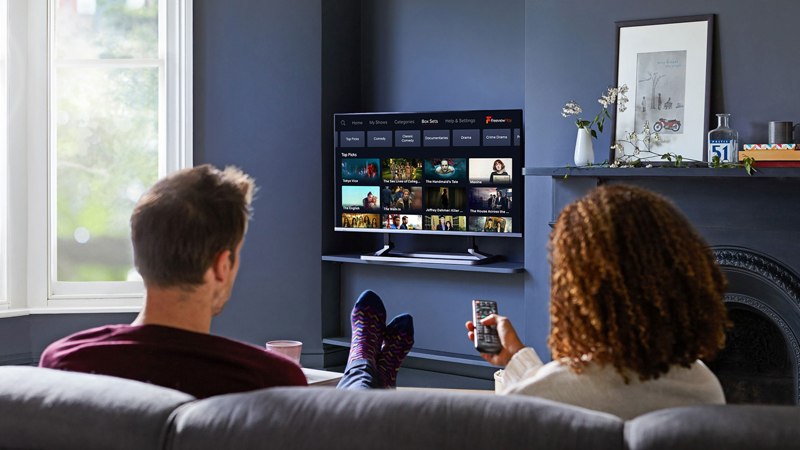
UK: The aerial is losing its grip. As broadband becomes the default way Britons watch television, the UK is edging towards a decisive, and divisive, question: should Freeview be switched off by 2034? The issue, highlighted in reporting by The Guardian, has exposed deep fault lines over access, affordability and the future of public service broadcasting.
For nearly 25 years, Freeview has delivered free-to-air television from the BBC, ITV, Channel 4 and Channel 5 to almost every corner of the country. Even now, it remains the UK’s largest TV platform, used in more than 16m homes and on around 10m main household sets. Yet the same broadcasters that built it are now pressing for its closure within eight years.
Their case rests on a structural shift in viewing. Smart TVs, superfast broadband and the Netflix-led streaming boom have pulled audiences online. Advertising economics have followed. By 2034, the number of homes using Freeview as their main TV set is forecast to fall from a peak of almost 12m in 2012 to fewer than 2m, making digital terrestrial television, or DTT, increasingly costly to sustain.
But critics say the rush to switch off risks abandoning those least able, or least willing, to move online.
“I don’t want to be choosing apps and making new accounts,” says Lynette, 80, from Kent. “It is time-consuming and irritating trying to work out where I want to be, to remember the sequence of clicks, with hieroglyphics instead of words. If I make a mistake I have to start again.”
Lynette is among nearly 100,000 people who have signed a “save Freeview” petition launched by campaign group Silver Voices. She fears the government is about to “take [Freeview] away from me and others who either don’t like, can’t afford, or can’t use online versions”.
Official figures underline the fault lines. A report commissioned by the Department for Culture, Media and Sport estimates that by 2035, 1.8m homes will still depend on Freeview. Ofcom’s analysis shows those households are more likely to be disabled, older, living alone, female, and based in the north of England, Wales, Scotland and Northern Ireland.
Freeview is owned by the public service broadcasters through Everyone TV, which also operates Freesat and the newer streaming platform Freely. After two years of review, DCMS is expected to set out its position soon, drawing on three options proposed by Ofcom: a costly upgrade of Freeview’s ageing technology; maintaining a bare-bones service with only core PSB channels; or a full switch-off during the 2030s.
The broadcasters have rallied behind the third option. They argue that 2034 is the logical cut-off, when transmission contracts with network operator Arqiva expire. By then, they say, the cost of broadcasting to a dwindling audience will far outweigh the returns from TV advertising.
Ofcom agrees a crunch point is approaching. In July, the regulator warned of a “tipping point” within the next few years, after which it will no longer be commercially viable for broadcasters to carry the costs of DTT.
Others see risks beyond economics. Questions remain over whether internet TV can reliably deliver emergency broadcasts, such as the daily Covid updates, in the way that universally available DTT can. The UK radio industry has also warned that an internet-only future for TV could push up distribution costs and force some radio stations off air if PSBs no longer share Arqiva’s mast network.
“It is a political hot potato,” says Dennis Reed, founder of Silver Voices, who says he has “dissociated” his organisation from the government’s stakeholder forum, which he believes is “heavily biased” towards streaming.
The Future TV Taskforce, representing the PSBs, counters that moving online could “close the digital divide once and for all”. “We want to be able to plan to ensure that no one is left behind,” a spokesperson says, adding that rising DTT costs could otherwise mean cuts to programme budgets.
The numbers show the scale of the challenge. Of the 1.8m Freeview-dependent homes projected for 2035, around 1.1m are expected to have broadband but not use it for TV. The remaining 700,000 are forecast to lack a broadband connection altogether.
Veterans of the analogue switch-off, completed in 2012 after 76 years, recall similar fears of “TV blackout chaos”. Around 6 per cent of households were labelled “digital refuseniks”, yet a targeted help scheme and a national campaign, fronted by a robot called Digit Al voiced by Matt Lucas, delivered a largely smooth transition.
This time, the BBC is less keen to foot the bill. Tim Davie, the outgoing director general, has said the corporation should not fund a comparable support programme for a Freeview switch-off.
Research for Sky by Oliver & Ohlbaum suggests that with early awareness campaigns and digital inclusion measures, only about 330,000 households would ultimately need hands-on help ahead of a 2034 shutdown.
Meanwhile, viewing habits continue to fragment. Audience body Barb says 7 per cent of UK households no longer own a TV set, choosing to watch on other devices. In December, YouTube overtook the BBC’s combined channels in total UK viewing across TVs, smartphones and tablets, albeit measured at a minimum of three minutes.
That shift may accelerate. YouTube has recently blocked Barb and its partner Kantar from accessing viewing session data, limiting transparency just as online platforms consolidate power.
“When the government chose British Satellite Broadcasting as the ‘winner’ in satellite TV it was Rupert Murdoch’s Sky instead that came out on top,” says a senior TV executive quoted by The Guardian. “There already is such an outsider ready to be the winner in the transition to internet TV; it is YouTube.”
Freeview’s future now hangs on a familiar British dilemma: modernise fast and risk exclusion, or protect universality and pay the price. Either way, the aerial’s days as king of the living room look numbered.






