News Broadcasting
Workshop urges media education to filter television messages

MUMBAI: If the soaps don’t change, the audience will have to.
That was the gist of a day-long workshop on media and gender equality held jointly by the Maharashtra State Commission for Women and the Delhi based Centre for Advocacy and Research. Agreeing that neither advertisements nor content on television are going to turn a new leaf overnight, panellists – who ranged from adman Prahlad Kakkar, UTV director Zarina Mehta and documentary filmmaker Chandita Mukherjee, concurred that the right way to deal with the medium and the message would be raise the levels of media education in the country.
Amid some lively sparring in the session on Making Satellite Televison accountable to public interest-setting and exchanging perspectives, CFAR’s Akhila Sivadas pointed out that the challenge today was to create qualitative difference in response to what is currently being shown on televison. While self regulation among broadcasters came up as an viable alternative to perpetuating politically correct gender equality on television, Sivadas also stressed on the need for media education among citizens, particularly among children, as one of the coping mechanisms to deal with conflicting messages from TV.

The workshop turned out to be one of the rare forums in recent days that heralded the implementation of conditional access in the country with warm anticipation. “CAS is going to be real arbiter; now we will really know where viewers are willing to put their money,” Mukherjee said. Added Sivadas, “CAS will now determine whether the channels’ claim that viewer preferences dictate programming strategy holds water.”
Mukherjee stressed that media education should be integrated with mainstream education so that kids learn to filter the messages that they are constantly bombarded with, former Zee TV president and now independent producer Madhavi Mutatkar opined that often parents themselves do not filter out programmes that could be skipped by children.
The result is echoed in studies done by CFAR which show that throughout the country, televison viewing increasingly dominates out of school activities making children restless, inattentive and distracted. The studies also show that children are exposed to one dimensional representation of the family, which is the site of oppression and rigid sex role modelling. Blurring of distinction between the real and the reel and excessive violence on screen is adding to the next generation’s skewed view of reality, the study indicates.
Prahlad Kakkar, who spoke on advertising and gender equality, said that while some ads blatantly exploit the female form in advertising and some play on skin colour, it is the more insidious messages that certain ads convey which are more dangerous. “Don’t get derailed by the issue of the female form in advertising,” he added, “It is ads like the Surf (Lalitaji) ads which distract from the main issues and implicitly question a woman’s competence outside the home, reaffirm her role as a homemaker.”
The simplest way to change the current advertising mindset, he said, would be to reject a product and run it out of the marketplace or to mobilise celebrity support for a campaign against offending ads, which would be more effective in generating public opinion.
UTV’s Mehta, the only production house representative at the workshop, defended the current crop of soaps saying they are the only ones working today and that if they didn’t evoke a strong emotional chord with viewers, no one would be watching these. While Doordarshan Mumbai station director Mukesh Sharma pointed out that his was the only regional channel to take up issues like sex education on live phone in interactive shows, Mehta countered that UTV’s Shaka Laka Boom Boom had taken a similar route by incorporating the theme of tackling blindness by including a blind character in the serial.
Sharma however maintained that the public broadcaster’s hands were tied due to paucity of funds which do not allow DD to come up with better quality programming. Secured funding to allow experimentation needs a revenue stream like television sets license fees ( a proposal recently rejected by the Centre). Sharma added that DD Mumbai had nevertheless managed a revenue of Rs 250 million last fiscal.




News Broadcasting
Network18 channels lead YouTube news viewership in March 2026
CNN-News18, News18 India and CNBC channels top categories with record views
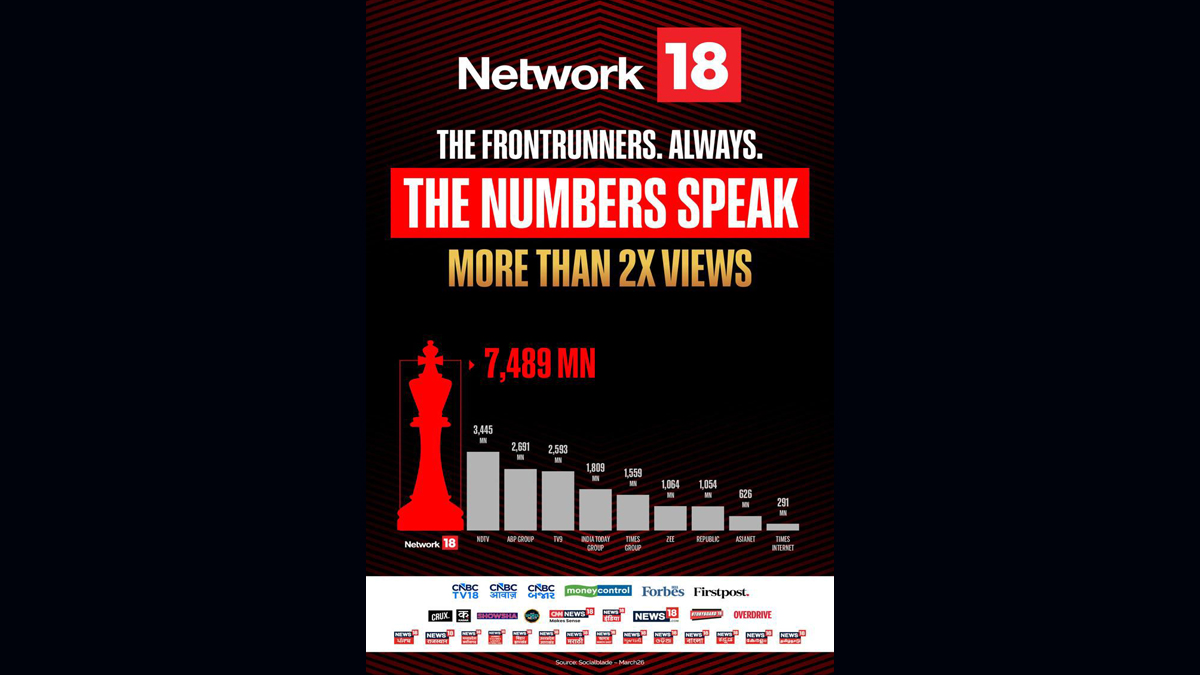
MUMBAI: When the world hit refresh on breaking news, Network18’s channels were already streaming ahead. As geopolitical tensions and war-driven headlines fuelled a surge in global news consumption, the network’s digital playbook delivered big clocking record Youtube viewership across English, Hindi and business news categories in March 2026.
At the forefront was CNN-News18, which emerged as the clear leader in the English news segment with 130 million live and video-on-demand views. The channel edged past competitors such as Times of India (126.5 million), Times Now (101.1 million), India Today (88.2 million) and NDTV (77.5 million), according to Databeings data for March.
In the Hindi news arena, News18 India delivered a commanding performance, racking up a staggering 3,297 million views on YouTube. The channel comfortably outpaced NDTV India, which recorded 3,119 million views, underlining its deep reach and consistent engagement with mass audiences, as per Playboard data.
The network’s dominance wasn’t confined to general news. In the Hindi business segment, CNBC Awaaz topped the charts with 92 million views, narrowly ahead of Zee Business (90 million) and well ahead of ET Now Swadesh (57 million). Meanwhile, its English counterpart CNBC-TV18 posted a strong 58 million views, reinforcing the network’s cross-category strength.
The spike in viewership reflects a broader shift in audience behaviour, with viewers increasingly turning to digital platforms particularly Youtube for real-time updates and in-depth coverage during high-intensity news cycles. For Network18, the numbers signal more than just scale; they underline the effectiveness of a multi-platform strategy that blends speed, credibility and continuous coverage.
In a month where the news never paused, it seems viewers chose to stay tuned where the stream never stopped.






