Cable TV
What will it take to make Indian CAS acceptable to MSOs?


KOLKATA: Despite the overwhelming importance of Conditional Access System (CAS) in the overall content distribution network, there have been few discussions on CAS. Moreover, the market has been dominated by foreign vendors for a long time now. If the government comes up with clear standardisation of CAS and offers Indian vendors viable, competitive solutions, the transition may begin, believe industry leaders.
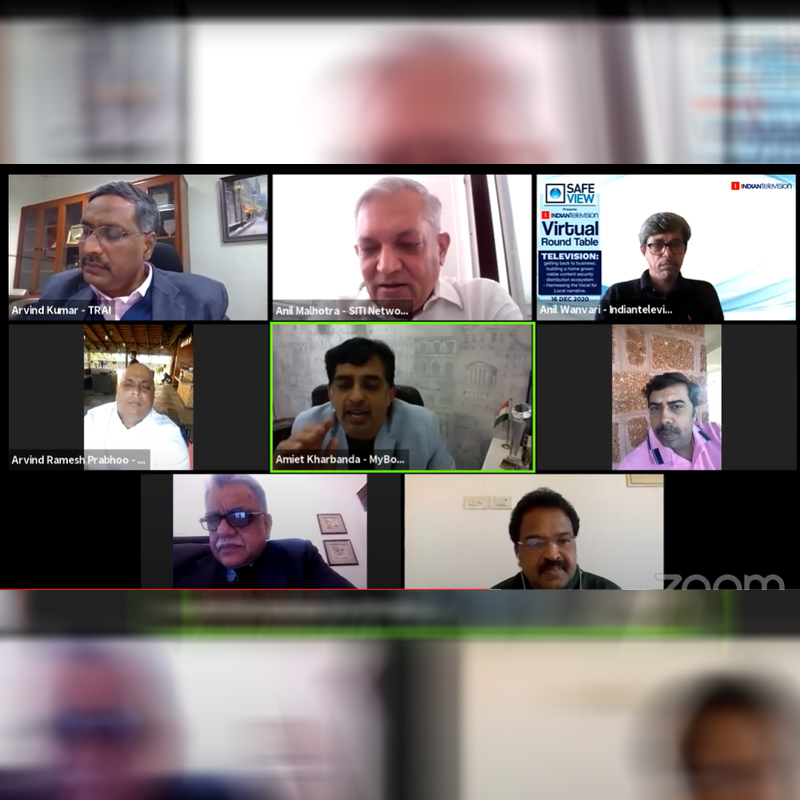
At a virtual roundtable organised by Indiantelevision.com, moderated by founder, CEO & editor-in-chief Anil Wanvari, panellists discussed how the cable industry can be self-reliant in terms of security equipment and technology. TRAI advisor (broadcasting & cable service) Arvind Kumar, MyBox Technologies MD and CEO Amit Kharbanda, SITI Networks Ltd CEO Anil Malhotra, Maharashtra Cable Operators Federation (MCOF) president Arvind Ramesh Prabhoo, Metro Cast Network promoter Nagesh Narayandas Chhabria, Kerala Communicators Cable Ltd (KCCL) business head N Padmakumar, Safe View chairman Pradeip Nanda participated in the session.
What did MSOs look for while setting up a security system during digitisation?
The moderator kickstarted the session asking what were the main areas looked at by MSOs while setting up a security system during digitisation. Malhotra mentioned that the whole purpose of addressability post digitisation is lost without proper security in place. He shared that his MSO focuses on a robust system, ease of operation, 24/7 support system, scalability, the ability to satisfy broadcasters’ audits while choosing a security system.
“Unfortunately, there is no security which is fool-proof and every security will get breached after a certain period of time. You have to consider a security system that survives the onslaught of hackers for up to 12 years at least, which is the life of an STB. When we choose anything for our network, we keep these things in mind,” Malhotra added.
In 2013-14, Metro Cast had surveyed which CAS vendors had already deployed services to more than a million or two million customers before selecting one, shared Chhabria. Initially, they went to European CAS vendors but later moved on to Chinese vendors as their service was 30-40 per cent cheaper. Unfortunately, there was no significant Indian CAS vendor at that time, he noted.
MCOF’s Prabhoo said that the local cable operators had limited choice because CAS and SMS as per regulation were supposed to be in the purview of MSO. So, they had very little say in which are the STBs and which is the backend SMS. It was the MSO that had the onus of choosing it.
“On the broadband and internet side, the first important thing was what was the availability. Therefore, with a ban on products from China, we had to look into more Indian products – which is cost-effective – and what service we got from them. These were the prime considerations while we were upgrading our networks,” he commented.
Is ‘Vocal for Local’ story taking off?
“Efforts should be made to adopt Indian technologies. Entrepreneurs, vendors didn’t have aspirations to become big or go global in the past. Now after a major push by the government in terms of initiatives and the narrative of vocal for local, they are aspiring to grow. But they can’t do it without support from the service providers who are catering to the masses. The supply chain must be endorsed by DTH operators, MSOs, whoever in the chain, then only it will encourage new or existing entrepreneurs,” TRAI’s Kumar said.
For instance, Safe View is a domestic producer who is very keen on working with Indian MSOs. Nanda mentioned that it is a 100 per cent Indian company and 120 small and big MSOs work with it. Moreover, it has a huge footprint overseas. Safe View has been in the market for six years with three million subscribers on its system.
Talking about the trust deficit with Indian vendors, KCCL’s Padmakumar added that the concern is more about security and quality. In his view, CAS should be secured entirely so that customers don't get affected and there should not be any scope for piracy in the system. If domestic players can provide such CAS internally, the industry would be happy to utilise their services, he said. However, it should be cost-effective as well.
On the other hand, Malhotra pointed out that Indian CAS entered quite late in the market, when the majority of the STBs had already been deployed. Had they come at the beginning of 2012 as the MSOs were deciding which CAS to take, the majority of STBs would have bought from Indian companies only.
“Even now also with Atmanirbhar Bharat, we are not seeing a push on the set top boxes because it is not an overnight thing. One needs to start integrating and create a road map. The Indian companies are still not talked about much, because there’s still hope that the government will understand and let imports continue. Six months later we will say we do not have the same volume that we have even now. However, the government is very clear now, Make in India cannot be an assembled product. And that for me is where we missed the bus time and again,” Kharbanda elaborated.
Chhabria also noted that the manufacturers are not getting total support from the Centre in keeping prices competitive. Naturally, price conscious MSOs are going for the Chinese players. If the same product is given at a competitive rate, then they would love to go with the Indian product. Hence, he is of the view that the government has to support the manufacturers with some incentives.
“As far as TRAI is concerned, we have already given recommendations on indigenous telecom equipment manufacturing. We are also mulling over what we can do for the broadcasting sector also. Recommendations on interoperability of STB have already been given. I think this is the right time to blend vocal for local narrative with interoperable STBs. Security part also becomes stronger with indigenous technology,” TRAI’s Kumar commented.
Standard guidelines for CAS is need of the hour:
However, all the MSOs agreed that adoption will be higher once TRAI comes up with clear guidelines and standardisation of CAS. In addition to that, if TRAI or an independent agency starts certification of CAS, then it will enhance the trust of MSOs. Testing procedures for CAS in the country also need to be initiated as early as possible.
“Every stakeholder has to play a role. There is a role for the government and the regulator also. We are making a framework for standardisation and I think that will happen very soon. In telecom, we had given recommendations to the government on telecom equipment manufacturing. Similar recommendations can be given to the government for the broadcasting sector. Most importantly, stakeholders, especially MSOs, have to come forward to use Indian-origin technology. It should be their call that at least all STB or CAS should be replaced by homegrown tech in future. As far as CAS is concerned, it is a question of only a thousand distributors who have to adopt indigenous technology. Hence, it should be the MSOs' will to support Indian CAS vendors,” Kumar stated.