English Entertainment
Warner Bros. Discovery posts Q2 net loss of $3.4 mn


Mumbai: Media conglomerate Warner Bros. Discovery has announced that second quarter revenues were $9.8 million, a one per cent decrease compared to the prior year quarter. Net loss was $3.4 million and included $2oo4 million of amortisation of intangibles, $1033 million of restructuring and other charges, and $983 million of transaction and integration expenses.
Adjusted Ebitda was $1.6 million. Cash provided by operating activities increased to $1 million and reported free cash flow increased to $789 million. The company ended the quarter with $3.8 million of cash on hand, gross debt of $53 billion and net leverage of 5x. It ended the quarter with 92.1 million global DTC subscribers, an increase of 1.7 million versus 90.4 million subscribers at the end of the first quarter, as adjusted for the company’s new DTC subscriber definition. The new definition resulted in the exclusion of 10 million legacy Discovery non-core subscribers and unactivated AT&T mobility subscribers from the Q1 subscriber count.
“We’ve had a busy, productive four months since launching Warner Bros. Discovery and have more conviction than ever in the massive opportunity ahead. We have the most powerful creative engine and bouquet of owned content in the world, as highlighted by our industry-leading 193 Emmy nominations, and we intend to maximise the value of that content through a broad distribution model that includes theatrical, streaming, linear cable, free-to-air, gaming, consumer products and experiences and more, everywhere in the world. We’re confident we’re on the right path to meet our strategic goals and really excel, both creatively and financially, and couldn’t be more excited about the future of our company” said WBD president, CEO David Zaslav.

Networks reported revenues were $5.7 million an increase of one per cent. Ad revenue increased by two per cent, primarily driven by strong demand for sports advertising, partially offset by lower news, kids, and general entertainment performance in the US International networks were impacted by modest declines in EMEA, offset by growth in Latin America, excluding the impact of Chilevisión, which was sold in September 2021.
Distribution revenue decreased by one per cent, as increases in US contractual affiliate rates were more than offset by a decline in linear subscribers in the US and lower contractual affiliate rates in some European markets. Networks reported operating expenses were $3.4 million. Adjusted Ebitda was $2.62 million.
Studios reported revenues were $2.7 million a growth of four per cent. Games were a strong contributor behind the release of “Lego Star Wars – The Skywalker Saga.” TV licensing revenues declined due to lower TV production revenue, partially offset by the timing of new series availabilities for distribution. Theatrical performance was unfavourably impacted by the timing of releases. Home entertainment across theatrical and television products was down due to strong Covid-induced demand in the prior year quarter. Studios reported operating expenses were $2.5 million. Adjusted Ebitda was $239 million.
DTC revenues were $2.2 million. Revenues increased by four per cent. Ad revenue increased to $98 million, primarily driven by the launch of the HBO Max ad-supported tier in June 2021 and subscriber growth on the discovery+ ad-lite tier. Distribution revenue increased by one per cent. Global retail subscriber gains at discovery+ and HBO Max compared to the prior year quarter were largely offset by lower domestic wholesale subscribers resulting from the Amazon Channels expiration in September 2021 for HBO Max. DTC’s operating expenses were $2.7 million. Adjusted Ebitda was a loss of – $518 million.







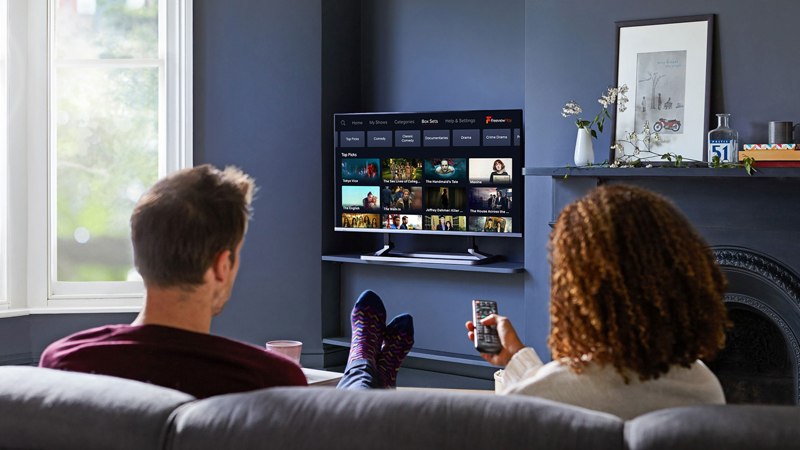
UK: The aerial is losing its grip. As broadband becomes the default way Britons watch television, the UK is edging towards a decisive, and divisive, question: should Freeview be switched off by 2034? The issue, highlighted in reporting by The Guardian, has exposed deep fault lines over access, affordability and the future of public service broadcasting.
For nearly 25 years, Freeview has delivered free-to-air television from the BBC, ITV, Channel 4 and Channel 5 to almost every corner of the country. Even now, it remains the UK’s largest TV platform, used in more than 16m homes and on around 10m main household sets. Yet the same broadcasters that built it are now pressing for its closure within eight years.
Their case rests on a structural shift in viewing. Smart TVs, superfast broadband and the Netflix-led streaming boom have pulled audiences online. Advertising economics have followed. By 2034, the number of homes using Freeview as their main TV set is forecast to fall from a peak of almost 12m in 2012 to fewer than 2m, making digital terrestrial television, or DTT, increasingly costly to sustain.
But critics say the rush to switch off risks abandoning those least able, or least willing, to move online.
“I don’t want to be choosing apps and making new accounts,” says Lynette, 80, from Kent. “It is time-consuming and irritating trying to work out where I want to be, to remember the sequence of clicks, with hieroglyphics instead of words. If I make a mistake I have to start again.”
Lynette is among nearly 100,000 people who have signed a “save Freeview” petition launched by campaign group Silver Voices. She fears the government is about to “take [Freeview] away from me and others who either don’t like, can’t afford, or can’t use online versions”.
Official figures underline the fault lines. A report commissioned by the Department for Culture, Media and Sport estimates that by 2035, 1.8m homes will still depend on Freeview. Ofcom’s analysis shows those households are more likely to be disabled, older, living alone, female, and based in the north of England, Wales, Scotland and Northern Ireland.
Freeview is owned by the public service broadcasters through Everyone TV, which also operates Freesat and the newer streaming platform Freely. After two years of review, DCMS is expected to set out its position soon, drawing on three options proposed by Ofcom: a costly upgrade of Freeview’s ageing technology; maintaining a bare-bones service with only core PSB channels; or a full switch-off during the 2030s.
The broadcasters have rallied behind the third option. They argue that 2034 is the logical cut-off, when transmission contracts with network operator Arqiva expire. By then, they say, the cost of broadcasting to a dwindling audience will far outweigh the returns from TV advertising.
Ofcom agrees a crunch point is approaching. In July, the regulator warned of a “tipping point” within the next few years, after which it will no longer be commercially viable for broadcasters to carry the costs of DTT.
Others see risks beyond economics. Questions remain over whether internet TV can reliably deliver emergency broadcasts, such as the daily Covid updates, in the way that universally available DTT can. The UK radio industry has also warned that an internet-only future for TV could push up distribution costs and force some radio stations off air if PSBs no longer share Arqiva’s mast network.
“It is a political hot potato,” says Dennis Reed, founder of Silver Voices, who says he has “dissociated” his organisation from the government’s stakeholder forum, which he believes is “heavily biased” towards streaming.
The Future TV Taskforce, representing the PSBs, counters that moving online could “close the digital divide once and for all”. “We want to be able to plan to ensure that no one is left behind,” a spokesperson says, adding that rising DTT costs could otherwise mean cuts to programme budgets.
The numbers show the scale of the challenge. Of the 1.8m Freeview-dependent homes projected for 2035, around 1.1m are expected to have broadband but not use it for TV. The remaining 700,000 are forecast to lack a broadband connection altogether.
Veterans of the analogue switch-off, completed in 2012 after 76 years, recall similar fears of “TV blackout chaos”. Around 6 per cent of households were labelled “digital refuseniks”, yet a targeted help scheme and a national campaign, fronted by a robot called Digit Al voiced by Matt Lucas, delivered a largely smooth transition.
This time, the BBC is less keen to foot the bill. Tim Davie, the outgoing director general, has said the corporation should not fund a comparable support programme for a Freeview switch-off.
Research for Sky by Oliver & Ohlbaum suggests that with early awareness campaigns and digital inclusion measures, only about 330,000 households would ultimately need hands-on help ahead of a 2034 shutdown.
Meanwhile, viewing habits continue to fragment. Audience body Barb says 7 per cent of UK households no longer own a TV set, choosing to watch on other devices. In December, YouTube overtook the BBC’s combined channels in total UK viewing across TVs, smartphones and tablets, albeit measured at a minimum of three minutes.
That shift may accelerate. YouTube has recently blocked Barb and its partner Kantar from accessing viewing session data, limiting transparency just as online platforms consolidate power.
“When the government chose British Satellite Broadcasting as the ‘winner’ in satellite TV it was Rupert Murdoch’s Sky instead that came out on top,” says a senior TV executive quoted by The Guardian. “There already is such an outsider ready to be the winner in the transition to internet TV; it is YouTube.”
Freeview’s future now hangs on a familiar British dilemma: modernise fast and risk exclusion, or protect universality and pay the price. Either way, the aerial’s days as king of the living room look numbered.






