iWorld
Vidnet2018: Regionalisation, localisation the way forward for the OTT industry

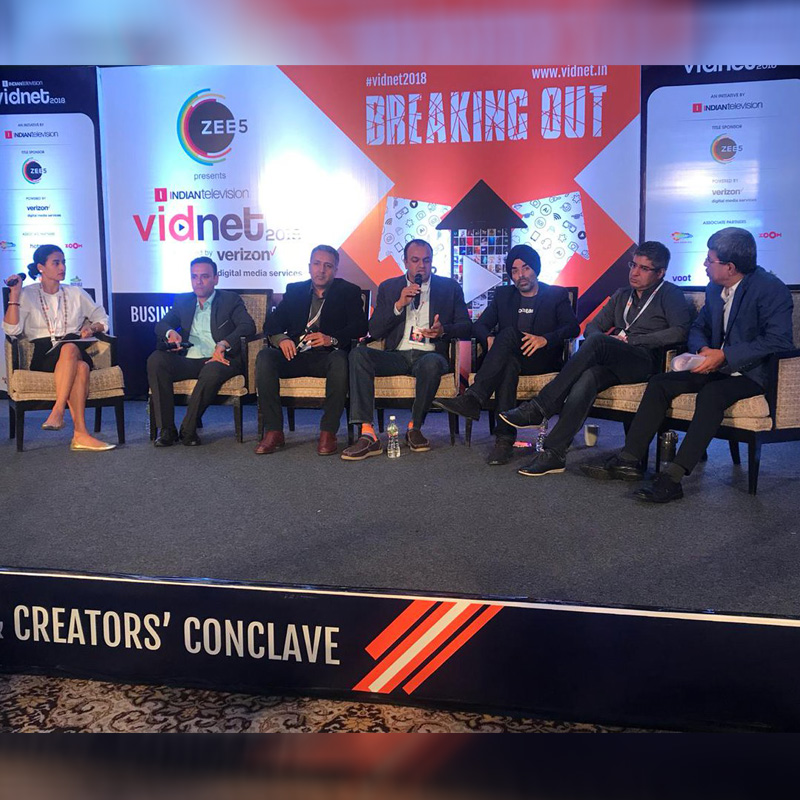
MUMBAI: Over the top (OTT) is no more a baby. The ecosystem has been eating and growing slowly, taking centre stage in several media and entertainment related scenarios.
On the stage of Vidnet 2018, hosted by Indiantelevision.com, experts from India’s leading OTT platforms were present. ZEE5 India CEO Tarun Katial, Amazon Prime Video India business director and head Gaurav Gandhi, YouTube India entertainment head Satya Raghavan, Voot head marketing and partnerships Akash Banerji and Hotstar consumer and revenue lead Prabh Simran Singh shared their key learning in a session named ‘Lessons from Battlefronts’.
Moderator of the session, Indiantelevision.com founder, CEO and editor in chief Anil Wanvari made the prelude of the session saying that it has been few years since the OTT ecosystem started in India and how it has been challenging since then. He also mentioned YouTube has been a pioneer much before any other platform. Another leading platform Hotstar came in later. He started the discussion asking market leader YouTube's Raghavan what have been the lessons over the years in terms of consumers, consumption and the way the market is playing out.

While asked what the industry has learnt, Raghavan mentioned a very important point that is obviously putting consumer the “queen” before anything. He shared how consumer taste and presence dictate the core of content.
“Second is that it takes a whole village to build this entire ecosystem. It was only when accessibility opened up and all of us saw that it’s not just that 100 or 150 million people who are out there to consume a content. The depth is just amazing that this country has as evident by television. So when we saw access open up, when we saw consumers coming up from every part of the country, creation started to follow. Today, there are creators on YouTube who are uploading content from over 400 locations in the country,” he added.
Gandhi, now with Amazon Prime Video India, saw the OTT industry very closely since a nascent stage. According to him, people are hungry for good stories and Prime Video goes bigger with every original show. Added to that, he thinks going regional is essential for streaming services given the diversity of the Indian market. He also highlighted the fact that adding value to service makes customers want to pay.
“I think given how diverse we are for streaming, regional is essential. The more you go regional, the bigger counts you get. We have now six languages of content. We have seen tremendous growth there. We have introduced Hindi UI, we will be following up it with Tamil and Telugu very soon. So, regionalisation and localisation is the second big thing,” Gandhi commented.
Agreeing with Gandhi, Katial also highlighted the importance of going more regional and adding more languages to the library. While tech giant Google has been promoting voice search lately, Katial also believed that both in the top and bottom end of the market, searching by ‘type’ is not the way to go. Considerably, ZEE5 has voice search available in 12 languages.
Voot’s Banerji added to these insights that delivering a good viewing experience for consumers is essential along with good content. Banerji also added that as a platform Voot believes that the depth of content in the library is important along with the width.
For Hotstar, live sports has been very critical in building its business. Breaking the myth that sports is a large screen experience, Prabh Simran Singh commented that consumers also love to watch it on the small screen. Rather than screen, moment matters. He also added that uni-dimensional focus on business model helps as Hotstar built both SVOD and AVOD category side by side.
All the experts also agreed on the polarised nature of the Indian market. While there are consumers wanting low bandwidth video, there are plenty of them wanting HD quality video. One segment may fit into AVOD business model, another one for high-end subscription. Smart TVs are emerging as an important device for consumption at the same time with feature phones priced at Rs 1500. While young audience still dominates digital space, consumption of spiritual content in older age group, educational content among kids are likewise prevalent.
“There is no one type of customer, there are so many kinds of customers and it is how we fulfill their desire. The biggest challenge we have is how our storytelling can keep pace with people’s desire and provide the kind of content they want,” Gandhi commented.
However, a comment from Raghavan sums up the most unique nature of OTT industry here. According to him rather than a battlefront, the Indian market is an amazing place to partner and collaborate with multiple players in the entire value chain.






iWorld
JioHotstar enters micro-drama space with 100 shows under Tadka banner
Short-form push targets 300M users as content meets commerce in new format
MUMBAI: JioStar has made a bold play in India’s fast-growing micro-drama space, rolling out over 100 short-form shows under its new Tadka banner on JioHotstar, timed with the massive viewership surge of the Indian Premier League 2026.
The scale of the launch signals clear intent. Rather than testing the waters, the company has dived in headfirst, releasing a wide slate of content on day one. Each show is designed for quick consumption, with episodes running 60 to 90 seconds in a vertical format tailored for mobile-first audiences.
The move comes as India’s micro-drama market, currently valued at around $300 million, is projected to grow tenfold to over $3 billion by 2030. Globally, the format has already proven its mettle, with China’s micro-drama sector recording explosive growth in recent years.
What sets this rollout apart is its built-in monetisation strategy. The shows are free to watch and ad-supported, with brand integrations woven directly into storylines from the outset. It reflects a broader shift where content and commerce are increasingly intertwined, rather than operating in silos.
The timing is equally strategic. With more than 300 million users already tuning in for IPL action, JioHotstar is effectively turning cricket’s biggest stage into a discovery engine for its new format.
The company is not entering an empty arena. Early movers like Kuku TV, MX Player and platforms backed by Zee Entertainment Enterprises have already laid the groundwork, building audiences and validating demand for snackable storytelling.
Now, with scale, distribution and advertiser interest aligning, the big players are stepping in. For JioStar, Tadka may well serve as a proving ground for the next evolution of digital entertainment, where every minute counts and every second sells.
If the bet pays off, India’s next big content wave might just arrive in under 90 seconds.






