iWorld
Vidnet Summit 2023: The role of subscription in an increasing AVOD/FAST world

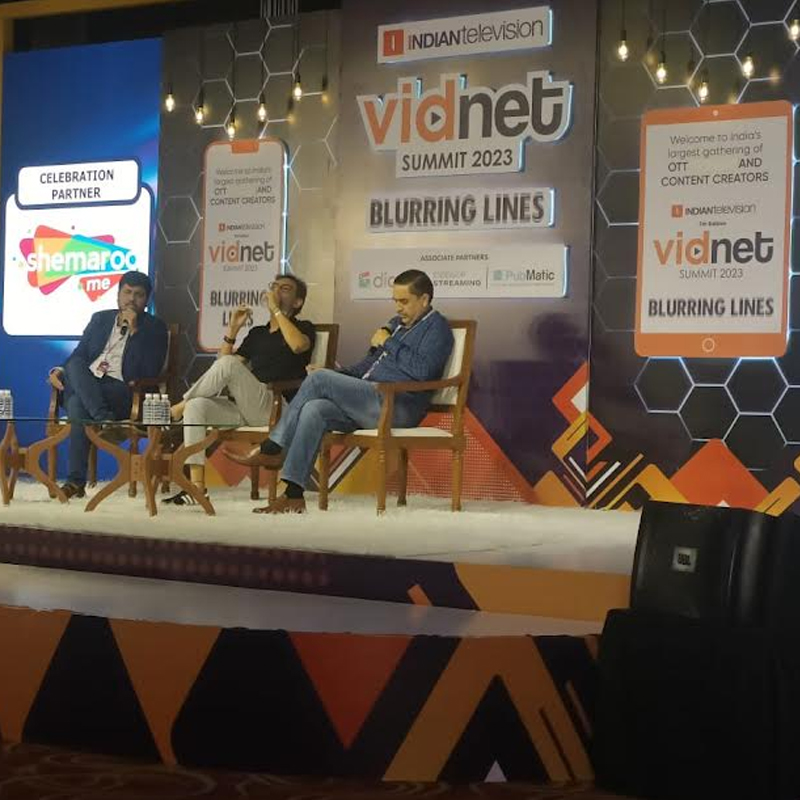
Mumbai: Today the lines are blurred as the streaming business is getting more complex and complicated, as monetization gets unclear. There is so much disruption happening, AVOD is offering SVOD and vice versa. Premium content is provided absolutely free and much more happening in this sector. Subscriber add-ons are slowing down. Time spent viewing on OTTs has plateaued for almost each and every platform, and high churn continues despite attractive annual schemes being offered by them. However, the good news is that the paid OTT subscription market in India continues to excite an increasing number of advertisers who are willing to put out their ads on these platforms. Mobile continues to be the main device of consumption even as connected TVs are increasingly getting into Indian homes. Investments in content continue to burgeon as viewers’ insatiable appetite continues to demand more and more.
It is certain that this new ecosystem is calling for new relationships to be forged, new partnerships to be developed as TV manufacturers, Cable TV, and DTH, and telcos and other aggregators’ presence as gatekeepers to their customers is increasingly being felt. So, what is the way forward for the OTT platforms? Where do the opportunities lie? What are the challenges?
This year’s Vidnet 2023 looked at all these scenarios and more, and found answers to some of these questions along with experts from the industry.
The fourth panel was chaired by Kurate Digital Consulting founding partner Uday Sodhi, and the panelists included ShemarooME head – OTT Abhishek Joshi and PlayboxTV founder & CEO Aamir Mulani. The topic of the panel discussion was – The role of subscription in an increasing AVOD/FAST world.
The question is where is the money? Sodhi started by talking about subscription, “How do you see the subscription ecosystem, how many subscribers are there in India today, what is the growth rate, and how is the market evolving?”
Mulani said, “Subscribers are always there, and will always be there. But the only transition that is happening today is that the consumer is platform-agnostic. If the content is right/good on one platform, then the consumer would go to that platform. Loyalty is missing from the subscriber front – the loyalty is for good content not for the platform. It was always like that. It has been so since the old television days – earlier people used to switch channels, and now they switch platforms. The only way forward is to make sure you get a recurring subscription by bundling OTT. That is my view to getting recurring subscription revenue out of this scenario.”
Joshi mentioned, “2015 – OTT was born in the country. It has been eight years now. In entertainment, there has not been a single true innovation in this ecosystem, there have only been interventions. The interventions have been from the environment – one, was Jio, and the other was unfortunately covid. During the bad times of covid, the OTT businesses, subscribers grew multifold.”
He added further, “Coming to the point of subscriptions, one unique subscriber subscribes to 2 – 2.5 subscriptions, so about 50-55 million unique subscribers in the country would have about 100-125 million subscriptions in the country. But what we should also realise is that we as an industry, knowingly or unknowingly, have created a line between haves and have-nots. Earlier that was not the case. Content should and has always been democratic. What we have unknowingly done is if you have the ability and capability to pay, then you get a chance to watch or experience premium content. Or go to the free side, and watch what the world is watching.
In a country like India, where there is mass, free content will always generate more engagement, more users, and more consumers. Hence the opportunity to build a steady revenue stream. Whereas that is not true when you are asking for two things – eyeballs, and money. So that’s a slightly steep curve.”
On a concluding note, Sodhi brought up the point about password sharing– how to protect and stop password sharing, or is this something we have to live with? Mulani revealed that technically, everything is possible – it’s that as a platform they don’t want to do it. “It’s also about sampling your content and making people talk about it. It’s very easy to protect all of this, but globally also it has been noted that even if you get 10 per cent of the paying audience, it will help you get 90 per cent of revenue from it. Joshi concluded by pointing out the truth, “Password sharing is for the rich – the poor can’t afford it.”






