iWorld
Vidnet Summit 2023: Is Connected TV Driving The Next Phase of Advertising Growth on OTT?

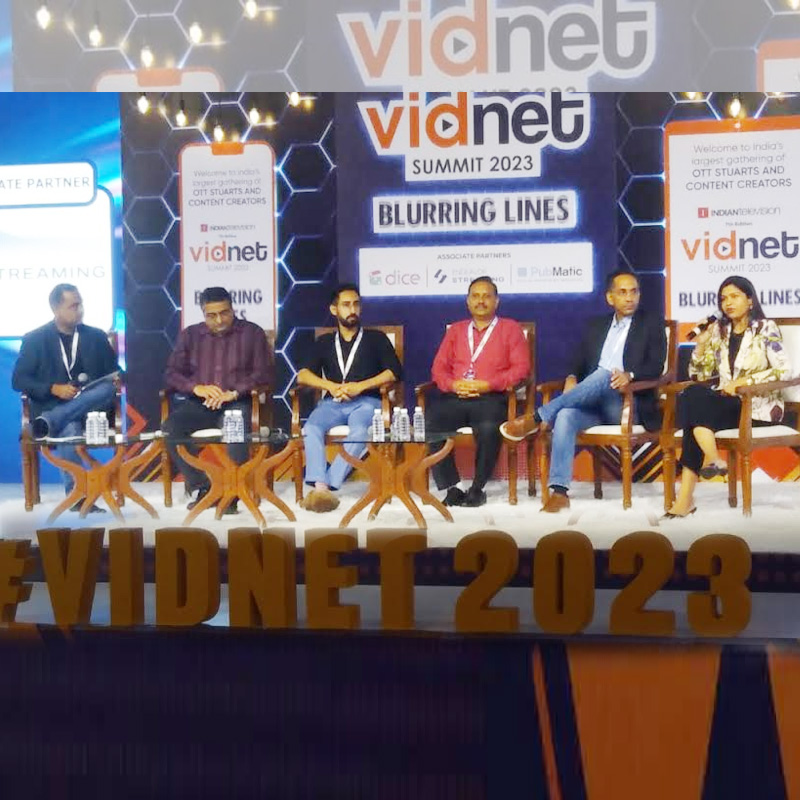
Mumbai: Mumbai: Today the lines are blurred as the streaming business is getting more complex and complicated, as monetization gets unclear. There is so much disruption happening, AVOD is offering SVOD and vice versa. Premium content is provided absolutely free and much more happening in this sector. Subscriber add-ons are slowing down. Time spent viewing on OTTs has plateaued for almost each and every platform, and high churn continues despite attractive annual schemes being offered by them. However, the good news is that the paid OTT subscription market in India continues to excite an increasing number of advertisers who are willing to put out their ads on these platforms. Mobile continues to be the main device of consumption even as connected TVs are increasingly getting into Indian homes. Investments in content continue to burgeon as viewers’ insatiable appetite continues to demand more and more.
It is certain that this new ecosystem is calling for new relationships to be forged, new partnerships to be developed as TV manufacturers, Cable TV, and DTH, and telcos and other aggregators’ presence as gatekeepers to their customers is increasingly being felt. So, what is the way forward for the OTT platforms? Where do the opportunities lie? What are the challenges?
This year’s Vidnet 2023 will look at all these scenarios and more, and find answers to some of these questions along with experts from the industry.
The moderator for this session was EssenceMediacom India managing partner Vishal Shah and the panellists were Mahindra & Mahindra (Automatic) head- integrated media & agency relations Sonam Pradhan, Sugar Cosmetics head of marketing Avtej Sawhney, Parle Products Pvt. Ltd. senior category head Krishnarao Buddha Thomas Cook (India) Ltd. president & group head- marketing, service quality, value added services & innovations Abraham Alapatt and ITC Ltd. head media & brand PR Jaikishin Chhaproo.
Shah began the session by asking, “What is the role of CTV and OTT playing in driving the marketing, advertising and communications for different brands which you all are working for and the different categories?”
To this, Pradhan answered, “ For us, CTV is one of the most critical platforms that we need to be present on. I dont need to stress the emphasis on it, but when it comes to the premium audience that brands like Mahindra needs to target. If I am not present on CTV, I miss the audience sitting in my house. So how do I not miss the audience sitting in my house that’s exactly the kind of sample size I would like to put for everybody who is a Mahindra audience. So ranging from the different brands that we have, from the most premium vehicle to the commercial vehicles, CTV becomes an integral part of my media campaigns.”
Alapatt shared his views, “CTV is an essential part of our media plan given the data that are already available and we can discuss the data accuracy later. Right now it is available at about 88 to 89 per cent of urban households typically use CTVs or have access to it. 60 million people watch YouTube on CTV and that’s really the slice of the audience we would like to target.”
Buddha told, “We at Parle believe in being where our audiences are. Though we acknowledge that CTV is being adopted quite quickly and very fast particularly post covid and with production of 4g and 5g. Considering the nature of our product portfolio which is extremely mass in nature we have Parle platina which is the premium offering. We do acknowledge and look forward to certain concrete numbers before we sort of start boarding CTV.”
Sawhney commented, “ I think it’s a trend that’s here to stay. We got 28 million households with CTV and expected to go up to 40-50 million in the next four-five years. Of course, we will see if it really pans out that way. It obviously changes the way we are able to deploy our media money. It gives us access again in a world where now there are four-five screens in a household we suddenly got CTV, which again allows you to go back and put your ads on the big screen. And I also feel that the size of the screen also has a very big role to play in terms of retention and consideration for brands. The way we do our planning regarding conversions also kind of changes in CTV.”
Chhaproo said, “As an advertiser, one of the key things is I am going to have an ROI for whatever I do. I am gonna make sure whatever investments are going in are reaching out in terms of connecting with the audiences. Today if you want to dig into any data for CTV, there will be only a handful of inputs and numbers you will get.”
Lastly, Shah concluded the session by saying that CTV is definitely promising and all of the panellists shared the same view that the numbers are consistently growing and it cannot be ignored.






