Budget
Union Budget 2026 targets 7 strategic sectors to scale manufacturing and global competitiveness


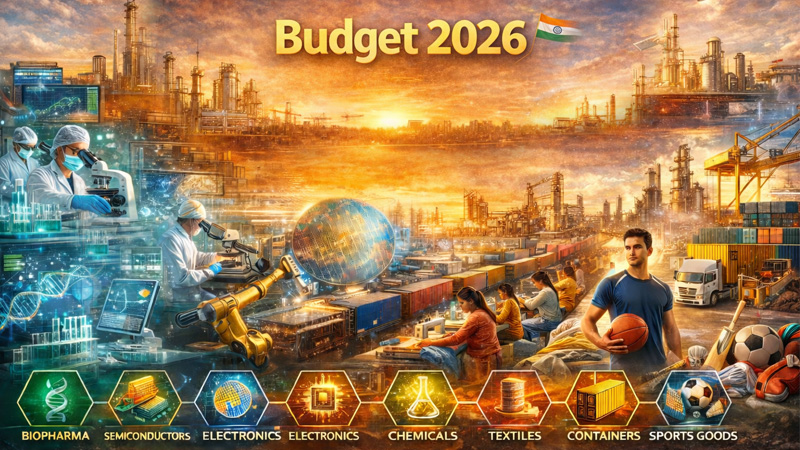
NEW DELHI: Union Budget 2026-27 lays out an ambitious plan to scale up manufacturing across seven strategic and frontier sectors, finance minister Nirmala Sitharaman said in Parliament, forming part of the six areas under the ‘First Kartavya’ framework.
Biopharma SHAKTI aims to develop India as a global biopharma hub, with ₹10,000 crore over five years. The initiative will expand domestic production of biologics and biosimilars, establish a biopharma-focused network with three new NIPER institutes, upgrade seven existing ones, and create over 1,000 accredited India Clinical Trial sites. The Central Drugs Standard Control Organisation will be strengthened with a dedicated scientific review cadre to meet global standards.

The semiconductor sector gets a boost with India Semiconductor Mission 2.0, focused on producing equipment and materials, designing full-stack Indian IP, fortifying supply chains, and developing industry-led R&D and training centres to upskill the workforce. The Electronics Components Manufacturing Scheme, launched in 2025 with ₹22,919 crore, will now see an outlay of ₹40,000 crore.
To tap mineral-rich states, the Budget proposes Rare Earth Corridors in Odisha, Kerala, Andhra Pradesh and Tamil Nadu, supporting mining, processing, research and manufacturing of rare earth permanent magnets.
For chemicals, three dedicated Chemical Parks will be set up on a cluster-based, plug-and-play model via challenge route to enhance domestic production and reduce import dependence.
Capital goods and construction equipment will get a fillip through Hi-Tech Tool Rooms in two locations, digitally-enabled for design, testing and manufacturing of high-precision components. A Construction and Infrastructure Equipment (CIE) Scheme will strengthen domestic production of lifts, fire-fighting gear, tunnel-boring machines and other high-value equipment. A Container Manufacturing Scheme with ₹10,000 crore over five years will create a globally competitive ecosystem.
The textile sector will see an Integrated Programme with five sub-components:
1. National Fibre Scheme – self-reliance in natural fibres (silk, wool, jute), man-made and new-age fibres.
2. Textile Expansion and Employment Scheme – modernisation of clusters with machinery, technology upgrades and common testing/certification centres.
3. National Handloom and Handicraft Programme – targeted support for weavers, artisans and rural industries.
4. Tex-Eco Initiative – promote globally competitive and sustainable textiles and apparels.
5. Samarth 2.0 – modernise textile skilling ecosystem via industry-academia collaboration.
Mega Textile Parks will be set up in challenge mode. The Mahatma Gandhi Gram Swaraj initiative will strengthen khadi, handloom and handicrafts, supporting training, skilling, quality processes and global market linkages.
Finally, the Budget backs sports goods manufacturing, promoting research, innovation in equipment design and material sciences, positioning India as a hub for high-quality, affordable sporting equipment.
From Biopharma to semiconductors, electronics, chemicals, textiles, containers and sports goods, Budget 2026-27 lays a comprehensive, integrated roadmap to make India a global manufacturing powerhouse, blending technology, infrastructure, skills and innovation to boost productivity, jobs and competitiveness.
Industry reactions:
Senthil Kumar Hariram, MD and Founder, FTA Global:
“For the advertising and marketing industry, Budget 2026–27 signals a clear recognition of the services sector as a key growth engine, particularly through its focus on AI and emerging technologies. While there could have been more targeted measures for smaller service-led companies, the intent to simplify compliance, expand MSME financing, and invest in Tier-2 and Tier-3 infrastructure is a positive step. Evaluating the impact of AI on jobs and the services sector is timely for marketing and communications, as AI is already redefining how insights are generated, content is created, media is optimised, and campaigns are measured. The next step is ensuring AI adoption goes hand in hand with upskilling, enabling long-term, sustainable growth.”
Rajiv Chilaka, Founder & CEO, Green Gold Animation:
“The Finance Minister’s renewed focus on the AVGC sector and structured content creation at school and college levels is a transformative step for India’s creative economy. By establishing Animation, VFX, Gaming and Comics Content Creator Labs across thousands of educational institutions, the government is building a deep, sustainable talent pipeline aligned with the industry’s projected requirement of nearly 2 million professionals by 2030. The strong push for regional content creators, access to world-class tools, training and production ecosystems, will accelerate original IP creation in local languages, expand employment opportunities, and fuel India’s cultural exports globally. These measures strengthen skill development and lay the foundation for India to emerge as a global hub for high-value digital content, gaming, and animation production.”
Vishal Goenka, Co-Founder, IndiaBonds.com:
“Small policy moves for the bond market, with the market-making framework, will enhance liquidity in the secondary market, and introduction of bond indices will bring more transparency for pricing and hedging credit risk. Big boost for municipal bond issuance with incentives up to ₹100 crore. Streamlining 15G/15H TDS exemption forms for inpiduals will ease retail bond investment. Although fiscal prudence is shown with 4.4 per cent fiscal deficit for FY26 and 4.3 per cent projected for FY27, the larger-than-expected gross borrowing plan of ₹17.2 lakh crore may worry markets, despite net borrowing of ₹11.7 lakh crore being in line. All eyes now on RBI policy to address bond market concerns.”
Karan Agarwal, Director, Cox & Kings:
“What stood out for me is that the Budget doesn’t treat travel as a one-sided story. Cutting TCS on foreign tour packages to 2 per cent corrects friction in outbound travel. On inbound travel, the focus on cultural and experiential tourism—archaeological sites, Buddhist circuits, skilled local guides—shifts India from crowded and transactional to curated and experience-led tourism. If executed well, this could transform Indian tourism and create long-term value for travellers, local communities and businesses.”