News Broadcasting
UK viewers for more visibility of disabled people on TV


LONDON: Television viewers show a high degree of acceptance of disabled people on screen, with 79 per cent saying they would not mind if a disabled person read the main evening news bulletin, The findings are contained in a new research Disabling Prejudice which was commissioned by the BBC, the Broadcasting Standards Commission (BSC) and Independent Television Commission (ITC).
The report also notes that broadcasters appear more cautious, concerned with perceived audience prejudices, ratings and other possible constraints.
The majority of viewers (61 per cent) say that there should be more portrayals of disabled people on television in a wide variety of roles, including as presenters. The inclusion of disabled people in television advertising was also welcomed, particularly where it challenges negative stereotypes or actively promotes positive images of disabled people.

The report examines attitudes towards disability, and the representation of disability on television, by both disabled and non-disabled viewers, and by broadcasting industry professionals.
ITC chief executive, Patricia Hodgson said: “The feedback we have had from viewers and from industry professionals in this project sheds some very useful light on their different expectations about disability.”
“It is understandable that broadcasters are sensitive about involving disabled people in programmes, both on and off screen, but this should not be an excuse to shy away from properly representing society,” Hodgson added.
The report notes that television is seen as a particularly powerful medium, so accuracy of portrayals is considered vital, as is the need for television to offer positive role models to young disabled people, and the avoidance of negative stereotypes (including well-intentioned emphasis on the “bravery” of a disabled person).
Among some non-disabled viewers there remained barriers to acceptance of more prominence of disabled people on screen. These viewers were less comfortable watching people whom they perceived to be “different”. Some industry professionals also thought that viewers expected actors and presenters to be traditionally good looking, and had concerns over how audiences might respond to more “severely” disabled actors or presenters.
The research identified several factors that would increase the likelihood of on-screen portrayals being widely accepted by these kinds of viewers: They include:
* Matching – This means demonstrating that “you are like me”. Portrayals should go beyond disability to focus on the disabled person as being, in most respects, just like everyone else
* Likeability – Broadcasters should aim at creating emotional connections with viewers through shared qualities, for example, a presenter with an engaging personality or sense of humour;
* Celebrity – using a famous actor to play a disabled role. This was recognised as an effective way of attracting attention to a programme, and there was support for this approach from the majority of viewers, given the desire to raise awareness and increase the number of variety of portrayals – as long as the resulting portrayals are accurate.
* Incidental inclusion – This refers to involving disabled people at all levels of programming and production, and featuring disabled characters or presenters where their disability was not the reason for their inclusion or central to the storyline.






News Broadcasting
Network18 channels lead YouTube news viewership in March 2026
CNN-News18, News18 India and CNBC channels top categories with record views
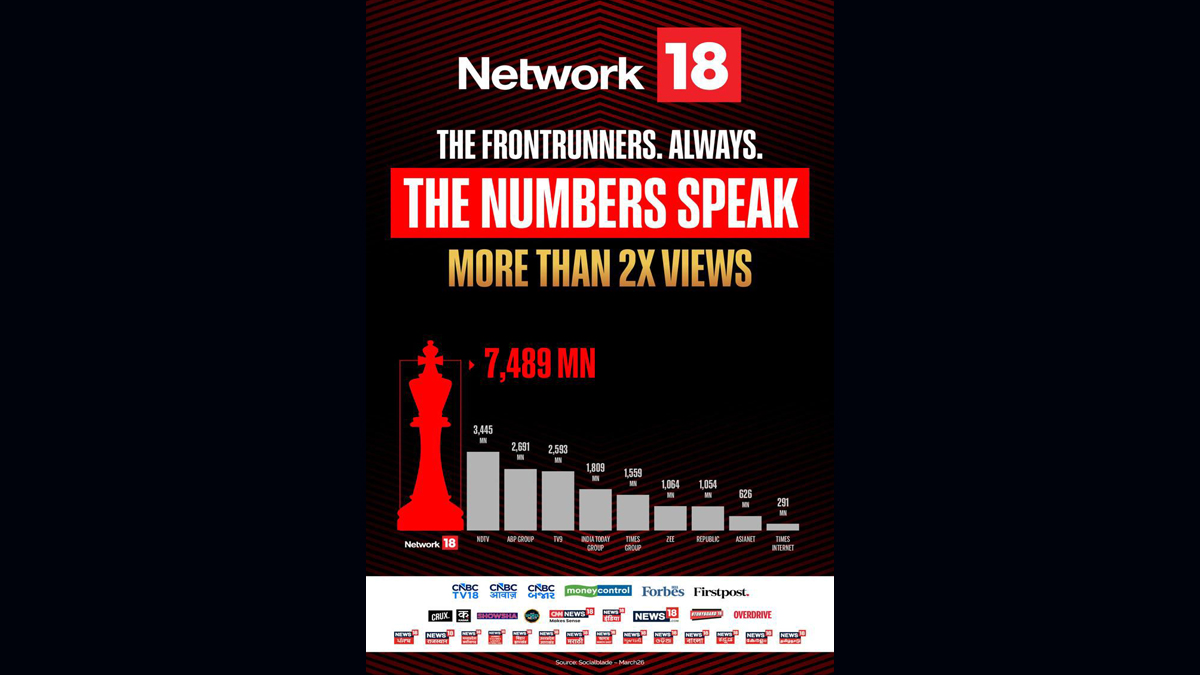
MUMBAI: When the world hit refresh on breaking news, Network18’s channels were already streaming ahead. As geopolitical tensions and war-driven headlines fuelled a surge in global news consumption, the network’s digital playbook delivered big clocking record Youtube viewership across English, Hindi and business news categories in March 2026.
At the forefront was CNN-News18, which emerged as the clear leader in the English news segment with 130 million live and video-on-demand views. The channel edged past competitors such as Times of India (126.5 million), Times Now (101.1 million), India Today (88.2 million) and NDTV (77.5 million), according to Databeings data for March.
In the Hindi news arena, News18 India delivered a commanding performance, racking up a staggering 3,297 million views on YouTube. The channel comfortably outpaced NDTV India, which recorded 3,119 million views, underlining its deep reach and consistent engagement with mass audiences, as per Playboard data.
The network’s dominance wasn’t confined to general news. In the Hindi business segment, CNBC Awaaz topped the charts with 92 million views, narrowly ahead of Zee Business (90 million) and well ahead of ET Now Swadesh (57 million). Meanwhile, its English counterpart CNBC-TV18 posted a strong 58 million views, reinforcing the network’s cross-category strength.
The spike in viewership reflects a broader shift in audience behaviour, with viewers increasingly turning to digital platforms particularly Youtube for real-time updates and in-depth coverage during high-intensity news cycles. For Network18, the numbers signal more than just scale; they underline the effectiveness of a multi-platform strategy that blends speed, credibility and continuous coverage.
In a month where the news never paused, it seems viewers chose to stay tuned where the stream never stopped.






