News Broadcasting
TV9 Network forays into Bengal market


NEW DELHI: With the aim to further reinforce its regional dominance and consolidate its position as the number one news network in the country, TV9 Network has embarked on a massive expansion plan for both its linear television as well as digital news businesses in West Bengal. The expansion plan will kick off with the launch of TV9 Bangla, a 24X7 news channel in the dynamic Bengal news market early next year.
Before the launch of TV9 Bangla, the network will unveil its digital offering, tv9bangla.com in December. As West Bengal prepares to go to the hustings, the grand entry of TV9 Bangla digital and TV platforms will be a game-changer for the robust Bangla news market.
TV9 Network CEO Barun Das said: “Gopal Krishna Gokhalre had famously said – ‘What Bengal thinks today, India thinks tomorrow’. But nearly a century later it would seem like that statement applies more to Bengal’s past than the present. An intellectually progressive state and exporter of the best talent to India and the world, we believe the state and its people still retain the wisdom and wares to make that its future as well. Bengalis are the typical argumentative Indians, they want to keep her ear to the ground and hence are naturally drawn to the news."

“More importantly, Bengalis are proud of their language and largely consume news in their language. The discerning Bengali viewer will always have room for a neutral perspective and a balanced opinion. That’s the place in the Bengali heart and mind that TV9 Bangla aspires to occupy. We are here to strike the right balance with neutrality and a fair perspective forming the core of our operations. Our unbiased coverage and world-class presentation will give teeth to the Fourth Estate in West Bengal,” added Das.
On the timing of the launch, Das said: “The state is already into election mode. Indirect canvassing has already started and the heat is building up. Given Bengal’s propensity for the free flow of information, news viewership is bound to peak. We believe this is a perfect opportunity for TV9 Bangla to establish its credentials and win the maximum share of viewership and voice.”
The network has onboarded veteran journalist Anjan Bandyopadhyay as the editor of TV9 Bangla news channel. A gold medallist from Calcutta University, Bandyopadhyay has 32 years of experience and has worked with almost all major media houses, including ABP, Zee, ETV and Sky Bangla. He was the Editor input of Zee 24 Ghanta and his last assignment was with ABP as its Editor-Digital.
Hiring for both the platforms is in full swing. Amritanshu Bhattacharya has also joined as the editor, TV9 Bengali Digital and will also serve as deputy managing editor, output, for the television channel. Bhattacharya comes with a rich experience of more than 25 years across print, audio visual and digital media, having worked with Jugantar, Aajkaal, ETV and Zee Media Corp. His last assignment was as an associate editor and head of digital of Zee 24 Ghanta.







News Broadcasting
UDF poised to return to power in Kerala, says Manorama-CVoter survey
Massive opinion poll projects shift in Kerala politics ahead of 2026 Assembly elections.
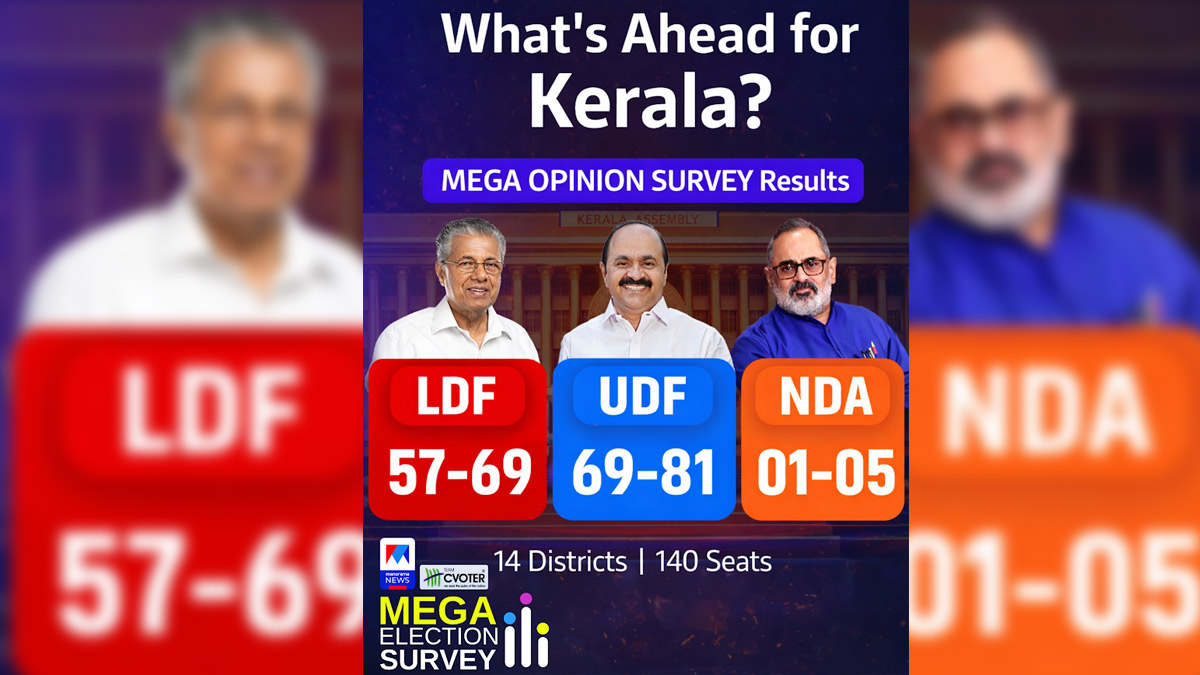
MUMBAI: The winds of change appear to be blowing through Kerala’s political landscape and this time, they seem to favour the United Democratic Front. A comprehensive mega opinion survey conducted by Manorama News in partnership with CVoter projects a potential comeback for the UDF in the upcoming Kerala Legislative Assembly Elections 2026. The survey, covering all 140 constituencies with a massive sample size of nearly 90,000 respondents, predicts the UDF could win between 69 and 81 seats.
The ruling Left Democratic Front (LDF) is expected to secure 57 to 69 seats, a significant drop from the 99 seats it won in the 2021 elections. This would mean the LDF losing 30 to 42 of its sitting seats. Meanwhile, the National Democratic Alliance (NDA), which drew a blank in 2021, is projected to open its account with 1 to 5 seats.
Region-wise, the UDF is expected to make strong gains in Malabar, winning 25 to 34 out of 48 seats, and in Central Kerala, where it could bag 29 to 33 out of 53 seats. In South Kerala, the LDF is likely to retain an edge with 21 to 25 seats, while the UDF may improve to 12 to 16 seats. The NDA could pick up 1 to 3 seats in the southern region.
The survey was conducted between 14 and 26 March 2026, with additional tracker and snap polls carried out from December 2025 to March 2026. A total of 89,693 respondents participated, ensuring representation across all demographics and social segments.
Manorama News has a strong track record of accuracy, with its previous projections closely matching the actual results of the 2019 and 2024 Lok Sabha elections as well as the 2021 Kerala Assembly polls.
In Kerala’s famously fierce political battles, this survey suggests the pendulum may be swinging back. Whether the final verdict matches these numbers or throws up another surprise, one thing is clear, the 2026 Assembly elections are shaping up to be one of the most keenly watched contests in the state’s history.






