Hardware
Transforming workforce training for Birla Opus Paints with VR innovation: An AutoVRse case study

Mumbai: Birla Paints, a new entrant in the market, is ambitiously aiming for a quick rise to the top spot. With plans to install production units in and outside India, there is a sudden need for an effective training program for the newly hired workforce. AutoVRse comes to offer the answer through immersive virtual reality (VR) training that caters to linguistic diversity and ensures effective skill acquisition and retention.
A trained and skilled factory workforce is of utmost importance for manufacturing companies. Whether you are expanding to newer geographies or growing your production per plant, scaling traditional safety and process training comes with its challenges:
“We implemented a comprehensive digital training program, utilizing immersive VR simulations and gamified learning modules to upskill their factory workforce. This innovative approach not only improved knowledge retention and engagement but also significantly reduced training time and costs, ultimately boosting productivity and ensuring a safer working environment.” exclaimed Anuj.

Skill Diversification: With diverse job roles spanning from manufacturing to customer service, ensuring uniform skill development across the workforce poses a significant challenge. Tailoring training programs to address the specific needs of each department while maintaining consistency can be complex.
Language Barriers: Birla Opus Paints operates in regions with linguistic diversity. Ensuring effective communication and comprehension across all levels of the workforce to scale your training across geographies is a major challenge in India.
Cost constraints: Implementing extensive training programs, particularly those utilizing Virtual Reality (VR), can result in cutting down expenses. Balancing the need for high-quality impactful training with budgetary constraints poses a challenge for most training initiatives.
Sustainability of learning: Ensuring that the skills acquired through training programs are retained and applied consistently in real-world scenarios is a must. Sustaining the impact of training beyond the initial sessions requires ongoing reinforcement and support mechanisms.
Remote work challenges: With the rise of remote work arrangements, providing effective training to employees working from different locations becomes challenging. Maintaining consistent training standards and accessibility for remote workers requires innovative solutions.
Employee engagement and motivation: Keeping employees engaged and motivated throughout the training process can be a challenge, particularly with repetitive or mandatory training modules. Designing training experiences that are interactive, engaging, and relevant to employees’ roles is crucial.
Measuring training effectiveness: Assessing the impact and effectiveness of training programs is essential for continuous improvement. Developing reliable metrics and evaluation methods to gauge the success of training initiatives and identify areas for improvement poses a challenge.
“Addressing these challenges requires a holistic approach that combines innovative technology, and tailored training strategies, and a commitment to continuous improvement. By overcoming these hurdles, Birla Paints can ensure that its workforce remains skilled, adaptable, and equipped to meet the evolving demands of the industry,” said AutoVRse enterprise and sales lead Anuj Gupta.
Birla Opus Paints recognised VR training as the right solution to its needs and picked AutoVRse as the perfect partner to create truly effective and scalable training modules in VR.
In 4 foundational steps, AutoVRse is helping Birla Opus Paints address the immediate requirement to train the incoming workforce and scale the training program across use cases and geographies.
Step 1: Beginning with off-the-shelf VR training lessons
To cater to the immediate requirement of Birla Opus to train the workforce in their new plants, the easy first step was to dip into AutoVRse’s content library of readymade VR training modules… These modules cover key processes along with working at height, electrical safety, fire safety, and lock-out-tag out, ensuring complete training in Hindi, Kannada, Tamil, and more. By leveraging AutoVRse’s proven instructional design philosophy, trainees can gain better skill retention, setting the stage for a solid foundation of protecting work and protocols.
Step 2: Customide training modules for increased ROI
Recognizing the need for customized training experiences, Birla Paints utilizes the personalisation options presented with AutoVRse. With the Unity SDK and VRseBuilder, you can tailor training scenarios without the need for coding expertise. This flexibility will allow them to create diverse and challenging situations, which ensures maximum engagement and improvement of skills among trainees. By customizing the modules, Birla Paints optimizes the ROI according to the session, making every training effective and impactful.
Step 3: Integration with corporate IT systems and scaling with VR-native LMS
As training initiatives expand, Birla Paints focuses on seamless integration with its existing corporate IT systems. AutoVRse’s VR-native LMS proves instrumental in consolidating training data and simplifying management tasks. Integration with single sign-on (SSO) and Learning Management Systems (LMS) streamlines administrative processes, allowing Birla Paints to efficiently track progress and demonstrate ROI. With all VR training data centralized, Birla Paints gains valuable insights into employee development and skill enhancement.
Step 4: Scaling XR across teams and use cases
To further enhance training effectiveness, the last step poised by AutoVRse for Birla Paints is VRseBuilder, an all-in-one platform for VR app creation and management. By adhering to the VRseBuilder philosophy of simplicity and accessibility, Birla Paints will empower its teams to develop immersive training experiences effortlessly. Through VRseBuilder, they can foster a culture of continuous learning and skill development, ensuring employees are best prepared for workplace challenges. With AutoVRse’s innovative solutions, Birla Paints embarks on a journey towards safer, more efficient manufacturing processes.
“AutoVRse’s training modules adhere to a set of instructional design principles aimed at maximizing learning retention and real-world application” added Anuj.
Mimic the real world: By creating training environments that closely resemble real-world scenarios, AutoVRse ensures high-fidelity learning experiences.
Engage learners with active tasks: Through interactive tasks and simulations, trainees are actively involved in the learning process, enhancing knowledge retention.
Train with variation and repetition: AutoVRse incorporates varied scenarios to reinforce concepts, ensuring comprehensive skill development through repeated exposure.
Provide instant actionable feedback: Trainees receive immediate feedback on their performance, fostering a culture of continuous improvement and learning.
Enable real-world behavioral change: By leveraging the immersive nature of VR, AutoVRse facilitates genuine behavioral change, as skills learned in virtual environments directly translate to real-world applications.
“AutoVRse and Birla Paints are revolutionizing the manufacturing industry, empowering employees with the skills and knowledge needed to thrive in a dynamic workplace environment.” finally exclaimed, Anuj.
In conclusion, with a focus on instructional design principles that prioritize real-world applicability and engagement, Birla Paints aims to foster a culture of continuous learning and skill development among its workforce with AutoVRse. By embracing VR technology, Birla Paints has not only enhanced workplace safety and efficiency but also positioned itself as a leader in next-generation manufacturing training. As they continue to evolve and innovate, the partnership between AutoVRse and Birla Paints serves as a testament to the transformative power of VR training in shaping the future of manufacturing education. Together, they are paving the way for a new era of training excellence, where virtual reality becomes an indispensable tool in empowering the workforce of tomorrow.






Hardware
India clears Rs 1.6 lakh crore semiconductor projects under Semicon India
Ten projects cleared as production begins and design ecosystem gathers pace
NEW DELHI: India’s push to become a global electronics powerhouse is gaining momentum, with the Semicon India Programme driving the creation of a full-fledged semiconductor ecosystem from design to manufacturing.
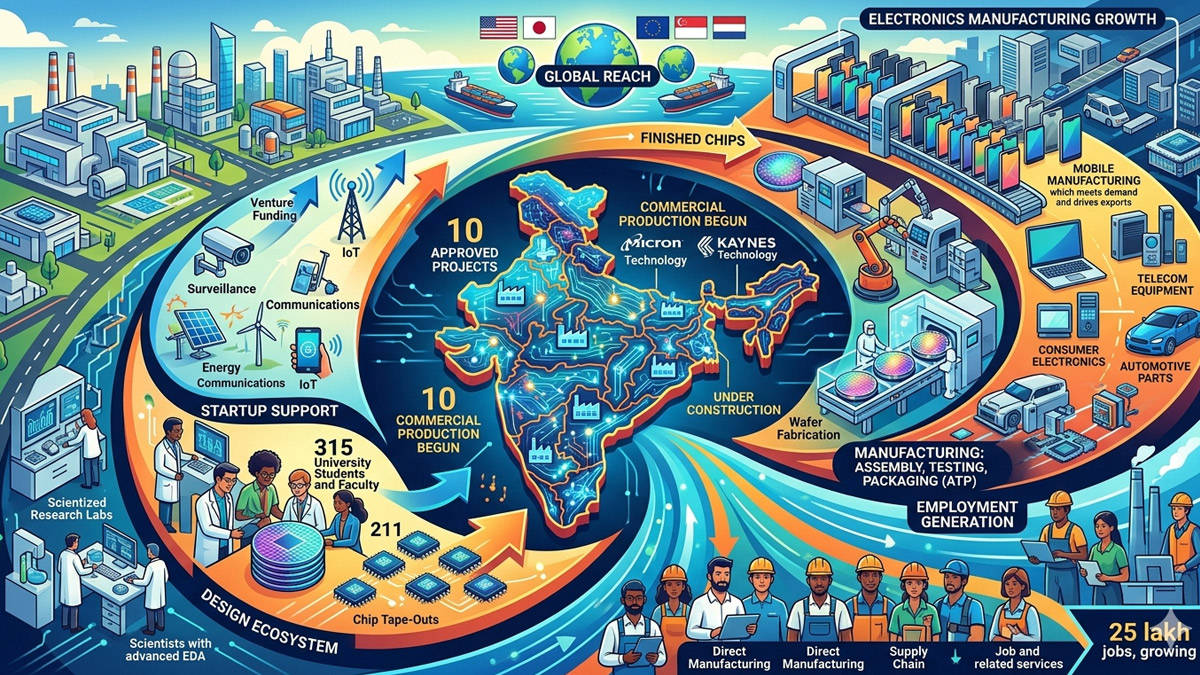
Launched in 2022, the programme aims to build capabilities across the entire value chain, including chip design, fabrication, assembly, testing and packaging. In just four years, the government has approved 10 semiconductor projects with a combined investment commitment of around Rs 1.6 lakh crore.
Two of these facilities have already begun commercial production, including units led by Micron Technology Inc. and Kaynes Technology India Limited. Two more plants are expected to go live later this year, signalling that India’s chip ambitions are moving from blueprint to factory floor.
The broader electronics manufacturing story has also seen sharp growth over the past decade. Production has jumped from roughly Rs 1.9 lakh crore in 2014-15 to about Rs 12 lakh crore in 2024-25, while exports have surged nearly eightfold. Mobile phone manufacturing, once heavily import-dependent, now meets almost all domestic demand and has become a major export driver.
Alongside manufacturing, the government is investing heavily in design capabilities. Through access to advanced chip design tools provided free to 315 universities, students and researchers have clocked over 200 lakh hours of usage. This effort has already resulted in 211 chip tape-outs from 75 institutions.
Support for startups is also picking up pace. Twenty-four chip design projects have been approved, targeting sectors such as surveillance, energy, communications and IoT. Of these, 14 companies have collectively raised over Rs 650 crore in venture funding, while several designs have progressed to fabrication, including at advanced nodes.
To strengthen supply chains, India has also signed semiconductor cooperation agreements with countries including the United States, Japan, the European Union, Singapore and the Netherlands. These partnerships aim to reduce global dependencies while boosting domestic capabilities.
The employment impact is equally significant. The electronics sector now supports an estimated 25 lakh jobs, with mobile manufacturing alone accounting for nearly half. As more semiconductor units come online under the India Semiconductor Mission, indirect job creation across supply chains is expected to rise further.
Sharing these updates in Parliament, Ministry of Electronics and Information Technology minister of state Jitin Prasada underscored the government’s focus on building a resilient, end-to-end semiconductor ecosystem.
With factories taking shape, designs moving to silicon and investments flowing in, India’s semiconductor story is steadily shifting gears from ambition to execution.






