News Broadcasting
Times’ Goswami upbeat about mid-year launch of news channel


MUMBAI: The Times of India group is gearing up for a mid year launch of their news channel. The channel’s vice president news and editor television division Arnab Goswami is itching to go on air after a short hiatus and is upbeat about the launch.
Having been in the broadcast arena for a decade now, Goswami; who moved into the business at a time when the daily news business was just picking up pace; has a keen understanding of the news business. Anchors who “like getting their hands dirty” and who get into broadcast journalism for the love of news and not for the love of seeing themselves on air, are what Goswami and the Times Group looking at hiring for the channel.
“I have been in the news business for almost 10 years now and I know the strengths and weaknesses of this medium. Having been a reporter I value news above anything else. These are some of the values I will be bringing on board at The Times of India Group. This job was an opportunity of translating my vision of news into reality. If there is one group that can pull it off and needs to make its mark in the television space it is The Times of India Group,” a buoyant Goswami says.

He is of the opinion that the news business has evolved in fits and starts. “It started out by being a consumer driven need for change where consumers wanted better programmes, new formats, a different style of presentation and delivery and a greater finesse in terms of production quality and they got it from people who came into television outside the traditional providers like DD. Over the last few years it has become a supplier driven growth where more than attempting to look at what the viewer needs, it is more about what you want to provide,” says Goswami. “In the last couple of years, the number of players has multiplied but there is not much difference in what they provide and hence this translates to this common man view that there are lots of news channels but nothing dramatically different between any of them. That’s something that we are looking forward to changing,” he adds.
Commenting on entering an already cluttered news channels’ space, Goswami says that they didn’t look upon themselves as being “just another news channel.” Coming from the stable of the country’s largest and diversified media group, the Times news channel will be looking at changing the rules of the news reporting business.
While new appointments have been happening in fits and starts until now, April is when major appointments of news anchors and reporters will be made. With ex-Sony hand as the CEO of the news venture, the Times will be hiring experienced professionals as well as scouting for new talent. “We have been incredibly fortunate in the professionals that have come on board. I can say with complete confidence that in terms of human resources we will be the most talented pool of professionals and also one of the youngest team of people to be leading a news channel. My team brings with it a mix of experience, a breath of fresh ideas and the willingness to experiment. We have a group of people who have been a part of the growth of this industry over the last decade and they have been a part of news channels like CNBC, NDTV, Star News, Headlines Today etc,” says Goswami.
Asked as to what would be the differentiating factor between the Times news channel and the other players in the market, Goswami says, “I am extremely possessive about this issue. We have a good product and we do not believe in following any set formats that are there in the market. All I can say at this point in time is that our content will change the rules of the game.”
Emphasis will also be laid on the look and feel of the channel, packaging and set design, which is being overseen by international designers. “I am personally obsessed with look and feel and production quality, so utmost care will be taken in the area,” he stresses.
The Group’s new swanky office equipped with live studios, production control rooms and news rooms is in the process of getting ready in Kamla Mills situated in Lower Parel in Mumbai. A large bureau in the Capital, with live studios and production equipment is also being set up. “We hope to have a fair spread of correspondents and bureaus across the country. I don’t believe that the number of correspondents or the quantum of your reach is what matters. It is the quality of your product, the editorial vision and the sharpness of your editorial focus that matters. And that is something that we want our channel to be driven by, rather than the number of people we employ,” says Goswami.
Loathe to talk about either the tilt of the news reportage, date of launch, name of the channel or the programming bit at this stage, Goswami says, “We want to be completely prepared when we launch and that’s the reason why we are not committing to any precise launch date till now.”
Speaking about the kind of content that the new channel from Times will be looking at and also throwing light on how there is little content differentiation in the existing news channels, Goswami says, “In the existing market, there is no content differentiation on news channels today as some formats are repeated across channels. I don’t see too much of a difference in one news channel from the other in the English as well as the Hindi space. There is a lot of potential in content differentiation and we will do it in our own way. I don’t want to speak too much on competition at this stage because my focus is more on creating a different product through this channel.”
Delving on the issue of “breaking news first,” Goswami is of the opinion that this issue has been taken a bit too far today to a point of triviality. “I am disappointed with this trend today where everything almost becomes breaking news. There is a false sense of breathlessness, which some channels have been tempted to fall into the trap of. I don’t think viewers are impressed with this kind of false pace that channels want to inject into their delivery of news,” he voices.
What the Times of India Group’s news channel will therefore be looking at is “serious and well researched content.” “The focus in news channels has shifted from reporting to sourcing information from agencies or wires and claiming it as their own. I hope this trend stops sooner than later. The focus on original reporting needs to be there. We will restore some of these lost values on our channel when we launch,” says a confident Goswami.






News Broadcasting
News18 India launches Command Centre war explainer with Arya
New show shifts from debates to decoding global conflicts and impacts
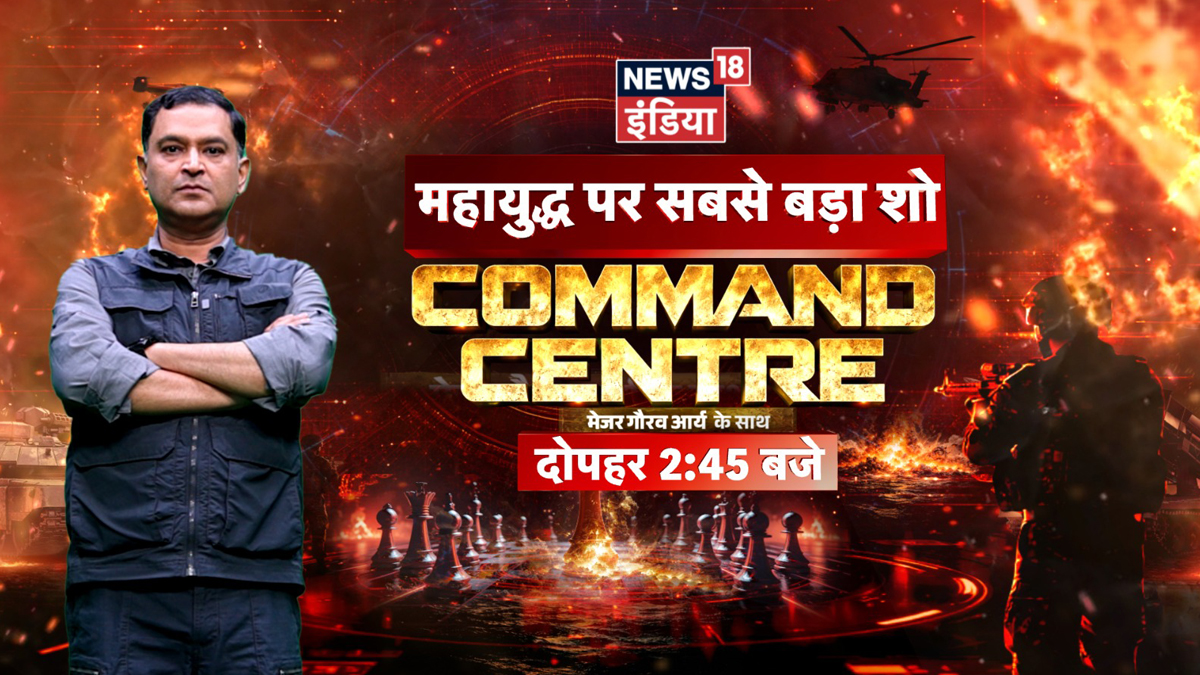
MUMBAI: News18 India has rolled out a new war-focused programme, Command Centre, featuring Gaurav Arya, as it looks to offer viewers a sharper, more grounded take on global conflicts amid rising tensions in West Asia.
Positioned as an “insider war room”, the show moves away from conventional panel debates and instead focuses on explaining military developments, decoding strategy and connecting global events to their everyday impact, from fuel prices to economic shifts.
The format leans heavily on visuals and data. The studio has been designed like a command hub, complete with large LED war maps, real-time graphics and an alert system to track developments as they unfold.
At the centre of it all is Arya, who brings his military background to simplify complex war strategies for viewers. His signature line, “Seedhi baat samjhiye”, anchors the show’s promise of clarity over noise.
News18 India managing editor Jyoti Kamal said, “Command Centre, featuring Major Gaurav Arya is designed to deliver accurate insights and a clear perspective on how evolving conflicts impact everyday life, from household budgets to national security. With expert voices analysing every development in real time, the show goes beyond headlines to decode what’s happening now, what it means, and what could come next.”
Echoing the intent, Gaurav Arya added, “In times of war, confusion is the biggest threat. With News18 India’s Command Centre, we are bringing viewers inside the war room, decoding strategies, tracking every escalation, and explaining, in the simplest terms, what it means for India and for every household. Seedhi baat samjhiye, this is where you understand not just what is happening, but what happens next.”
The weekday show will air in the afternoon slot and will also feature Gaurav Shukla, adding to its editorial depth.
With its mix of analysis, visuals and a clear focus on impact, the show reflects a broader shift in news consumption. Viewers are no longer just watching events unfold, they are looking to understand what those events mean for them.







