I&B Ministry
Time to have rules ensuring no one player dominates media: Smriti Irani

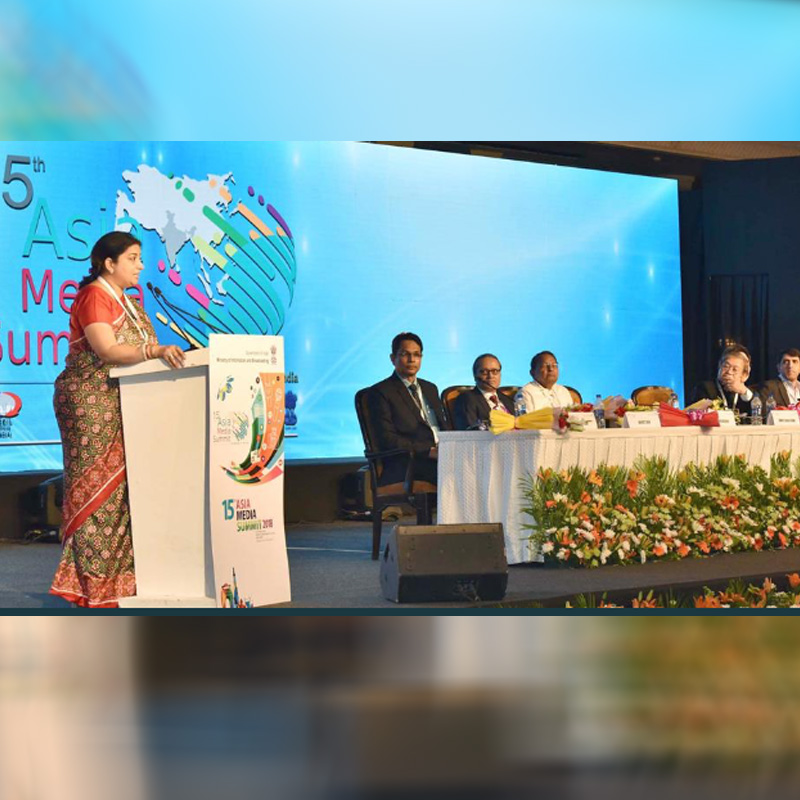
NEW DELHI: Minister for Information & Broadcasting Smriti Zubin Irani yesterday said that the time has come to put laws, ethics and rules into place that will help in balancing the media industry so that no one dominant player can rule the roost. She, however, did not elaborate what those parameters should or could be.
Speaking at the 15th Asia Media Summit (AMS) 2018 yesterday, she, however, hinted at her version of what good content could be, throwing oblique references to the growing digital-spurred edgy content in Indian media, including television.
Pointing out that India will have around 969 million internet users by 2021 and that the media industry looks upon the digital world “not only as a challenge but also as an opportunity”, Irani asked, “How do we attract, retain and develop talent, which frees good content from the trappings of revenue needs and brings about a balance in media institutions?”

She hoped that the media event would deliberate on ways to “delve and deliberate on Asia values”, and the need for good stories to be told.
Dwelling on the need for regulations to ensure level playing field for all, the minister referred to an address made by media baron Vineet Jain, group MD of Times Group, before her at the media conference to drive home a point that present laws may be inadequate to deal with the changing landscape of the Indian media.
Jain, during his address to the delegates at AMS 2018, had said, “But for Indian media to realise its full potential, regulatory reforms are needed across the board – to make it easier to do business, remove anomalies in the system, and above all, ensure a fair marketplace that benefits the consumer.”
Carrying forward, Irani said the India media is getting more consumer-centric because of the opportunities (and challenges) that the digital ecosystem is offering stakeholders, apart from the overall evolution of the industry.
Giving a perspective of the expanding Indian media industry, Irani said India was one of the fastest growing advertising market that is expected to touch $10.59 billion by the end of 2018, while the mobile spend was estimated to grow to $1.55 billion in the current year. “We have a vibrant media industry, which has a direct established impact of Rs 1.35 lakh crore and indirect and induced benefits of Rs 4.5 lakh crore, with close to 4 million people associated with it,” she added.
The three-day 15th Asia Media Summit is being hosted by the Ministry of Information and Broadcasting jointly with the Indian Institute of Mass Communication (IIMC), and Broadcast Engineering Consultants India Limited (BECIL) in New Delhi. The theme of this year’s summit is ‘Telling Our Stories – Asia and More’, which would encourage regional and bilateral dialogue and cooperation to respond to challenges to the broadcasting sector in the region.
The minster expressed hope that the event will throw up new ideas so that pathways to strengthen media institutions for a better mankind could be explored.
Addressing the inaugural session, Minister of Information from Bangladesh Hasanul Haq Inu outlined six complex challenges the world faces today: poverty, gender disparity, terrorism, ICT revolution, climate change and uneven globalisation. Expressing concern at cybercrimes, he stressed upon the need to fight a war against cyber-criminals to keep the media safe and expanding.
This is the first time that the Asia Media Summit is being held in India. Over 220 foreign delegates representing 39 countries (SAARC, ASEAN, East Asia, Africa, Oceania, Europe, Syria, Uzbekistan, USA, China) and senior officials of the government and members of Indian media industry are participating in the event.
Also Read:
MIB moves to regulate online media: various organisations join issue
Online media professionals write to Smriti Irani expressing regulation concerns






I&B Ministry
CBFC speeds up film certification; average approval time cut to 22 days
Over 71,900 films cleared in five years as digital system shortens approval timelines

MUMBAI: The Central Board of Film Certification (CBFC) has significantly reduced the time taken to certify films, with the average approval timeline now down to 22 working days for feature films and just three days for short films.
Operating under the Ministry of Information and Broadcasting, the statutory body certifies films for public exhibition in line with the Cinematograph Act, 1952 and the Cinematograph (Certification) Rules, 2024. The rules prescribe a maximum certification period of 48 working days, though the adoption of the Online Certification System has sharply accelerated the process.
Over the past five years, from 2020-21 to 2024-25, the board certified a total of 71,963 films across formats. Of these, the majority fell under the U category with 41,817 titles, followed by UA with 28,268 films and A with 1,878 films. No films were certified under the S category during the period.
Film approvals have also steadily risen in recent years. The CBFC cleared 8,299 films in 2020-21, a figure that peaked at 18,070 in 2022-23 before settling at 15,444 films in 2024-25. During the same period, 11,064 films were certified with cuts or modifications.
Despite the high volume of certifications, outright refusals remain rare. Only three films were denied certification over the last five years, with one refusal recorded in 2022-23 and two in 2024-25.
The board may recommend cuts or modifications if a film violates statutory parameters relating to the sovereignty and integrity of India, security of the state, friendly relations with foreign states, public order, decency or morality, defamation, contempt of court or incitement to an offence.
Filmmakers can challenge CBFC decisions in court. Data shows that such disputes remain limited but have seen some fluctuation. Between 2021 and 2025, a total of 21 certification decisions were challenged before High Courts, with the number rising to 10 cases in 2025.
Responding to a question in the Rajya Sabha, minister of state for information and broadcasting L. Murugan shared the data. The question was raised by Mallikarjun Kharge.
With faster timelines and a largely digital workflow, the certification process appears to be moving at a far brisker pace, signalling a shift towards quicker clearances for India’s growing film output.