Movies
The Hema Committee Report: Is Indian cinema facing a new dark chapter?

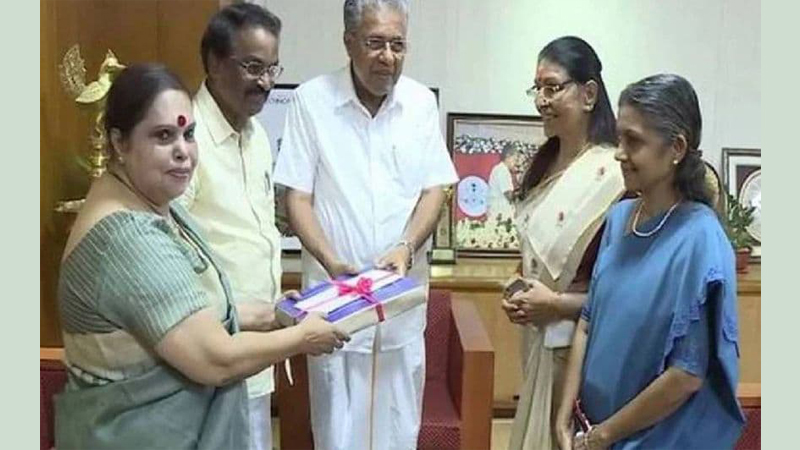
Mumbai: “Do not trust what you see; even salt looks like sugar!” A provocative line from the controversial Hema Committee Report, made public by the Kerala government last month, has ignited widespread controversy and debate. The report has prompted numerous actors to share their experiences, leading to an outcry in Kerala and raising crucial questions about the state of the Malayalam film industry.
Malayalam cinema has long been celebrated for its progressive portrayal of women. Yet, recent revelations suggest a disturbing hypocrisy within the industry—a stark contrast to its outwardly feminist stance. The report has triggered a significant uproar, shedding light on issues of abuse, misogyny and inequality.
How it all began?

The crisis in the Malayalam film industry began with a shocking incident involving South Indian actress Bhavana Menon, who was kidnapped and sexually assaulted in broad daylight by a group of men back in 2017. The attack sent shockwaves through the industry, leading to the arrest of actor Dileep on charges of criminal conspiracy. Although Dileep, a major figure in Malayalam cinema, has denied the allegations, as the case remains unresolved in court.
The horrific details of the crime initially spurred public outrage and a police investigation. As the public attention waned, women in the industry rallied together in solidarity, culminating in the formation of the Women in Cinema Collective (WCC) on 1 November, 2017.
Formation of the report
In its early years, the WCC focused on combating sexual harassment and addressing gender disparity and poor employment conditions in Malayalam cinema. In response, Kerala chief minister Pinarayi Vijayan established a three-member expert committee led by former Kerala high court judge K. Hema, alongside veteran actor Sarada and ex-IAS officer K.B. Valsala Kumari. The Hema Committee conducted a thorough investigation from November 2017 and submitted its final report on 31 December, 2019.
The 235-page report, compiled by the panel, exposed the tight grip held by a small group of male producers, directors, and actors over the industry. This control has perpetuated a culture of abuse and inequality.
Disturbing details in the report
Though the report refrained from naming specific individuals, its revelations have reverberated throughout the industry. According to sources, some sections of the report were redacted, leading to speculation that influential figures are being shielded. The report detailed numerous instances of harassment, including allegations of male actors, producers, and directors demanding sexual favors and subjecting those who refused to mental torment, such as repeatedly forcing intimate scenes.
The report also highlighted the struggles faced by male actors, including unauthorised bans from working in the industry. Many men, including prominent artists, have been reluctant to speak out for fear of jeopardising their careers. The report described the Malayalam film industry as being under the control of a “mafia” of powerful male figures who wield the authority to ruin careers and enforce their will.
Reactions
Following the report’s release, several women have come forward with their stories. One actress accused veteran actor Siddique of rape and harassment when she was 19. Although she initially faced skepticism, the release of the Hema Committee report has given her claims renewed attention. In response to these allegations, Siddique resigned from his position as General Secretary of the Association of Malayalam Movie Artists (AMMA).
Actor Mohanlal had resigned from his post as president of the AMMA amid sexual assault cases against top office bearers Siddique, Baburaj and other actors such as Mukesh, Maniyanpilla Raju and Jayasurya.
Actor Mammootty wrote in a Facebook post that the industry wholeheartedly welcomes and supports the recommendations and solutions outlined in that report. He also stated it is high time that all associations in the film industry join hands to implement them.
In a similar fashion, both the actors have been facing criticism in the public sphere for being silent on the Hema committee report, which was made public on 19 August. According to media reports, Mohanlal, while welcoming the report, had also said that issues that are happening in the other sectors are part of cinema too.
Legal actions
At the time of writing, the special bench of Kerala high court that was tasked with hearing the cases related to the Hema Committee report came down heavily upon the Pinarayi Vijayan government for its inaction over the disclosures made in the report, which looked into the challenges faced by women in the Kerala film industry. The special bench comprising Justices AK Jayasankaran Nambiar and CS Sudha was constituted by the HC on 5 September and directed that the full report be handed over to the Special Investigation Team (SIT) to take requisite action.
“We are surprised by this inaction. When it received the report or when DGP was given a copy in Feb 2021, some action must have been taken. Assuring confidentiality of women, we understand that. But the state govt is confronted with practices derogatory to women, what has it done? What is it that you are doing to address problems facing women, not just in cinema?” the court asked. Further, stating that this was a problem affecting the majority in the state, the court observed that it cannot be silent.
Key lessons for the Indian film industry to be taken in consideration
The Hema Committee Report has empowered many women in the industry to share their harrowing experiences, triggering a new wave of #MeToo activism in Kerala. While this was just a tip of the iceberg, many disturbing stories remain untold. The report exposes the urgent need to address women’s safety and challenging the wretched patriarchal values within the industry.
While such instances are not surprisingly uncommon in Indian cinema, the recent surge in crimes against women and the silence of many male industry figures reveal a troubling disconnect between public statements and private attitudes, showcasing the industry has indeed entered a new dark chapter. It is crucial for Indian cinema to confront these issues openly, tackle its internal problems and create safer environments for all its members.
Readers can access the full report given below: https://event.indiantelevision.com/banner/hcr.pdf






Hollywood
Paramount eyes $24bn Gulf support to fund Warner Bros Discovery merger: Reports
Sovereign funds line up funding as media giants chase streaming scale
NEW YORK: Paramount Skydance is in talks to secure nearly $24 billion in equity commitments from Gulf sovereign wealth funds to support its planned takeover of Warner Bros. Discovery, according to a WSJ report.
The funding push comes as Paramount Skydance advances its proposed $110 billion deal for Warner Bros. Discovery, which carries an equity valuation of $81 billion and is expected to close in the third quarter of 2026.
At the heart of the financing plan are three major Gulf investors. Saudi Arabia’s Public Investment Fund is expected to contribute roughly $10 billion, while the Qatar Investment Authority and Abu Dhabi-based L’imad Holding are likely to make up the remainder.
Crucially, the proposed investments are structured as non-voting stakes. This means the Gulf backers would not have direct control in the combined entity, a move designed to ease regulatory concerns in the United States. Paramount executives reportedly do not expect the deal to trigger scrutiny from bodies such as the Committee on Foreign Investment in the United States or the Federal Communications Commission.
If completed, the merger would bring together a formidable portfolio of entertainment and news assets, including CNN and CBS. The combined entity aims to better compete in a fast-evolving media landscape where streaming platforms are steadily pulling audiences away from traditional television.
The deal reflects a broader shift in global media, where scale is increasingly seen as essential to survive the streaming wars. By pooling content libraries, technology and distribution, Paramount Skydance and Warner Bros. Discovery are betting on size and synergy to drive future growth.
The involvement of deep-pocketed Gulf investors also underscores the growing role of sovereign wealth in shaping global media consolidation, particularly at a time when high-value deals demand equally large financial backing.
With shareholder votes and regulatory milestones still ahead, the proposed tie-up remains one of the most closely watched media deals of the year. If it clears the final hurdles, it could redraw the competitive map of the global entertainment industry.






