News Headline
Television viewership peters down slightly in Week 14

BENGALURU: The first three weeks of Indian COVID-19 lockdown have expanded television viewership in India to an extent that was probably never imagined earlier. As many average Indian citizens, bound by the lockdown within the confines of their homes, sought to comfort their minds with news of what was happening within the country and the world and with the pseudo realism that Movies provide, their television viewership habits changed week-on-week. Here’s how.
Viewership
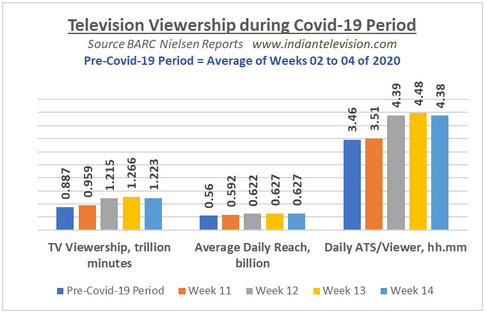
In the third week of the Indian COVID-19 lockdown (week 14 of 2020, Saturday, 4 April 2020 to 11 April 2020), television viewership at 1.223 trillion minutes was 37.9 per cent higher when compared to the average of Weeks 2 to 4 of 2020, or the pre-COVID-19 period according to joint Broadcast Audience Research Council of India (BARC) Nielsen reports. But then, this was 3.4 per cent lower than the 1.266 trillion minutes of the previous week, despite the same average daily reach of 627 million television viewers. Hence, the average time spent was obviously lower at 4 hours 38 minutes in Week 14 of 2020 as compared to the 4 hours and 48 minutes that television viewers spent in Week13.

As is obvious from the chart below, TV viewership has grown like never before during the lockdown week, but week 14 data shows that week-on-week, viewership in Week 14 of 2020 is slightly lower than the previous week, which has so far seen numbers peak at high levels. Please refer to the chart below:
Effect on genres
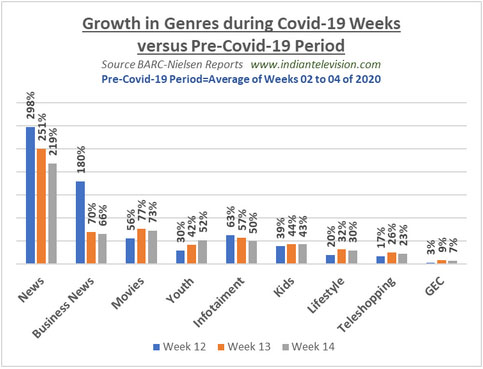
News, which until the COVID-19 period had seven per cent share of viewership, saw it triple to 21per cent in Week 12, or the first week of the Covid-19 Lockdown in India. Though news is still the leader in terms of growth in viewership, the growth of the genre in relation to the Pre-Covid-19 period has been lower in Weeks 13 and 14 as compared to Week 12 of 2020. Business news also seemed to be following the trends of its larger sibling, news. The other seven genres have seen growth in Weeks 13 and 14 vis-à-vis the Pre-Covid-19 Period averages.
Since no fresh content was being produced, GECs’ saw the smallest growth during the first three weeks of the Covid-19 lockdown. It must be noted that GECs’ are the largest genre in terms of viewership, so the 9per cent and 7per cent growth in Weeks 13 and 14 respectively versus the Pre-Covid-19 are good numbers.
In the Pre-Covid-19 Period, Hindi GECs’ had a 32per cent share of viewership of the Hindi speaking market of HSM. Hindi GEC’s in the urban Hindi speaking market or HSM (U) which reduced to 29per cent in Week 14. Despite this Hindi GECs’ in HSM (U) attained an all-time high of 4 billion impressions. HSM (U) viewership grew by 26per cent in Week 14 in relation to the average of the Pre-Covid-19 Period. This growth could be attributed mainly to GECs’ resorting to airing old classics. The major growth drivers of the genre were pubcasterDoordarshan’s GECs’ DD National and DD Bharti which saw the return of programmes such as Ramanand Sagar’s Ramayan and B R Chopra’s Mahabharat, as well as soaps like Dekh Bhai Dekh, Byomkesh Bakshi, Shaktimaan, ShrimanShrimati, Buniyaad and Circus. The other GECs’ generally saw flat growth according to BARC.
Please refer to the figure below:
GECs’ in South India continued to lead viewership in Week 14 of 2020, but with a lower share as compared to the pre-COVID-19 period. The movies and news genres saw higher viewership in Week 14 as compared to the Pre-Covid-19 Period. Please refer to the chart below:

Who was watching television when?
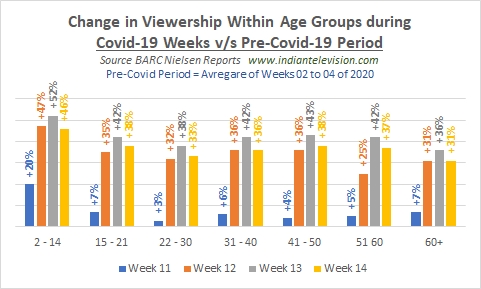
Growth in viewership continued to be led by the younger generation –the 2-14-years age groups followed by the 15-21 and the 31-40-years age groups as well as in the week preceding (Week 11) the lockdown and during the three weeks of the lockdown (Weeks 12, 13 and 14 of 2020). However, growth was lower amongst all age groups in Week 14 of 2020 as compared to Week 13 with respect to the Pre-Covid-19 Period.
Please refer to the figure below:
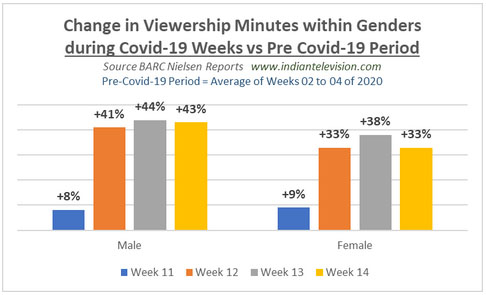
Since people spent time at home, growth in time spent in minutes for watching television was higher among males. The change was slightly lower in Week 14 of 2020 as compared to Week 13 for males and females with viewership of both the weeks in relation to the Average of the Pre-Covid-19 Period. Please refer to the chart below:
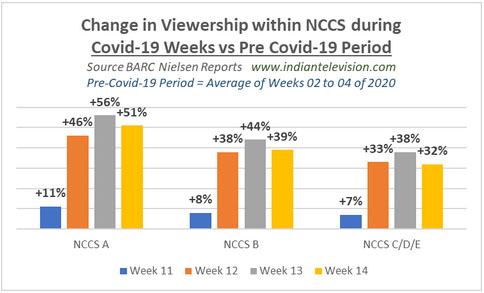
A BARC Nielsen Report dated 16 April 2020 said that BARC’s NCCS A saw the highest growth during the three weeks of the lockdown as well as Week 11 of 2020 as compared to the average of the Pre-Covid-19 Period. NCCS A has seen the highest growth in Weeks 12, 13 and 14, with growth peaking in Week 13 of 2020 and then petering slightly in Week 14 of 2020. Please refer to the chart below.
Non-primetime continued to be a growth driver of Television viewership in Week 14. While Full Day All India Television viewership grew 38per cent in Week 14 as compared to the Pre-Covid-19 Period, Rural India viewership growth was driven by non-Primetime viewership. Primetime viewership grew 10per cent in Urban India, while it remained stable in Rural India.
News is event driven. Week 15 of 2020 has seen the Covid-19 lockdown in India being extended to 3 May 2020. Prime Minister Narendra Modi’s speech on 14 April 2020 announcing the extension of the lockdown which was aired on 199 channels garnered the highest ratings at 3,937.3 million viewing minutes as compared to his previous 3 addresses to the nation on the Covid-19 crisis.





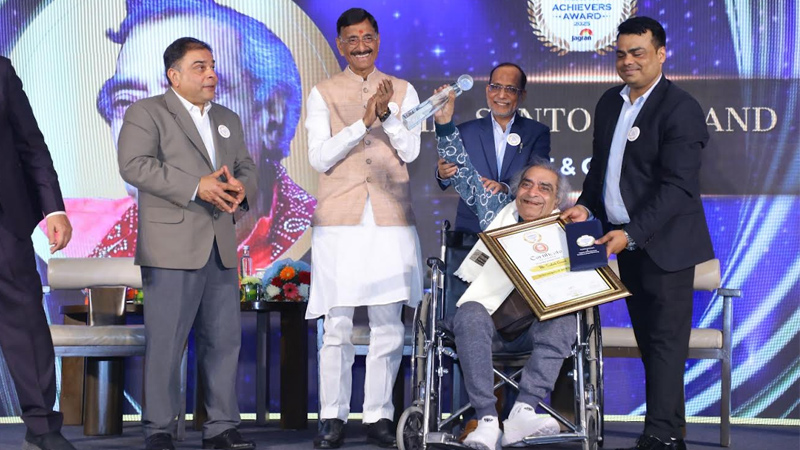
NEW DELHI: Hamdard Laboratories gathered a cross-section of India’s achievers in New Delhi on Friday, handing out the Hakeem Abdul Hameed Excellence Awards to figures who have left their mark across healthcare, education, sport, public service and the arts.
The ceremony, attended by minister of state for defence Sanjay Seth and senior officials from the ministry of Ayush, celebrated individuals whose work blends professional success with a sense of public purpose. It was as much a roll call of achievement as it was a reminder that influence is not measured only in profits or podiums, but in people reached and lives improved.
Among the headline awardees was Alakh Pandey, founder and chief executive of PhysicsWallah, recognised for turning affordable digital learning into a mass movement. On the sporting front, Arjuna Awardee and kabaddi player Sakshi Puniya was honoured for her contribution to the game and for pushing women’s participation onto bigger stages.
The cultural spotlight fell on veteran lyricist and poet Santosh Anand, whose songs have echoed across generations of Hindi cinema. At 97, Anand accepted the honour with characteristic humility, reflecting on a life shaped by perseverance and hope.
Healthcare honours spanned both modern and traditional systems. Manoj N. Nesari was recognised for strengthening Ayurveda’s place in national and global health frameworks. Padma shri Mohammed Abdul Waheed was honoured for his research-backed work in Unani medicine, while padma shri Mohsin Wali received recognition for his long-standing contribution to patient-centred care.
Education and social development also featured prominently. Padma shri Zahir Ishaq Kazi was honoured for decades of work in education, while former Meghalaya superintendent of Police T. C. Chacko was recognised for public service. Goonj founder Anshu Gupta received an award for his dignity-centred rural development initiatives, and the Hunar Shakti Foundation was honoured for empowering women and young girls through skill development.
The Lifetime Achievement Award went to former IAS officer Shailaja Chandra for her long career in public healthcare and governance, particularly in the traditional systems under Ayush.
Speaking at the event, Hamdard chairman Abdul Majeed said the awards were a tribute to those who combine excellence with empathy. “These awardees reflect Hakeem Sahib’s belief that healthcare, education and public service must ultimately serve humanity,” he said.
Minister Seth struck a forward-looking note, saying India’s young population gives the country a unique opportunity to become a global destination for learning, health and wellness by 2047.
The ceremony also featured the trailer launch of Unani Ki Kahaani, an upcoming documentary starring actor Jim Sarbh, set to premiere on Discovery on 11 February.
Instituted in memory of Unani scholar and educationist Hakeem Abdul Hameed, the awards have grown into a national platform that celebrates those building a more inclusive and resilient India. For one evening at least, the spotlight was not just on success, but on service with substance.