DTH
Tata Sky ventures into curated short content with Shorts TV

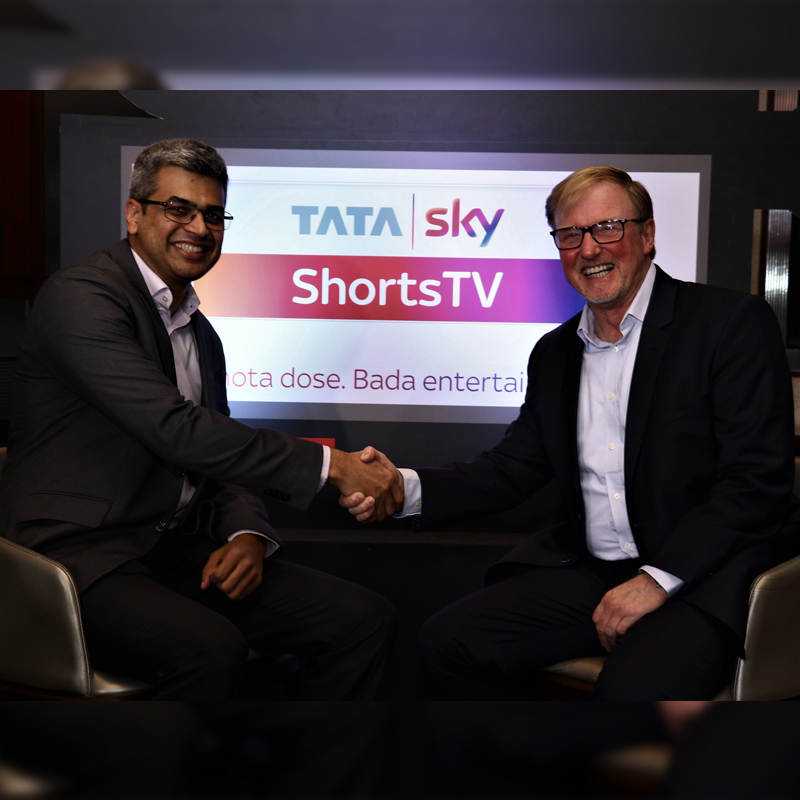
MUMBAI: India’s leading DTH player Tata Sky has entered into a partnership with a London-based television channel Shorts TV for its new platform Tata Sky ShortsTV.
The newly launched platform is one of a kind in the country, dedicated to curated short stories and films. The subscription price for this service has been fixed at Rs. 75 per month. Along with availability on the telly screen, the service is also available on the mobile app as well as the DTH operator’s website.
“We were always keen to bring beautiful short form content on our platform, but we needed to find the partner who did it right. That’s how we found Shorts TV team who really knew how to curate short films properly,” Tata Sky chief content officer Arun Unni said, announcing the launch of the new service here yesterday.

Shorts International Ltd chief executive Carter Pilcher, who mentioned they had scouted for other Indian partners, said, “We are thrilled to partner with Tata Sky. They’re India’s cutting-edge content distributor and as their launch of Tata Sky ShortsTV proves, they’re way ahead of the crowd.”
Pilcher added that the new Tata Sky ShortsTV service was a good addition to the DTH operator’s value-added services portfolio and will be a “huge success with millennial audiences”.
ShortsTV has also partnered with Royal Stag Barrel Select Large Short Films to bring a flood of India’s most original and powerful short films to the Tata Sky platform.
The curated platform will feature a line-up of ,2000 premium titles, including the best of Oscars, Cannes, etc. apart from a comprehensive collection of recent Indian short stories and films. There will be original content in regional languages also. Interestingly, there are also collaborations with some of the Indian film schools, including Hindi film director-producer Subhash Ghai-promoted Whistling Woods.
“Tata Sky ShortsTV aims to be that destination where a curated selection of 2000+ of the world’s best short films can be enjoyed on a 24×7 basis. Our partner has worked hard for more than a year to localize the proposition with 500+ Indian short films,” Unni explained.
Though Unni did not mention the targeted subscriber number, he did admit a good service goes to 10-15 per cent of the relevant base as experience has shown them. “Hence, these statistics guide us for this particular service and its growth potential,” he added.
For promoting the content, Tata Sky will use every available medium to talk to consumers.
Some of the international offerings include God of Love, Bear Story, Atlantic, Henry, Borrowed Time, Curfew, Blood Money, A Sense of History, Neighbours, Walls, Blue Season, Midnight of My Life and Picture Paris. Also featured will be the likes of Chutney, Ahalya, Shunyata, Aamad, Kheer, Arre Baba, Urmi’s Cat, Naughty Amelia Jane, all critically acclaimed films.
Shorts International is headquartered in London and is represented in the US by Shorts Entertainment Networks, a wholly owned subsidiary located in Los Angeles. The company is led by CEO Carter Pilcher, and is owned by Shorts Entertainment Holdings with AMC Networks as a significant minority shareholder.


DTH
Prasar Bharati’s WAVES earns Rs 2.9 crore in first year
Platform scales content, users but monetisation gaps limit revenue growth.
MUMBAI: Big waves, small ripples at least for now. When Prasar Bharati launched its OTT platform WAVES at the 55th International Film Festival of India in November 2024, it pitched a bold vision: a homegrown rival to global and domestic streaming giants, blending video, audio, gaming and commerce into a single digital ecosystem. Five months into FY2024–25, however, the platform’s revenue stands at just Rs 2.90 crore, a figure that underscores the gap between ambition and monetisation.
On paper, WAVES looks anything but modest. The platform has ingested 13,608 titles, totalling 9,495 hours of content, with over 13,000 titles already live. It has streamed more than 575 live events from the Mahakumbh Amrit Snan and the 76th Republic Day parade to the Hockey India League, Kabaddi World Cup and Mann Ki Baat while offering 74 live TV channels and 12 radio channels. With over 10 lakh registered users and more than 200 content partners onboarded, the scale resembles that of a fully operational streaming service rather than a pilot project.
The architecture supporting this scale is equally robust. Built under Prasar Bharati’s Central Archives vertical, WAVES runs on a cloud-based infrastructure with DRM, encryption and an integrated analytics dashboard. It includes dedicated units for content ingestion, quality control, publishing, graphics, marketing and billing, and is distributed across platforms such as OTTplay, Tata Play and BSNL. The offering extends beyond video to include audio-on-demand, e-games and even e-commerce via ONDC integration.
Yet, the numbers reveal a core disconnect. Despite its scale, WAVES generated just Rs 2.90 crore in a market where India’s OTT industry crossed Rs 23,000 crore in 2024. A key bottleneck lies in monetisation infrastructure: subscriptions cannot currently be purchased within the app and must be completed via an external website. In a mobile-first country where over 95 per cent of OTT consumption happens on smartphones, this extra step creates friction that most users are unlikely to overcome.
Ironically, content is not the problem, it is the platform’s biggest strength. Prasar Bharati holds one of the world’s richest broadcast archives, including 45,154 hours of digitised Akashvani programming and 35,723 hours from Doordarshan. For WAVES alone, over 3,800 hours of archival content have been made OTT-ready, including classics such as Ramayan and Shaktimaan, alongside rare cultural recordings and historical broadcasts.
There are early signs that this library holds commercial potential. Revenue from archival content licensing rose sharply to Rs 3.38 crore in FY24, up from Rs 67 lakh the previous year. Meanwhile, free digital platforms continue to drive massive reach, the PB Archives Youtube channel clocked 119.78 million views and added 4,02,000 subscribers in FY2024–25, crossing 1.7 million in total, while DD News has over 5.84 million subscribers.
That, however, presents a strategic dilemma. While free distribution builds scale, it also conditions audiences to expect content at zero cost making it harder to transition to paid models. WAVES, designed as a hybrid AVOD-SVOD platform with advertising and subscription layers, is yet to fully crack this balance.
The broader challenge is not technological but strategic. In an ecosystem dominated by platforms offering seamless payments, aggressive pricing and high-budget originals, WAVES is still bridging the gap between being a content repository and a commercially viable product.
For now, the platform reflects both promise and paradox. It has the scale, the content and the infrastructure but until monetisation catches up, WAVES remains less a revenue engine and more a digital showcase of what India’s public broadcaster could become.






