DTH
Tata Sky solidifies lead in the DTH sector
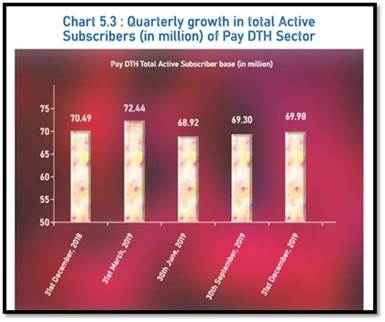
KOLKATA: According to ‘The Indian Telecom Services Performance Indicator Report October – December 2019‘ published by the Telecom Regulatory Authority of India (TRAI), the Indian DTH service has displayed phenomenal growth since launch in 2003. The total number of total active subscribers with pay DTH operators (Tata Sky, Airtel, Dish TV, Sun Direct) in India in the quarter ending December 2019 was 69.98 million, which is an increase from 68.30 million in the quarter ending September.
In terms of market share, Tata Sky led the DTH sector with the highest 31.80 per cent share followed by Dish TV at 30.55 per cent. Compared to the previous quarter, Tata Sky has further strengthened its market share lead over Dish TV. The data also suggests Tata Sky is 1.5X the size of Hathway, Den and GTPL Hathway all combined.
Commenting on the development, a Tata Sky Spokesperson said, “At Tata Sky our commitment is to ensure our ever increasing base of consumers can access their entertainment across platforms. This philosophy has enabled us to cement our leadership position in the direct to home and overall pay TV business, as underlined in TRAI’s latest report. As we explore technology driven newer platforms for content delivery and further scale up our customer support, we are confident that our viewers will continue to make Tata Sky the prime choice of their entertainment needs. The report also reinforces our belief that Television as a medium of entertainment continues to grow and strengthen.”

DTH
Den Networks reports Rs 1,227 million FY26 profit growth
Revenue crosses Rs 10,009 million as margins improve and costs ease
MUMBAI: Not all signals are on screen some are buried in the balance sheet. Den Networks has reported a steady financial performance for FY26, with profit after tax rising to Rs 1,227.53 million, reflecting improved operational discipline despite a relatively flat top line. For the year ended March 31, 2026, the company posted revenue from operations of Rs 10,009.17 million, marginally higher than Rs 9,891.45 million in FY25. Total income stood almost unchanged at Rs 12,282.10 million compared to Rs 12,279.77 million a year earlier, signalling stability rather than aggressive expansion.
The real story, however, lies beneath the surface. Total expenses declined to Rs 10,648.32 million from Rs 10,691.30 million, driven by tighter cost controls across key heads. Employee benefit expenses dropped to Rs 548.64 million from Rs 651.52 million, while depreciation and amortisation expenses also eased to Rs 652.01 million from Rs 723.06 million, indicating a leaner operational structure.
As a result, profit before tax rose to Rs 1,633.78 million from Rs 1,588.47 million, while profit after tax improved to Rs 1,227.53 million, up from Rs 1,173.96 million in the previous year. Earnings per share stood at Rs 2.57, compared to Rs 2.46 in FY25, underlining incremental shareholder value creation.
On the balance sheet front, the company’s total assets expanded to Rs 43,416.76 million from Rs 42,496.64 million, supported by a sharp rise in bank balances to Rs 30,628.71 million. Equity also strengthened to Rs 38,532.74 million, reflecting accumulated profits and a growing financial cushion.
Cash flow dynamics, however, present a more nuanced picture. While investing activities generated a net inflow of Rs 632.80 million, operating activities saw an outflow of Rs 553.50 million, largely due to tax payments and working capital adjustments. The company ended the year with cash and cash equivalents of Rs 151.70 million, up from Rs 106.11 million.
Taken together, the numbers suggest a business that is prioritising efficiency over expansion holding revenue steady while tightening costs and strengthening its balance sheet. In an industry where growth often grabs headlines, Den Networks appears to be making a quieter statement: sometimes, resilience is the real signal.