Hindi
Student Of The Year: A classic KJO fare

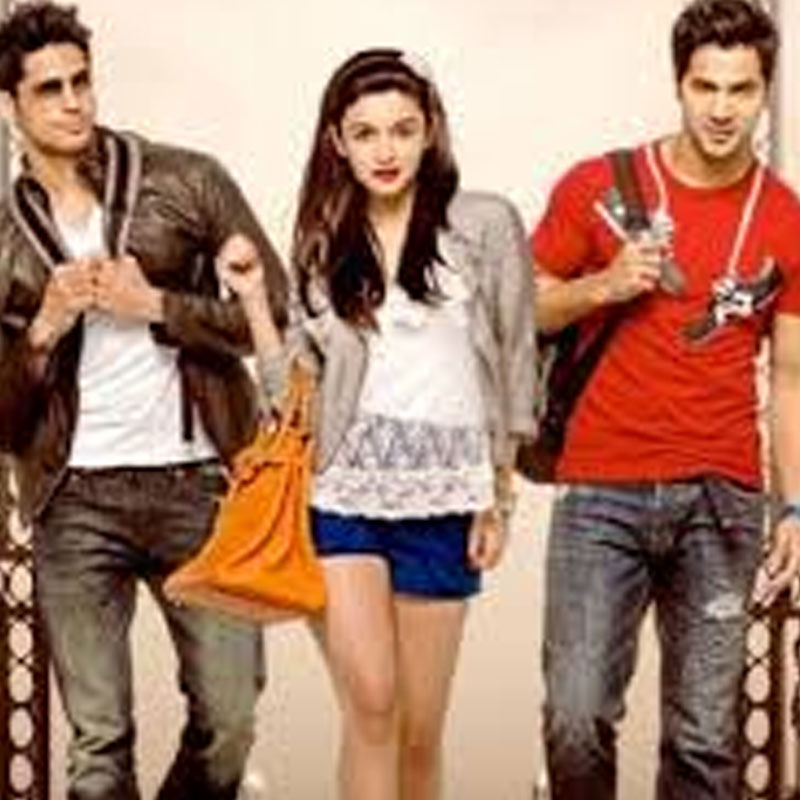
MUMBAI: Launching all new faces is a tricky business, especially in an era when opening day response and the first three day collections determine the fate of the film. Karan Johar is in a position to launch new faces but has wisely chosen to do so with a tried and tested formula instead of experimenting. In that, Student Of The Year, is about two friends, one rich and the other not so and there is a girl and, hence, an inevitable ‘friends turned foes‘ angle of interest in this school campus story.
Varun Dhawan is a rich man‘s son and as it happens in most such films, the school is bankrolled by his father, Ram Kapoor who spites his son because his ambition is to become a musician instead of joining Kapoor‘s empire. Dhawan has a steady girlfriend, Alia Bhatt, but that does not stop him from flirting with other girls. In walks Sidharth Malhotra, a sports scholarship student, an orphan living with his uncle, an always ready to insult aunt and a doting grandmother. Malhotra awes the students with his personality when he enters the campus. However, he will remain an outsider in a scene dominated by Dhawan unless he strikes a friendship with him. He makes the first move during a game of football and both, Dhawan and Malhotra, become thick friends.
The idea being to entertain, in-class clichés are spared and the film deals mainly with campus and sports arena.
Malhotra notices Bhatt‘s discomfort when Dhawan cosies up with another girl. Deciding to help her, he suggests she do exactly what Dhawan is doing that is to pretend to get close to someone else to make Dhawan jealous. For Bhatt who better than Malhotra himself since besides being close at hand, he is the best friend of Dhawan and hence safe for her! The ploy works and Bhatt gets her man back but the inevitable has happened; Malhotra has fallen for Bhatt in the process. Bhatt seems to have discovered new love too but she is not able to decide who she wants. Dhawan notices her bend towards Malhotra and friendship changes into enmity.
It is Student of the Year contest time but such a contest is no fun without rivalry; and for both the lads, what better opportunity to outdo other? Since this is cinema, dancing is a part of the contest (having a partner is must), others being IQ test and a multi event field contest where swimming, cycling and running follow back to back. The IQ test is won by the dumbest guy in the class who ticks each answer after chanting ‘Jai Mata Di‘. In his sinister way, Dhawan‘s father, Ram Kapoor wants Malhotra to win. As for Malhotra himself, he is on a sportsman‘s scholarship and, even in this five star school, athletics can‘t be won merely because one is rich. The Student of the Year trophy is in his grasp.
The film begins in a flashback as an impromptu reunion has happened of the students after ten years because their dean, Rishi Kapoor, is breathing his last and the students have come to see him. Malhotra, the underdog has realized his ambition of making millions and so has Dhawan by becoming a successful singer. These friends turned foes get into a fight and while exchanging blows, till they realize that they were never really enemies.
What is good about Student Of The Year is that, it introduces three new faces thus lending the film freshness. Though a single location film, director Johar has given the film all the gloss and finesse thus making it visually pleasant. The supporting cast has been selected very well avoiding stereotypes. Dialogue is simple yet peppered with ample wit; melodrama or mush of any sort is avoided in dialogue as well as in the proceedings. Cinematography catches all the gloss aptly. This is a patent Johar film alright. The film has foot tapping songs and using remixed old songs goes very well with the viewer. Radha….., Ratta Maar….., Vele…. all have popular appeal.
Malhotra and Dhawan are good at what a film actor would need today, good physic and competence in dancing besides being confident. Bhatt is petite and pretty, doll like. Rishi Kapoor as the gay dean of the school adds some lighter moments to the film. Ram Kapoor and Ronit Roy are okay. Kajol, Boman Irani, Farha Khan and Vaibhavi Merchant make flitting appearances.
Student Of The Year is fun while it lasts and having opened to a favourable response from the youth, it is a money-maker.
Shudra -The Rising: A pointless meandering bore
Shudra – The Rising is a film about the class system and attempts to depict the ill treatment and injustice meted out to the Shudras. The film chooses an undefined era where there is a settlement of these underprivileged and a local Thakur. While the film‘s promotional material shows a picture of Dr Bhimrao Ambedkar, the film or whatever is happening on the screen has no relevance to the great man.
In this settlement of Shudras, every person looks more than occupied doing something or the other. Their lot is supposed to wear a bone to mark them out, a bell to warn the upper cast of their being around, a utensil (handi) around their neck and tie a broom at the back to wipe the floor they walk on to remove their footprints. That having been established (which was depicted earlier more effectively in Ketan Mehta‘s 1980 much acclaimed Gujarati film, Bhavni Bhavai) the film just meanders around the plights of the lot.
Their problems arise when the local thakur spots a pretty face among the Shudras and orders her husband to drop her off at his haveli come evening. One such woman has been picked by the thakur and the film spends most of its footage in showing helplessness of the woman and her husband trying to elicit viewer sympathy but managing to get some yawns instead. Time to deliver the woman and the thakur‘s henchmen arrive to collect her. The resisting husband is beaten up bad to die ultimately.
The settlement decides to revolt. To avenge the murder of one of them, they kill the thakur‘s son. In retaliation, thakur lets his goons lose on the settlement to burn it down and kill every soul there.
What kind of rising is this and what is the maker trying to say? Is the film someone‘s idea of an intelligent film? Please, not with this kind of tripe.
Janleva 555: Lives up to its nameJanleva 555 could have been a 1940s film. It is about a love story of ichhadhari naagin, Kalpana Pandit, and her beau and the myth of such snakes.
Pandit along with her team is visiting a part of South India where many people die of snakebites for lack of instant treatment. But soon as they arrive at the location, strange things start happening to Pandit. The dreams of a snake she has been seeing since her childhood are now getting amplified. A bhairav or snake charmer wants to kill her. He is the same bhairav who killed her snake beau in the 15th century and has been waiting for her so that he can lay his hands on mani or a huge diamond which she has hidden before her death in that era!
In her reincarnation, Pandit used to dream of events of 15th century and was destined to come back to the same place. Her beau is still around in human form and acts as her protector from the bhairav. The bhairav wants the diamond because that will make him immortal. Isn‘t he immortal without it to be around since 15th century? What follows is a lot of nonsense stuff till a historian of some kind, Anant Nag, solves her puzzle; sad he can‘t help the audience. The surprising thing is that the film has been made by a doctor based in the US, the very same Pandit who also plays the female lead.