Hollywood
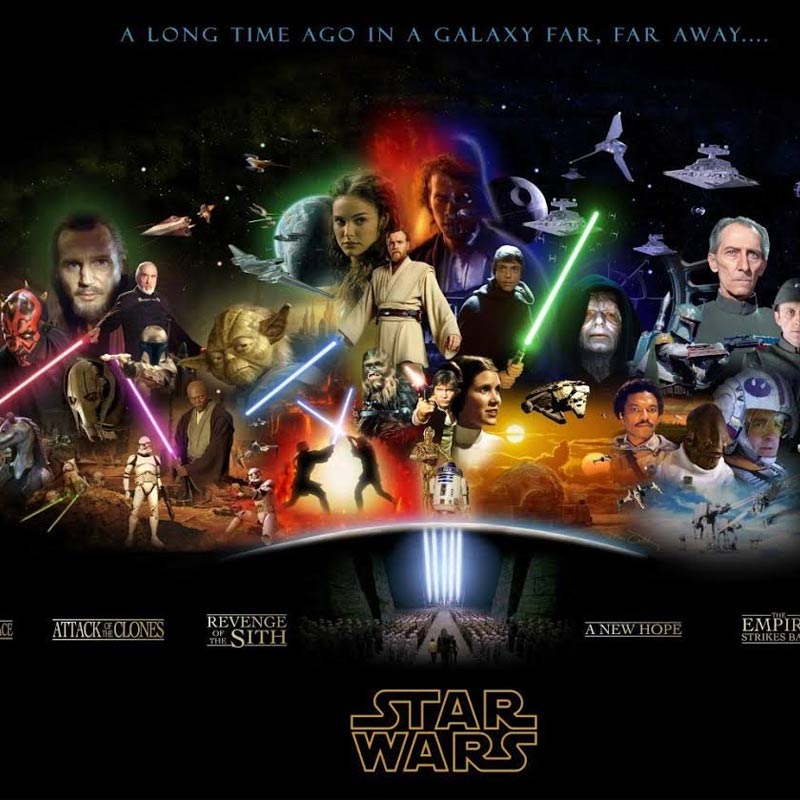
Star Wars: Complete Saga is back on Star Movies!
MUMBAI: Star Wars: Episode I – The Phantom Menace is starting on 14 January at 12 noon, and Star Wars: Episode II – Attack of the Clones on 15 January at the same time.
From 1977 to 2017, Star Wars, a space film series created by George Lucas of “a long time ago in a galaxy far, far away” famous for its innumerable fans following The Complete Saga religiously. In first place this film series has multiple characters and secondly each character has its own little or big story which draws attention of the viewers.
There are so many facts about the Star wars that people love to debate. Merchandise like light saber, T-shirts, Star Wars Character figurines and bobble heads have always remained I the shelves of every 90s kid until now. With the Star Wars Saga making a comeback on Star Movies, a quikc look at some of the mind boggling facts of the Star Wars Saga.
. Anthony Daniels, who voiced C3P0 and climbed into the tin suit, is the only actor to appear in all 8 Star Wars films
. Bail Organa and Yoda step into the hallway of Organa’s ship and have a nice coversation about being rebels or something in Sith. It’s the actual ship that Darth Vader boards to capture Princess Leia Organa in the start of A New Hope.
. Clones age TWICE as fast as normal.
. According to Animation Director Rob Coleman, not a single clone trooper suit was ever built. Every single clone trooper seen in the film is computer generated, with motion capture performed by ILM employees, wearing only the helmet and sometimes the footwear of the suit. The rest is complete CG.
. In Jedi, listen very carefully as Darth Vader picks up the Emperor and throws him down the Death Star shaft. This is the only time the Jedi theme music plays over a shot of Vader, reflecting his return to the light side of the Force.
. Princess Leia was subject to one of the most famous ad libs in cinema history – that being Han Solo’s response to her declaration of love – “I know”. Harrison Ford apparently made it up at Irvine Kershner’s suggestion. Leia got to return the line in Jedi during the Battle of Endor.

Hollywood
Utopai Studios partners Huace to deploy PAI for long form content
Deal includes revenue sharing as Huace adopts AI engine across global ops
MUMBAI: Lights, camera… algorithm, the script just got a silicon co-writer. In a move that signals how storytelling itself is being re-engineered, U.S.-based Utopai Studios has partnered China’s Huace Film & TV Co. Ltd. to bring artificial general intelligence into the heart of long-form content creation.
At the centre of the deal is PAI, Utopai’s cinematic storytelling system, which Huace will deploy as a core engine across its production pipeline from development and creative iteration to global localisation. The partnership includes a large-scale annual usage commitment from Huace, alongside a usage-based revenue-sharing model, underscoring both ambition and commercial confidence on both sides.
For Huace, one of China’s largest film and television companies, the bet is not on automation alone but on scale with control. With distribution spanning over 200 countries and a presence across more than 20 international platforms, including Netflix and YouTube, the company brings a vast content ecosystem where even marginal efficiency gains can translate into significant output shifts. Its extensive TV IP library further positions it as fertile ground for AI-assisted storytelling workflows.
The choice of PAI follows what Huace described as a rigorous evaluation of existing AI tools, many of which remain limited to fragmented use cases such as video generation or editing. What tipped the scales, according to the company, was PAI’s ability to handle long-form narrative complexity maintaining continuity, structure, and creative coherence across entire story arcs rather than isolated clips.
Utopai, for its part, is using the partnership to anchor its international expansion strategy, pitching PAI as an enterprise-ready system built for customisation, privacy, and regulatory adaptability across markets. That positioning becomes particularly relevant as global media companies increasingly scrutinise how AI integrates into proprietary workflows.
The timing is notable. Earlier this month, Utopai upgraded PAI to support three-minute 4K video generation and advanced multi-shot sequencing features designed to tackle one of AI storytelling’s biggest hurdles: consistency across scenes.
What emerges is not just another tech collaboration, but a glimpse into how the grammar of filmmaking could evolve. Because if stories were once crafted frame by frame, the next chapter might just be coded scene by scene.