News Broadcasting
Soft power and brightest stars shine at TV9 What India Thinks Today (WITT) inaugural

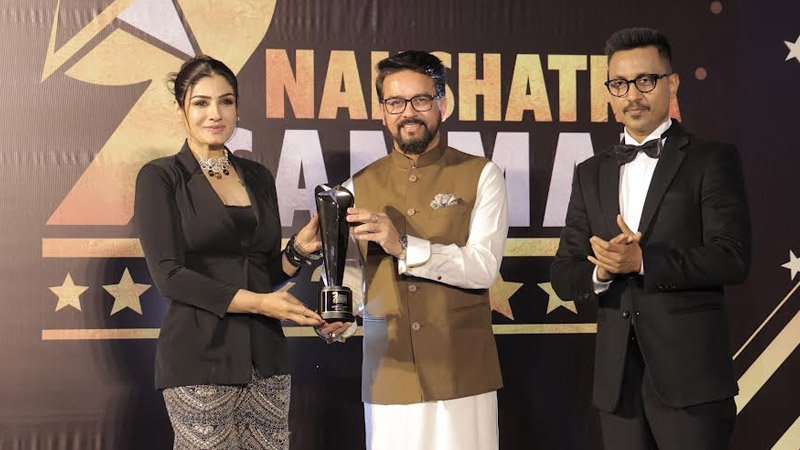
Mumbai: The Inaugural of the TV9 What India Thinks Today (WITT) Global Summit 2024 kicked off on the 25 February, with a captivating exploration of India’s soft power and a celebration of its brightest stars in cinema and sports. Held under the overarching theme, “India: Poised for the Next Big Leap,” the inaugural day set a dynamic tone for the following days of insightful discussions and collaborative initiatives.
The day commenced with a rousing welcome address by TV9 Network MD and CEO Barun Das, who said, “We are here to celebrate the curtain-raiser with a subject very close to my heart, many well-known faces from the world of sports and entertainment are here today for a purpose – to discuss a bold vision for India. Not as an economic or military power. But as a soft power”.
Following shortly after was a fireside chat, with both the MD Barun Das and the Union Minister of Sports, Youth Affairs and Information & Broadcasting, Anurag Thakur. Speaking about the strides India is making in the arena of sports, he said, “Today, in sports other than cricket, we have a lot of stars to look up to. The government has increased (its) sports budget by about three times”.

Also expressing his pride in the way the Indian entertainment industry is evolving, he said, “In the next ten years, India will be the content hub of the world. It will be the ‘content continent’ of the world”.
The Inaugural day of the summit also featured the TV9 Nakshatra Samman Awards, celebrating contributions by the very finest stars in sport and entertainment. Record-holding athlete Harmilan Bains, para cricket champion Amir Hussain Lone, professional shooter Sift Kaur Samra, and badminton champion Anmol Kharb rounded out the list of sporting stars to be honoured, while superstars Allu Arjun, Raveena Tandon, Grammy award winners Rakesh Chaurasia and V. Selvaganesh were awarded for their artistic genius in a dazzling display.
The panel discussion on ‘Sports Burnishing: An Opportunity for New India’ witnessed participation from sports industry stalwarts and sports stars themselves, including badminton legend Pullela Gopichand, Collage Sports Management CEO Latika Khaneja, Bundesliga CCO Peer Naubert, Former FK Austria Vienna CEO Markus Kraetschmer, and Tata Motors CVBU CMO Shubhranshu Singh.
Amitabh Kant, India’s G20 Sherpa, joined the Inaugural Day of the What India Thinks Today Global Summit for a keynote interview on ‘Brand India: Leveraging Soft Power’, where he seconded the administration’s faith in soft power, saying, “The PM believes that the cultural strength, the civilizational impact, the tourism products which India has, no other country in the world has. He believes that this can be the biggest driver of India’s growth, it can be the biggest employment creator”.
Firing up the glamour quotient at The Inaugural was none other than Raveena Tandon, who talked, in a fireside chat on the subject of ‘Female Protagonist: The New Hero’, about the problems of a patriarchal society, saying, “When the time came for women to be great at their work, to be masters of their craft, they were told to retire. This is something that I never understand.”
The panel discussion on the same theme saw participation from prominent women leaders from different fields, including National Commission for Women Member Khushbu Sundar, Stiftung Jugendaustausch Bayern MD Mirjam Eisele, football evangelist Julia Farr, and GAIL Director HR Ayush Gupta.
Casting a spotlight on the burgeoning content scene in India, a panel discussion on ‘Boundless Bharat: Beyond Bollywood’ capped off the evening’s events, with several notable faces lending their views to the subject, including actor-director Shekhar Kapur, Grammy award winners Ricky Kej, Rakesh Chaurasia, V Selvaganesh, and Sinclair Broadcast Group CEO Christopher Ripley.
The TV9 What India Thinks Today Global Summit 2024 continues on 26 February with the much-anticipated Global Summit, where distinguished guests from around the world will converge to discuss pressing geopolitical and geo-economic issues, and where Prime Minister Shri Narendra Modi will deliver the Summit Keynote address.






News Broadcasting
UDF poised to return to power in Kerala, says Manorama-CVoter survey
Massive opinion poll projects shift in Kerala politics ahead of 2026 Assembly elections.
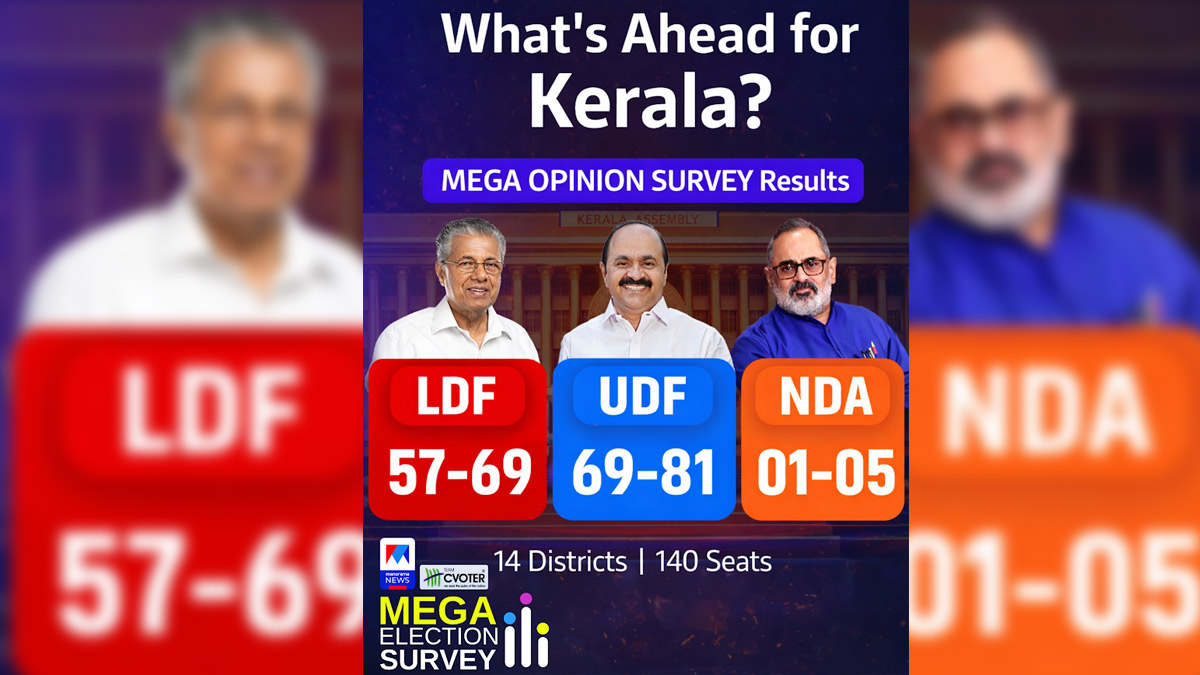
MUMBAI: The winds of change appear to be blowing through Kerala’s political landscape and this time, they seem to favour the United Democratic Front. A comprehensive mega opinion survey conducted by Manorama News in partnership with CVoter projects a potential comeback for the UDF in the upcoming Kerala Legislative Assembly Elections 2026. The survey, covering all 140 constituencies with a massive sample size of nearly 90,000 respondents, predicts the UDF could win between 69 and 81 seats.
The ruling Left Democratic Front (LDF) is expected to secure 57 to 69 seats, a significant drop from the 99 seats it won in the 2021 elections. This would mean the LDF losing 30 to 42 of its sitting seats. Meanwhile, the National Democratic Alliance (NDA), which drew a blank in 2021, is projected to open its account with 1 to 5 seats.
Region-wise, the UDF is expected to make strong gains in Malabar, winning 25 to 34 out of 48 seats, and in Central Kerala, where it could bag 29 to 33 out of 53 seats. In South Kerala, the LDF is likely to retain an edge with 21 to 25 seats, while the UDF may improve to 12 to 16 seats. The NDA could pick up 1 to 3 seats in the southern region.
The survey was conducted between 14 and 26 March 2026, with additional tracker and snap polls carried out from December 2025 to March 2026. A total of 89,693 respondents participated, ensuring representation across all demographics and social segments.
Manorama News has a strong track record of accuracy, with its previous projections closely matching the actual results of the 2019 and 2024 Lok Sabha elections as well as the 2021 Kerala Assembly polls.
In Kerala’s famously fierce political battles, this survey suggests the pendulum may be swinging back. Whether the final verdict matches these numbers or throws up another surprise, one thing is clear, the 2026 Assembly elections are shaping up to be one of the most keenly watched contests in the state’s history.






