I&B Ministry
Smriti Irani gets additional charge as MIB minister
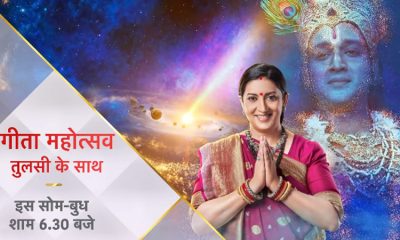
NEW DELHI: Actor-turned politician Smriti Zubin Irani has been given the additional charge of the information and broadcasting ministry following the resignation of M Venkaiah Naidu who has been nominated for the post of the country’s vice-president.
Irani will hold this charge in addition to her main ministry, textiles. Welcoming her after the announcement was made by the prime minister Narendra Modi, minister of state Rajyavardhan Rathore tweeted: “Delighted to welcome the sharp, erudite smt. @smritiirani to @mib_india. Looking fwd to working with her in the ministry.”
Nominated to the Rajya Sabha from Gujarat, Irani had first joined Modi’s cabinet as Human Resource Development Minister but had been shifted to Textiles in a cabinet reshuffle.
Irani joined the Bharatiya Janata Party in 2003. She became the vice-president of the Maharashtra Youth Wing in 2004.In the 2004 general elections for the 14th Lok Sabha, she contested unsuccessfully against Kapil Sibal from the Chandni Chowk constituency in Delhi. She was nominated as executive member of the central committee of the BJP. In early 2010, Irani was appointed National Secretary of BJP and on 24 June, she was appointed All India President of the BJP’s women’s wing, BJP Mahila Morcha.
Irani contested the 2014 general elections against Rahul Gandhi in Amethi and lost. On 26 May 2014, Modi appointed her as the minister of human resource development in his cabinet. Her appointment was criticised by many people owing to her lack of formal higher education.
Irani was born in Delhi to a Bengali mother and a Punjabi father, Ajay Kumar Malhotra. She is the eldest of three sisters. She has been a part of the Rashtriya Swayamsevak Sangh (RSS) from childhood as her grandfather was an RSS swayamsevak and her mother a member of Jana Sangh.
Irani was one of the finalists of the beauty pageant Miss India 1998, along with Gauri Pradhan Tejwani. In 1998, Irani appeared in a song “Boliyan” of the album “Saawan Mein Lag Gayi Aag” with Mika Singh.
In 2008, Irani along with Sakshi Tanwar hosted the show Yeh Hai Jalwa, a dance based reality show featuring celebrities along with their troops on 9X. In the same year she also produced another show on Zee TV, Waaris which ended in 2009. In 2009, she appeared in a comedy show Maniben.com, aired on SAB TV. She also co-produced the show in collaboration with Contiloe Entertainment. In 2012, she worked in Bengali movie Amrita.
Also Read :

I&B Ministry
Government sets up AI governance group to steer policy
AIGEG to align ministries, assess jobs impact, guide AI deployment.
MUMBAI: If artificial intelligence is the engine, the government is now building the dashboard and making sure everyone reads from the same screen. The Centre has constituted a new inter-ministerial body to coordinate India’s approach to AI, formalising a key recommendation from its governance framework and the Economic Survey. The AI Governance and Economic Group (AIGEG), set up by the Ministry of Electronics and Information Technology, will act as the central platform to align AI-related policy across ministries, regulators and departments, an attempt to bring coherence to what has so far been a fragmented and fast-evolving landscape.
The group will be chaired by union minister Ashwini Vaishnaw, with minister of state Jitin Prasada as vice chairperson. Its composition reflects both technological and economic priorities, bringing together the principal scientific adviser, the chief economic adviser, and the CEO of NITI Aayog, alongside key secretaries from telecommunications, economic affairs and science and technology. A representative from the National Security Council Secretariat is also part of the group, while the MeitY secretary will serve as member convenor.
At its core, AIGEG is designed to do two things: coordinate and anticipate. On the policy front, it will review existing regulatory mechanisms, issue guidance across sectors and ensure companies remain compliant with evolving legal frameworks. Beyond that, it will oversee national initiatives on AI governance, with a focus on enabling responsible innovation rather than merely regulating it.
The economic dimension is equally central. The group has been tasked with assessing how AI-driven automation could reshape jobs identifying which roles are most at risk, where those impacts may be geographically concentrated, and whether technology will augment or replace human labour. Based on these assessments, it will develop mitigation strategies and transition plans, signalling a more proactive stance on workforce disruption.
In parallel, AIGEG will work with industry stakeholders to chart a long-term roadmap for AI adoption, categorising use cases into “deploy”, “pilot” or “defer” buckets depending on readiness factors such as data availability, skill levels and regulatory clarity. The aim is to move from broad ambition to structured execution deciding not just what can be built, but what should be built now.
The group will function as the apex layer in India’s AI governance architecture, supported by a Technology and Policy Expert Committee that will track global developments, emerging risks and regulatory priorities. Together, the two bodies are expected to shape both the pace and direction of AI adoption in the country.
In a landscape where technology often outruns policy, the creation of AIGEG signals an attempt to close that gap ensuring that India’s AI journey is not just rapid, but also coordinated, accountable and economically grounded.