iWorld
Screen Test: OTT and TV face an identity crisis in India’s content crossover

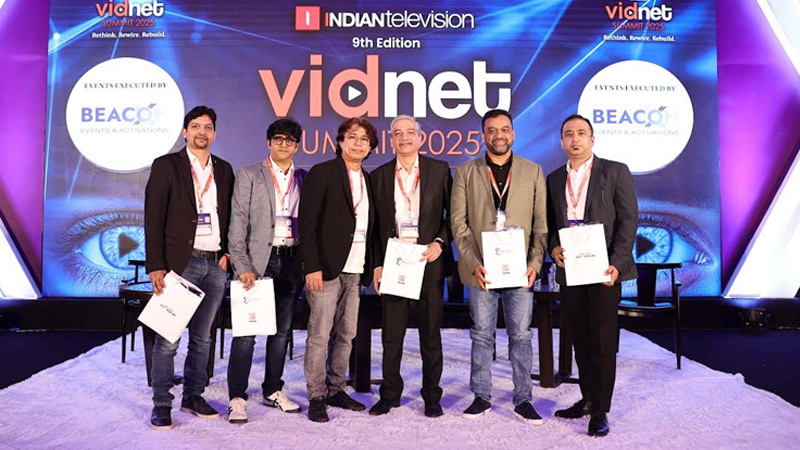
MUMBAI: If the future of television had a remote, India seems to be pressing every button at once. At the 9th edition of the Vidnet Summit 2025, an ostensibly polite panel on Blurring Lines Between OTT and Broadcast quickly turned into a spirited tug-of-war over who regulates what, who influences whom, and who is really luring India’s increasingly device-agnostic viewer.
What began as a discussion on programming soon morphed into something far bigger, censorship, consumer behaviour, family dynamics, illegal feeds, hybrid tech, and the great Indian parental panic. If the streaming revolution needed a reality check, this roomful of broadcasters, tech chiefs and platform bosses delivered one without buffering.
The loudest debate circled the regulatory vacuum around OTT content. While broadcast TV remains tightly governed by Ministry of Information & Broadcasting (MIB) norms, certification codes and self-regulatory bodies (SMBs), OTT continues to float in a grey zone of “age ratings”, “parental guidance” and “viewer discretion”.
“There is no censorship on OTT,” one panellist declared, sparking a volley of objections. “I won’t call it censorship,” countered another, “but from a regulatory perspective, there is a lot of control.” Yet several others disagreed entirely, pointing to content that would never pass broadcast scrutiny but thrives online.
And then came the audience moment, “How many people want censorship on OTT?” Not a single hand went up until a parent raised the obvious, “Would you let your 10-year-old watch anything and everything?”
The room conceded the contradiction. OTT claims to empower users with choice, but children rarely follow guidelines, and parental locks are often simple four-digit codes typed right in front of them. “Even if I put a child lock, the password is visible on the TV,” one delegate sighed, summarising the helplessness many parents feel.
Broadcast executives argued that family viewing is still sacred, especially in India. Linear TV is designed for living rooms; OTT is designed for personalised devices — yet Connected TV (CTV) complicates that neat divide.
“Connected TV is family-watched,” said one broadcaster, insisting CTV sits closer to linear TV than OTT in spirit. “If that’s the model, it will also need the same regulation.”
This was promptly challenged. “OTT is my choice. If I want to watch adult content, I will. But I will not let my kid watch it,” said another panellist. Platforms, they argued, must take responsibility to design safer experiences not just slap age labels and call it a day.
Despite the ideological differences, everyone agreed on one thing: the consumer no longer cares where content comes from. They care only that it loads fast and entertains.
“Linear is still convenient,” insisted Yatin Gupta of GTPL Hathway. “A channel flip is easier than deciding what to watch on OTT.” That flip the laziest thumb movement in media history is still one of television’s strongest value propositions.
Yet bundling models are evolving rapidly. “We are experimenting with whether to bundle cable with OTT,” Gupta revealed, though he admitted that consumers may never use all 20 apps they’re offered. But the option adds perceived value, and perception sells.
Another panellist pushed back: OTT isn’t inherently inconvenient; new users simply need time to settle. “If I go to Netflix for the first time, I’ll take half an hour to pick something,” he joked, drawing groans and laughter in equal measure. “You clearly have time on your hands,” quipped another.
For all the promise of ad-free streaming, India’s OTT landscape is rapidly veering back to TV-like advertising. “I watched a cricket match there were 14 ads before the match started,” one panellist said, half amused, half traumatised. Another called this “a textbook example of economics”.
Consumers paying for OTT subscriptions are furious that ads now follow them everywhere. OTT executives retorted: “If users can watch ads on YouTube, they can watch them anywhere,” ignoring the inconvenient truth that YouTube remains free for most Indians.
With ad-supported tiers growing and non-skippable ads becoming the norm, panellists warned that OTT is now mimicking the exact behaviour it once promised to escape.
If content divides the room, technology unites it. Everyone agrees on one thing: hybrid viewing is the future.
Ajay Meher of Tata Elxsi pointed out that hybrid TV penetration globally has crossed 35 per cent, reflecting a massive shift in how audiences consume content. Broadcast infrastructure is becoming increasingly IP-driven, and smart TVs are erasing the distinction between live channels and apps.
“The traditional model of broadcasting is blurring,” he said. “Everyone is moving towards hybrid production.” Vivek Mishra of Samsung reinforced this, “The future trend is where the medium doesn’t matter content and convenience do.”
He argued that consumers are not switching from broadcast to OTT; they are blending both depending on mood, time and attention span. “There has always been a need for relaxing viewing,” he said. “That need doesn’t disappear just because OTT exists.”
A surprise flashpoint was the proliferation of FAST (Free Ad-Supported TV) channels. While some are licensed satellite channels, many others are not, raising concerns around oversight and legality.
“There are 200 channels on some FAST platforms barely 20 are licensed by the MIB,” one panellist warned. “Tomorrow, if a channel banned in India streams through FAST, who is accountable?”
This is where the regulatory debate sharpened.
Cable operators argued, “We are licensed distributors. We can only show licensed channels. FAST platforms are bypassing the entire framework.”
Streaming platforms countered, “There is no law that forbids us. The internet is not regulated in the same way.”
The stalemate is obvious:
Broadcasters want parity.
Platforms want freedom.
Consumers want convenience.
Regulators want safety.
And none of these wants cleanly align.
Sandeep Gupta of Shemaroo cut through the noise with the line that summed up the morning, “The lines between OTT and broadcast are blurring but not because of content. Because the consumer now has so many choices.”
Imran Khan of Amagi pushed it further, “As consumers get smarter devices, the divide will eventually disappear.”
The new reality is not broadcast vs OTT, it is passive vs active viewing, family vs personal screens, ad-free vs ad-stuffed, choice vs convenience.
By the end of the session, it was clear that India’s media ecosystem is no longer a neat two-column chart of TV vs OTT. It is a messy, glorious, user-driven spectrum powered by hybrid screens, smarter devices and ever-shifting attention.
Regulation will tighten. Monetisation will evolve. Technology will disrupt. But the consumer fickle, demanding, spoilt for choice will remain the ultimate regulator.
And as one panellist warned bluntly, “If the rules don’t change, the platforms that adapt fastest will take over.”
In India’s next chapter of TV vs OTT, the only thing truly blurry is the line separating yesterday’s remote from tomorrow’s algorithm.