Connect with us

Hindi

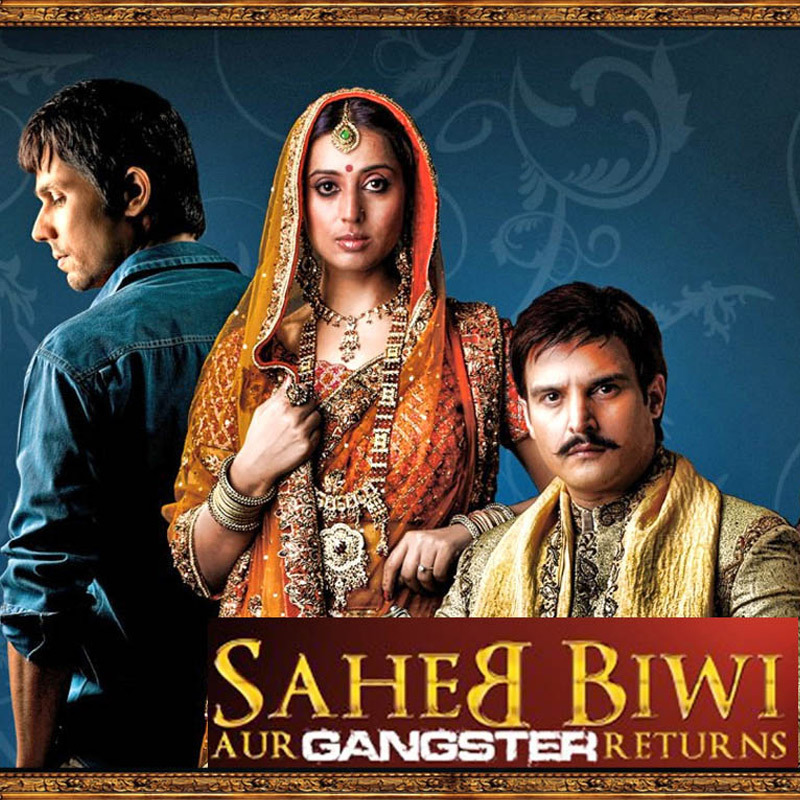
Saheb Biwi Aur Gangster Returns: A sequel that doesn’t disappoint

Published

on

MUMBAI: Saheb Biwi Aur Ganster Returns is a sequel to the 2011 film, Saheb Biwi Aur Gangster. It is, like its predecessor, a film about about warring men but the winner eventually is a woman. Jimmy Shergill, who has taken to illegal ways including running a dacoit gang to maintain his royal lifestyle since losing all the privileges, survived a shootout with his enemy but lost movement in his legs. He is wheelchair bound and had to give up his MLA seat to his wife, Mahie Gill. The sequel takes it from here.

Producers: Tigmanshu Dhulia, Nitin Tej Ahuja, Rahul Mittra.
Director: Tigmanshu Dhulia.
Cast: Irrfan, Jimmy Shergill, Soha Ali Khan, Mahie Gill, Raj Babbar, Deepraj Rana, Pravesh Rana, Rajeev Gupta.

This one is about four UP royals, now deep into politics. Of these, Shergill and Raj Babbar are the main ones. The four don‘t belong to any party but all are against the ruling party‘s proposal to divide UP into four states. Shergill is in control because he is the one the others turn to when they need muscle. His henchman, Deepraj Rana, is loyal and asks no questions when needed to eliminate his boss‘s enemies.

Unknown to him, Shergill has an enemy, Irrfan Khan, who wants to avenge his grandfather‘s death at the hands of Shergill‘s family. Shergill then goes on to add another enemy to his list in Babbar whose daughter, Soha Ali Khan, has caught his fancy. He knows Babbar would not willingly give away his daughter to a handicapped man. He plots to make Babbar agree but promises he will marry her only when he is able to stand on his feet again. Meanwhile, Gill continues her wayward life, always a drink in hand and in search of a man.

Advertisement

Irrfan is now even more determined to take on Shergill because he and Soha are very much in love. He, along with Babbar, starts plotting against Shergill and adds others with an axe to grind. The first one is the weakest link around Shergill, and that is Mahie. Irrfan can meet for her demands: cash and sex. The background political games are on and Shergill or no Shergill, the group has joined the cause of dividing UP. When it comes to reality, it is Gill who is the MLA and whose vote will count the next day. But Shergill is not the one to take things lying down. He locks up the three MLAs to stop them from voting.

Many such games are played by the four ‘royals‘. But it is finally between Irrfan and Shergill. Irrfan‘s family does not even have residual sign of royalty left as the older brother has taken to teaching for survival while the younger has joined the police. He is that much more bent on restoring his ancestral glory. However, if he has turned Gill against Shergill, he has also unwittingly lost his love, Soha, to Shergill.

Saheb Biwi Aur Gangster Returns goes along smoothly through its lengthier first half but come second half, it loses pace. Too much is happening but not all that is promised in the first half is delivered. Except verbal one-upmanship, there are no bullets flying. Irrfan has promised ‘ghamasan‘ war but nothing of the sort happens. He goes out meekly (maybe to be resurrected in Part 3?). The climax leaves one disappointed.

Advertisement

The direction by Tigmanshu Dhulia is competent as expected. The best part of the creative side is the film‘s dialogue. Music is okay and the item number is funny. Photography is good. While all artistes contribute ably, Irrfan is his usual best. Shergill exudes all the pride and power of an ex-royal very much still in control. Gill is okay. Soha is restrained. Raj Babbar does well. Deepraj Rana is effective.

Saheb Biwi Aur Gangster Returns has not been able to draw the expected opening response but should show some improvement over the weekend. The exams period will also affect the collections.


Advertisement

Saare Jahaan Se Mehnga: A satire that hits the right notes

Producer: Ashok Pandey.
Director: Anshul Sharma.
Cast: Sanjay Mishra, Pragati Pandey, Vishwa Mohan Badola, Ranjan Chhabra, Pramod Pathak, Zakir Hussain, Sitaram Panchal, Disha.

Saare Jahan Se Mehnga is a satire, one of those films that aim to make a point. It is also the kind of film that does not demand big stars but needs more lifelike characters. This helps both, the subject as well as the budget. Besides, like the producer‘s earlier film, Phas Gaye Re Obama, its aim is to entertain.

The film is about a family of four and how it copes with rising costs. Sanjay Mishra works with the animal husbandry department in Haryana. His wife, Pragati Pandey runs a beauty parlour from within the house. His younger brother, Ranjan Chhabra is a good-for-nothing young lad who took three attempts to get through 10th exams and has failed thrice already in 12th. The patriarch of the house is a grumpy old Vishwa Mohan Badola who is upset at having to make compromises in his lifestyle. The village crowd gathers outside Sitaram Panchal‘s cycle repair shop where, while working, he delivers speeches against rising costs and promises people that once the government brings back the black money from Swiss banks, every Indian will get four lakh rupees.

Advertisement

Meanwhile, Mishra learns that the local government is offering a lakh for every 10th-pass youth to start a business, that too with interest waiver for the first three years. He can avail of this loan in the name of his brother but is sceptical at first knowing his brother will only sink the cash. Then an idea strikes him. He can avail of this loan and with that money; stock up enough provisions to last the family for the next three years! The monthly cost on this account can be saved and will be enough to repay the loan at the end of three years. This way, the family can enjoy an inflation free life for the period.

Soon the loan is availed and the provisions stocked up. But there is one condition of the loan they missed: It is to set up business and they have no such venture to show when the loan inspector, Zakir Hussain, visits. The consequences, according to the inspector, could be jail for Chhabra. As a solution, a part of the parlour is converted into grocery shop. The customers come but are sent back. After all, the shop is only a front. The neighbourhood grocer, Pramod Pathak, thinks he has a competition and keeps Hussain in the loop about the situation. Pathak is already unhappy with the family since Chhabra is courting his daughter, Disha.

Following various ways to trick Hussain into believing they are running a genuine shop with the loan amount, the bubble bursts.

Advertisement

The film is a dig at the continuously rising costs and a family‘s struggles to beat it. The script is a bit stagey. The direction is fair. Dialogue is witty and effective. Music is average. Performances by Mishra, Chhabra, Pandey, Pathak are good while Badola makes his mark. Disha is okay. The film has familiar faces in supporting casts, those seen on TV or in films in side roles.

Saare Jahaan Se Mehnga is an okay film but it lacks the face value and promotion to survive at the box office.

Advertisement
Click to comment

Leave a Reply

Your email address will not be published. Required fields are marked *

Hindi

GUEST COLUMN: Why film libraries & IPs are the new engines of growth

Unlocking value through catalogue strength and IP synergy

Published

on

MUMBAI:In a media landscape defined by fragmentation, platform proliferation, and ever-evolving audience behavior, the economics of filmmaking are undergoing a fundamental shift. No longer confined to box office performance, a film’s true value is now measured across an extended lifecycle that spans digital platforms, syndication networks, and global markets. As content consumption becomes increasingly non-linear and algorithm-driven, film libraries and intellectual properties (IPs) are emerging as strategic assets, capable of delivering sustained, long-term returns. For Mohan Gopinath, head – bollywood business at Shemaroo Entertainment Ltd., this transformation signals a decisive move from hit-driven models to portfolio-led value creation. In this piece, Gopinath explores how legacy content, when intelligently repurposed and distributed, can unlock recurring revenue streams, why the interplay between catalogue and original IP is critical, and how media companies can build resilient, future-ready entertainment businesses.

For all these years, we thought that a film is successful if it performs well in theatres. There are opening weekend numbers, box office milestones, and distribution footprints that gave a good picture of how the movie has done commercially and also tell us about its cultural impact. However, there are multiple platforms today, always-on content ecosystem, which has caused a shift. Today, the theatrical performance is not the culmination of a film’s journey but merely the beginning of a much longer and more dynamic lifecycle.

Film libraries today are emerging as high-value, constantly evolving assets that deliver sustained returns well beyond initial release cycles. This becomes a point of great advantage for legacy content owners with diverse catalogues, to shape long-term business outcomes.

Advertisement

According to FICCI-EY, the media and entertainment industry of India achieved a valuation of Rs 2.78 trillion in 2025 which is expected to reach Rs 3.3 trillion by 2028 through a compound annual growth rate of approximately 7 per cent and digital media will bring in more than Rs 1 trillion to become the biggest sector which generates about 36 per cent of overall market revenues.

This shift is the expansion of distribution endpoints. We know how satellite television was once the primary secondary window but today, it coexists with YouTube, OTT platforms, Connected TV, and FAST channels. Each of these platforms caters to distinct audience demographics and consumption behaviors, helping content owners to obtain more value from the same asset across multiple formats.

For instance, films that had great reruns, now find continuous engagement across digital platforms. On YouTube, classic Hindi cinema continues to attract significant viewership, reaching audiences across generations and geographies with remarkable consistency. At Shemaroo Entertainment, this is reflected in our film library shaped over decades as part of a long association with Indian entertainment. From classics such as Amar Akbar Anthony to much-loved entertainers like Jab We Met, Welcome, Dhamaal, Phir Hera Pheri, Dhol, Golmaal, and Bhagam Bhag, many of these titles continue finding new audiences while retaining their place in popular memory. Their enduring appeal reflects how culturally resonant stories can continue creating value over time.  Similarly, FAST channels have created curated, always-on environments where catalogue content can continue to thrive through star-led and genre-based programming.

Advertisement

This multi-platform approach has very well transformed films into long-tail IP assets which are capable of generating recurring revenue across advertising, subscription, and syndication models. 

The evolution of audience behavior is equally important. Nowadays, it’s more important to find what’s more relative than what’s recent as viewers are more influenced by mood, memories, and algorithmic suggestions than by release schedules. Even if a movie was released decades ago, it can trend alongside a newly released movie, if surfaced in the right context. Thoughtful packaging, whether through festival-based playlists, actor-driven collections, or genre clusters, allows catalogue content to remain dynamic and continuously discoverable. Shemaroo Entertainment has built extensive film libraries over decades and its focus has mostly been on recontextualizing content for the consumption of newer environments. This process doesn’t just include digitization and restoration, but also re-packaging of films as per platforms.

Syndication itself has evolved into a key growth driver. In perspective, when looking at the domestic market, curated content packages continue to find strong demand across broadcast and digital platforms. Meanwhile, in the international market, especially in markets like Middle East, North America and Southeast Asia, the appetite for Indian content is opening up new monetization avenues. Here, the ability to package and position catalogue content effectively becomes as important as the content itself.

Advertisement

Importantly, the need to re-package catalogue content does not diminish the role of new content. In fact, originals and fresh IP are essential to sustaining the long-term value of a film library because they act as discovery engines that bring audiences into the ecosystem, while catalogue content drives depth, retention, and repeat engagement. 

This interplay between the “new” and the “known” is what defines a robust content strategy today. While new films generate spikes in consumption, catalogue titles offer familiarity and comfort. These are factors that are increasingly valuable in an era of content abundance and decision fatigue. This is also shaping our strategy, drawing value from both a deep catalogue assets and a growing focus on original IPs to strengthen long-term audience engagement and build more predictable revenue streams.

There is growing recognition that long-term value in entertainment will be shaped not only by how intelligently existing content continues to live, travel and find relevance, but also by how consistently new stories are created to renew that ecosystem. In that sense, film libraries and original IP are not parallel bets, but reinforcing engines of growth. For media companies, the opportunity lies in making these two forces work together, because that is increasingly where more resilient and predictable businesses are being shaped.

Advertisement

Note: The views expressed in this article are solely the author’s and do not necessarily reflect our own.

Continue Reading

Advertisement News18
Advertisement
Advertisement
Advertisement
Advertisement Whtasapp
Advertisement Year Enders

Indian Television Dot Com Pvt Ltd

Signup for news and special offers!

Copyright © 2026 Indian Television Dot Com PVT LTD