News Broadcasting
Sahara snares Sridevi for small screen debut


Its Sridevi, finally.
After letting rumours that Bollywood top glitter would stud forthcoming Sahara TV programmes permeate the industry, the channel has finally zeroed in on the yesteryear queen bee to play the lead in its new serial.
The as-yet-unnamed 104-episode serial promises to showcase Sridevi’s talent, hitherto unseen on the small screen. This will be the actress’ first celluloid appearance (big or small screen) after a three-year hiatus, claims Sahara. The announcement that Sridevi will be the channel’s star value comes as a dampener of sorts after reports that Amitabh Bachchan might be appearing next on Sahara, after the Kaun Banega Crorepati season ended in January.

Sahara TV promoter Subroto Roy had in July 2001 set up a committee consisting of Modi Entertainment Group’s Buena Vista Television CEO Pratik Basu, programming head Basaav Raj, its ad agency Percept Advertising’s promoters Harindra and Shailendra Singh, and other senior managers from within the company. The Percept duo along with the Sahara team were given the task of looking after the programming and marketing of the channel. With some Rs 100-120 million set aside for the channel’s overhaul, it was clear there was some serious intent to get the channel up and going. November saw Sahara really get into the groove with the launch of a host of new programmes on its prime time slot, between 8 and 9 pm, ranging from mythological series to family dramas. It was around the same time that the reports about Bollywood biggies being roped in surfaced.
One interesting fallout of this new initiative is that the small screen will see the revival of an old rivalry. That between Sridevi and Madhuri Dixit. In fact it was Madhuri who displaced Sridevi from her perch as the Queen of Bollywood. With the Madhuri-hosted marriage show Shubh Vivaah certain to have its debut on Sony Entertainment any time after 30 June how Sridevi’s show fares will be watched with interest.
And judging by the fact that there there are no details forthcoming as to what the new Sahara show entails, it seems to indicate that the programme launch might take a few months. This may well mean that both shows will be ready to air at around the same time.
Certainly something to look forward to.






News Broadcasting
UDF poised to return to power in Kerala, says Manorama-CVoter survey
Massive opinion poll projects shift in Kerala politics ahead of 2026 Assembly elections.
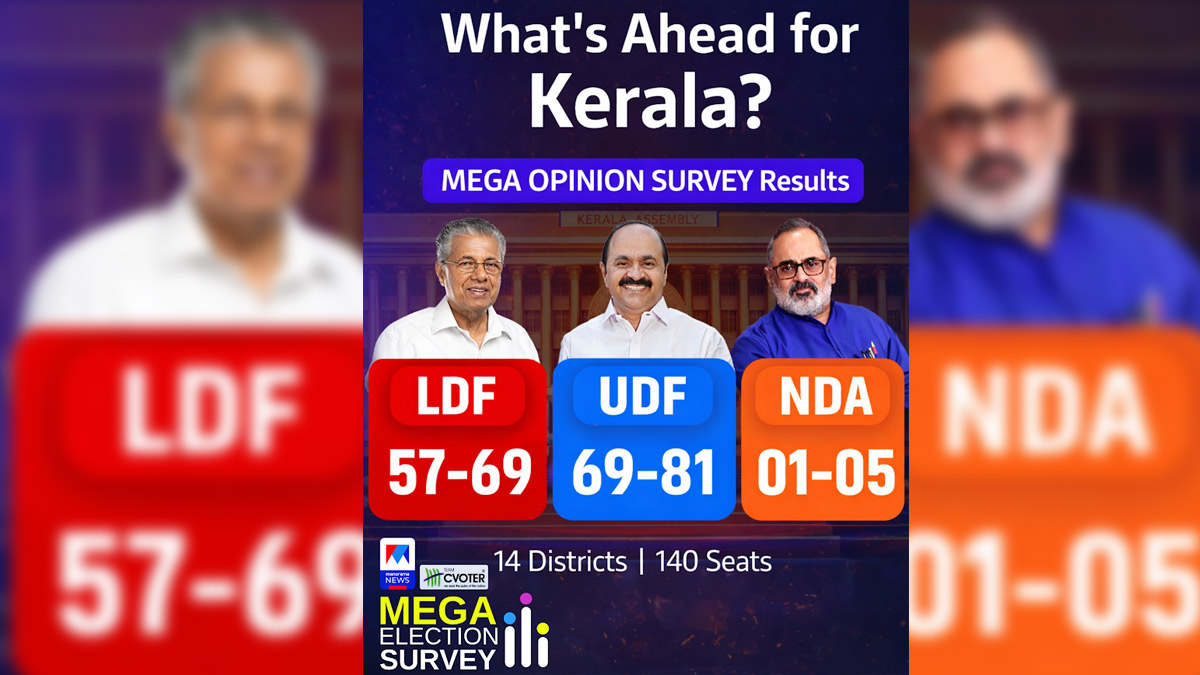
MUMBAI: The winds of change appear to be blowing through Kerala’s political landscape and this time, they seem to favour the United Democratic Front. A comprehensive mega opinion survey conducted by Manorama News in partnership with CVoter projects a potential comeback for the UDF in the upcoming Kerala Legislative Assembly Elections 2026. The survey, covering all 140 constituencies with a massive sample size of nearly 90,000 respondents, predicts the UDF could win between 69 and 81 seats.
The ruling Left Democratic Front (LDF) is expected to secure 57 to 69 seats, a significant drop from the 99 seats it won in the 2021 elections. This would mean the LDF losing 30 to 42 of its sitting seats. Meanwhile, the National Democratic Alliance (NDA), which drew a blank in 2021, is projected to open its account with 1 to 5 seats.
Region-wise, the UDF is expected to make strong gains in Malabar, winning 25 to 34 out of 48 seats, and in Central Kerala, where it could bag 29 to 33 out of 53 seats. In South Kerala, the LDF is likely to retain an edge with 21 to 25 seats, while the UDF may improve to 12 to 16 seats. The NDA could pick up 1 to 3 seats in the southern region.
The survey was conducted between 14 and 26 March 2026, with additional tracker and snap polls carried out from December 2025 to March 2026. A total of 89,693 respondents participated, ensuring representation across all demographics and social segments.
Manorama News has a strong track record of accuracy, with its previous projections closely matching the actual results of the 2019 and 2024 Lok Sabha elections as well as the 2021 Kerala Assembly polls.
In Kerala’s famously fierce political battles, this survey suggests the pendulum may be swinging back. Whether the final verdict matches these numbers or throws up another surprise, one thing is clear, the 2026 Assembly elections are shaping up to be one of the most keenly watched contests in the state’s history.






