Hollywood
Roger Deakins to shoot sequel of 1982 sci-fi film ‘Blade Runner’

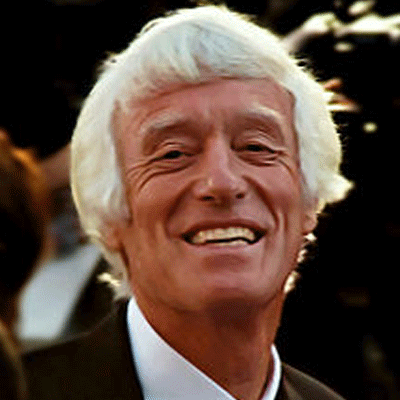
MUMBAI: Twelve-time Academy Award-nominated cinematographer Roger Deakins will join director Denis Villeneuve on Alcon Entertainment’s shoot the sequel to Ridley Scott’s 1982 sci-fi film Blade Runner.
Deakins, who was presented with the Pierre Angenieux Excellens in Cinematography Award at the Cannes Film Festival, reteams with Villeneuve on what will be their third feature collaboration, having previously worked together on Alcon’s Prisoners, starring Hugh Jackman and Jake Gyllenhaal as well as Villeneuve’s upcoming film Sicario, a drug-trafficking drama starring Emily Blunt, Josh Brolin and Benicio Del Toro from Black Label Media.
Deakins received his latest Academy Award nomination this year for his work on Angelina Jolie’s Unbroken. He was previously nominated for Joel and Ethan Coen’s Fargo, The Man Who Wasn’t There, O Brother, Where Art Thou?, No Country for Old Men and True Grit; Frank Darabont’s The Shawshank Redemption; Martin Scorsese’s Kundun; Andrew Dominik’s The Assassination of Jesse James by the Coward Robert Ford; Stephen Daldry’s The Reader, which he shared with Chris Menges; and, more recently, Prisoners and Sam Mendes’ Skyfall.
Blade Runner is scheduled to start principal photography in summer of 2016. Hampton Fancher (co-writer of the original) and Michael Green have written the original screenplay based on an idea by Fancher and Ridley Scott. The story takes place several decades after the conclusion of the 1982 original. Harrison Ford will reprise his role as Rick Deckard.
Alcon co-founders and co-CEOs Andrew Kosove and Broderick Johnson said, “Roger is an extraordinary talent and we are very excited that Denis and Roger have chosen to continue their collaboration in bringing the sequel to Blade Runner to the big screen.”
Alcon Entertainment acquired the film, television and ancillary franchise rights to Blade Runner in 2011 from producer Bud Yorkin to produce prequels and sequels to the iconic science-fiction thriller. Yorkin will serve as a producer on the sequel along with Kosove and Johnson. Cynthia Sikes Yorkin will also produce.
Thunderbird Films CEOs Frank Giustra and Tim Gamble will serve as executive producers. Ridley Scott will also executive produce.
Among its many distinctions, Blade Runner has been singled out as one of the greatest movies of all time by innumerable polls and media outlets, and overwhelmingly as the greatest science-fiction film of all time by a majority of genre publications.
Released by Warner Bros., Blade Runner was adapted by Hampton Fancher and David Peoples from Philip K. Dick’s novel Do Androids Dream of Electric Sheep? and was directed by Ridley Scott following his landmark Alien. The film was nominated for two Academy Awards.