News Broadcasting
Republic Media Network emerges in pole position in BARC news ratings


Republic Media Network claims to establish complete and ultimate news dominance across the English, Hindi and Bangla news genres.
According to the latest BARC data provided by Republic Media Network, the channel claims to record a smashing performance across India, and across time bands.
Across Republic TV, Republic Bharat and Republic Bangla, Republic Media Network has witnessed increased viewership. Republic TV is 200 percent greater than the Number 2 channel TIMES NOW.

Republic TV’s continued dominance in super primetime was once again established by the whopping 44 per cent viewership share it recorded in the time band. Across India, Republic TV’s viewership was 270 per cent greater than India Today, and 330 per cent greater than CNN News18.

Source – BARC India | Target Group:-NCCS 15+ | Period:- WK.10’22 | Market:- India | Days:- All Days

Source – BARC India | Target Group:-NCCS M 22+ | Period:- WK.10’22 | Market:- West Bengal | Days:- Weekdays | Time:- 1700-2000

Source- BARC India | Target Group:-NCCS AB 22+ | Period:- WK.10’22 | Market:- HSM | Days:- Weekdays | Time:- 1900-2000
This all-round performance that has towered over the competition single-handedly shatters the entire conspiracy and propaganda campaigns against Republic TV.
Republic Bharat has continued to dominate the Hindi news genre with a splendid and record-breaking performance that has unseated AajTak in primetime. Republic Bharat’s primetime show Poochta Hai Bharat is in pole position as India’s most-watched news show in its slot. As India’s most loved Hindi news channel which has dominated on its coverage of the Ukraine-Russia War and the recently concluded elections, the record viewership ratings released today have once again toppled the legacy Hindi news player.
With the scorching and historic entry of Republic Bangla into the Bengal news genre, a new order in Bengali news has been undisputedly established.
Republic Media Network’s Editor-in-Chief, Arnab Goswami, said, “The viewership across the Network is historical. These numbers are the ultimate answer to the conspirators who laboriously spent months hatching conspiracy after conspiracy against us. The truth and the viewership are both with the Republic because we have the faith of the people of India, and no one can change that.”
Specifically commenting on the wide gap between Republic and the competition, Goswami said, “We are 200 per cent bigger than any other channel in the English News Genre. That is unmatched dominance. In Hindi, with Republic Bharat we have become the leading channel much ahead of AajTak in the most critical slots. In Bangla, we have created history by a thundering entry. We have become Number 1, beating ABP Ananda in primetime which was the leading channel there. Today, with pride I can say that Republic is the largest News Network in India. These phenomenal results are a slap in the face of channels who conspired against us.”
On the overwhelming reaction from the people of India, Goswami said, “We are flooded with calls from Advertisers, Supporters and Viewers who are calling the channel to congratulate us. We are so grateful for their support.”
“There is a phenomenal spirit and energy in all our newsrooms—Mumbai, Noida and Kolkata. I am so proud of my team who has let their journalism do the talking. I will say though that even though this is a big vindication Brand Republic, the game has just begun,” he added.






News Broadcasting
News18 India launches Command Centre war explainer with Arya
New show shifts from debates to decoding global conflicts and impacts
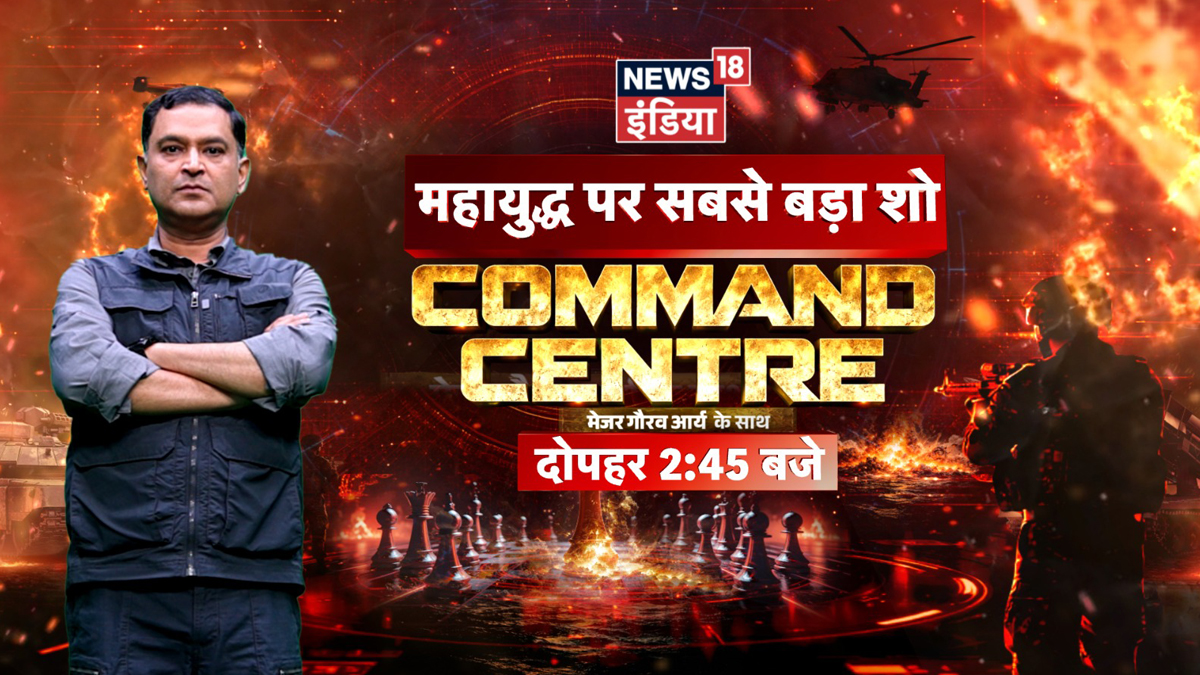
MUMBAI: News18 India has rolled out a new war-focused programme, Command Centre, featuring Gaurav Arya, as it looks to offer viewers a sharper, more grounded take on global conflicts amid rising tensions in West Asia.
Positioned as an “insider war room”, the show moves away from conventional panel debates and instead focuses on explaining military developments, decoding strategy and connecting global events to their everyday impact, from fuel prices to economic shifts.
The format leans heavily on visuals and data. The studio has been designed like a command hub, complete with large LED war maps, real-time graphics and an alert system to track developments as they unfold.
At the centre of it all is Arya, who brings his military background to simplify complex war strategies for viewers. His signature line, “Seedhi baat samjhiye”, anchors the show’s promise of clarity over noise.
News18 India managing editor Jyoti Kamal said, “Command Centre, featuring Major Gaurav Arya is designed to deliver accurate insights and a clear perspective on how evolving conflicts impact everyday life, from household budgets to national security. With expert voices analysing every development in real time, the show goes beyond headlines to decode what’s happening now, what it means, and what could come next.”
Echoing the intent, Gaurav Arya added, “In times of war, confusion is the biggest threat. With News18 India’s Command Centre, we are bringing viewers inside the war room, decoding strategies, tracking every escalation, and explaining, in the simplest terms, what it means for India and for every household. Seedhi baat samjhiye, this is where you understand not just what is happening, but what happens next.”
The weekday show will air in the afternoon slot and will also feature Gaurav Shukla, adding to its editorial depth.
With its mix of analysis, visuals and a clear focus on impact, the show reflects a broader shift in news consumption. Viewers are no longer just watching events unfold, they are looking to understand what those events mean for them.







