News Headline
Regulation as opposed to the market dictating distribution trends

Regulation, as opposed to the market, largely determined trends in India’s cable and satellite distribution business over the past 12 months. The Telecom Regulatory Authority of India (Trai) ushered in 2004 with a rate freeze, closed the year by stipulating a seven per cent increase for 2005 and then brought in the New Year by stating that the must provide clause for non-discriminatory program provision would be enforced only when there were two pay TV DTH platforms in operation. Trai has also indicated that once competition to cable assumes significance (i.e. DTH and potentially broadband TV acquire a critical mass of subscribers), cable TV rates will be deregulated entirely.
In 2004, volume growth partially offset some of the effects of the rate freeze with leading broadcasters extracting higher declarations in 2004 through aggressive minimum subscriber guarantee (MSG) agreements. In a major regional research report due to be officially released next week, Media Partners Asia (MPA) estimates show that domestic cable TV industry distribution revenues reached more than Rs 90 billion ($2 billion) as of year end 2004, 10 per cent year-on-year growth versus 25 per cent in 2003.
Broadcasters extracted a 13 per cent share of the pie, implying just over Rs 12 billion in subscription revenues, 20 per cent year-on-year growth versus almost 60 per cent in 2003. Competition for space on the cable dial was even more intense in 2004 amid a rate freeze and the launch of several new pay and FTA channels. A seven per cent rate increase, in line with nominal inflation, will be some compensation to leading bouquets as competition is set to further intensify while economics become even more challenging.

According to MPA estimates, cable MSOs had only a six per cent share (Rs 5.5 billion) of the subscription pie in 2004. The rate freeze partially offset escalating program costs for some leading MSOs but nonetheless impacted revenue generation and collection from LCOs, who were also squeezed. Both Siticable and Hathway saw flat revenue growth in 2004 along with continued cash flow losses while other MSOs have been wilting under the pressure of aggressive MSG agreements with broadcasters. Moreover, market demand remains soft for digital cable services.
Competition to cable monopolies remains limited. Dish TV, the DTH platform 20 per cent directly owned by Zee, had about 190,000 subs as of year end 2004 with growth largely impacted by the refusal of leading broadcasters Star and Sony to supply channels to the platform. The platform aims to achieve breakeven with Dish at 1 million subs though targets have scaled down from 1 million at March 2005 to between 400,000 – 500,000.
The participation of well-funded majors such as Reliance, Tata and News Corp. in addressable pay TV distribution remains minimal due to operational and regulatory issues. The government has yet to award a license to Space TV, the Rs 16 billion DTH pay TV joint venture between the Tata Group (80 per cent) and News Corp.’s Star Group (20 per cent), which had hoped to launch services by January 2005.
In October 2004, Trai made it mandatory for all broadcasters to make available all channels on a nondiscriminatory basis to all major platforms. The regulation was intended to promote competition in the market with Zee’s Dish TV potentially benefiting as Star and Sony would be forced to provide its channels to the Dish platform. However, in January 2005, Trai stated that such regulation would only come into place when there are two DTH pay TV platforms in operation. This clearly provides some measure of protection to Star Group, and encourages the Ministry of Information and Broadcasting (I&B) to award Space TV a license and finally settle the problem of program exclusivity.
In the long term, the must provide law may also accelerate the commoditisation of C&S TV as the lines of battle between cable and DTH may, in the future, be based on price, customer service and marketing as opposed to program exclusivity and differentiation. The latter has typically driven DTH penetration in markets such as the US and UK. This may impact the economics of pay and premium channel suppliers and will almost certainly impact the strategies of cable and satellite distributors.
Meanwhile, the Reliance Group, India’s largest corporate, is still targeting the expansion of broadband services via subsidiary Reliance Infocomm (RI). RI is focused on launching integrated broadband services in 2005, having built a 65,000 km fiber optic cable network across the country, passing through most major metros. In 2004, the company was working on its last-mile strategy.
The end-game is to offer consumers a triple play of telephony, broadband Internet and digital video for an all inclusive price of about Rs 700 per month with STBs subsidised. A commercial launch of consumer broadband is expected in mid-2005 along with the introduction of IPTV services. However, RI will have to overcome sizable obstacles to achieve full-implementation of its IPTV project, including last-mile access, program acquisition, STB technology and ownership issues.
Numerous other telecom-based providers are also targeting the broadband and broadcasting business, including Bharat Sanchar Nigam Ltd (BSNL), Atlas and MTNL. Telecom giant BSNL is targeting 5 million – 6 million DSL lines over the next two years to promote triple play services including digital video and on-demand TV. Atlas Interactive, a subsidiary of the Atlas Group has entered into an agreement with BSNL to provide a range of entertainment and media related services through broadband.
In 2004, Atlas Group chairman Philippe Bednarek was quoted as saying, “our aim is to converge telephony with Internet and television content in India, where the potential for growth is mind boggling. Once the subscriber gets used to watching TV and video / movies on demand on this service, they will forget about the unreliable services from the local colony “cable-walah.”
Bednarek’s pronouncements are hopeful, at best, in the near term, especially as we think that the Indian market is about two-three years away from true competition in both broadcasting and broadband. Broadband penetration remains low (about 200,000 subs) as the delivery of high quality Internet access at low consumer prices is a tough proposition. There is significant pressure on the government to un-bundle the local loop, which will enable broadband to be provided by private players at cheap prices.
Regulatory clarity would also help. In January 2004, the government authorised Trai with regulatory responsibility for the broadcasting and cable TV sector, which was previously under the supervision of the I&B. Despite a change of government in April 2004, Trai is still responsible for certain functions. However, the I&B is intent on winning back entire responsibility for the broadcasting sector though TRAI wants to maintain and perhaps even increase its powers as the convergence between broadcasting and telecommunications begins to grow in India.
 Vivek Couto is an Executive Director of Media Partners Asia Ltd (MPA), a leading publishing, research and consulting firm in Asia. Couto heads up the content and research division at the firm. MPA will release its new expanded and updated research report on broadband and pay TV distribution in Asia (including India) next week. Indian Television Com will have exclusive coverage of the key findings.
(The views expressed here are those of the author. www.indiantelevision.com need not necessarily subscribe to them.)






NEW DELHI: Hamdard Laboratories gathered a cross-section of India’s achievers in New Delhi on Friday, handing out the Hakeem Abdul Hameed Excellence Awards to figures who have left their mark across healthcare, education, sport, public service and the arts.
The ceremony, attended by minister of state for defence Sanjay Seth and senior officials from the ministry of Ayush, celebrated individuals whose work blends professional success with a sense of public purpose. It was as much a roll call of achievement as it was a reminder that influence is not measured only in profits or podiums, but in people reached and lives improved.
Among the headline awardees was Alakh Pandey, founder and chief executive of PhysicsWallah, recognised for turning affordable digital learning into a mass movement. On the sporting front, Arjuna Awardee and kabaddi player Sakshi Puniya was honoured for her contribution to the game and for pushing women’s participation onto bigger stages.
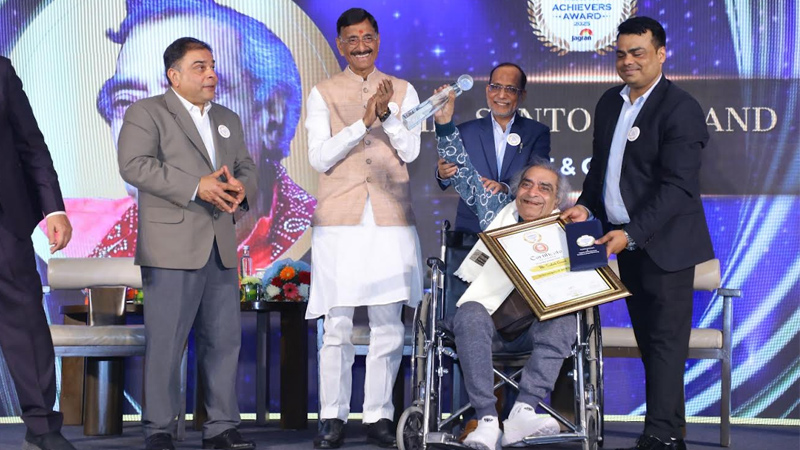
The cultural spotlight fell on veteran lyricist and poet Santosh Anand, whose songs have echoed across generations of Hindi cinema. At 97, Anand accepted the honour with characteristic humility, reflecting on a life shaped by perseverance and hope.
Healthcare honours spanned both modern and traditional systems. Manoj N. Nesari was recognised for strengthening Ayurveda’s place in national and global health frameworks. Padma shri Mohammed Abdul Waheed was honoured for his research-backed work in Unani medicine, while padma shri Mohsin Wali received recognition for his long-standing contribution to patient-centred care.
Education and social development also featured prominently. Padma shri Zahir Ishaq Kazi was honoured for decades of work in education, while former Meghalaya superintendent of Police T. C. Chacko was recognised for public service. Goonj founder Anshu Gupta received an award for his dignity-centred rural development initiatives, and the Hunar Shakti Foundation was honoured for empowering women and young girls through skill development.
The Lifetime Achievement Award went to former IAS officer Shailaja Chandra for her long career in public healthcare and governance, particularly in the traditional systems under Ayush.
Speaking at the event, Hamdard chairman Abdul Majeed said the awards were a tribute to those who combine excellence with empathy. “These awardees reflect Hakeem Sahib’s belief that healthcare, education and public service must ultimately serve humanity,” he said.
Minister Seth struck a forward-looking note, saying India’s young population gives the country a unique opportunity to become a global destination for learning, health and wellness by 2047.
The ceremony also featured the trailer launch of Unani Ki Kahaani, an upcoming documentary starring actor Jim Sarbh, set to premiere on Discovery on 11 February.
Instituted in memory of Unani scholar and educationist Hakeem Abdul Hameed, the awards have grown into a national platform that celebrates those building a more inclusive and resilient India. For one evening at least, the spotlight was not just on success, but on service with substance.






