Hindi
Reel women power as IFFI panel flips the script on cinema’s old narratives

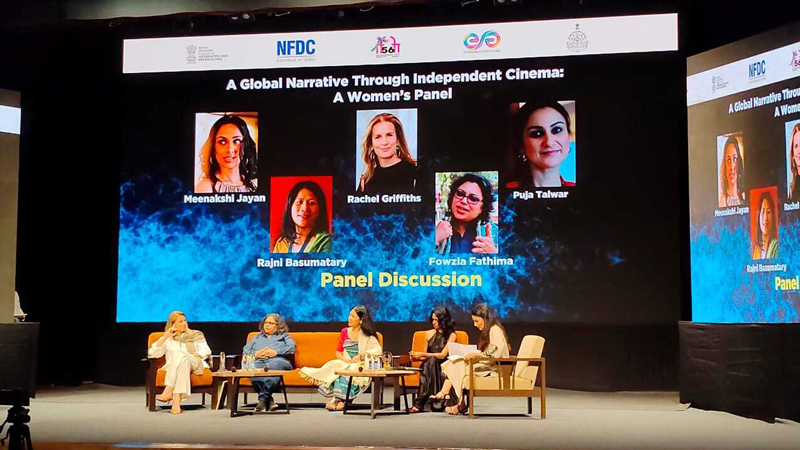
MUMBAI: Cinema may run on lights, camera and action but at IFFI 2025, it was honesty, humour and hard-earned wisdom that took centre stage. In a masterclass that played out like a director’s commentary on gender, power and perspective, four women from across continents unpacked how female creators are reshaping storytelling from the inside out.
Moderated by journalist Puja Talwar, the panel brought together Australian actor Rachel Griffiths, Malayalam actor Meenakshi Jayan, cinematographer Fowzia Fathima, and Assamese actor-filmmaker Rajni Basumatary each speaking with a mix of candour, frustration, wit and fierce optimism.
And the big question that set the mood? Where does cinema begin to bridge the intimate and the universal?
Griffiths wasted no time diving in. She argued that women instinctively understand one another across languages, borders and cultures. “I could watch a woman’s story in any language and never feel othered,” she said, describing the “molecular connection” that binds women’s experiences as daughters, mothers and creators. Her point landed with a laugh and a punch: “Women are actually the answer.”
Meenakshi Jayan agreed, adding that women’s films often begin from a deeply personal place and that intimacy, when handled with honesty, almost always translates into something universal.
Cinematographer Fowzia Fathima expanded the idea further, calling empathy the quiet force that shapes not only stories but the filmmaking process itself. “When empathy informs the work, the local becomes global,” she said, a simple statement that neatly captured why nuanced, smaller stories often resonate far beyond their origin.
Assamese actor Rajni Basumatary observed that women are naturally attuned to the “smallest of things”, which is why their films often hold exceptional nuance making the seemingly small feel monumental to the communities represented.
She also reminded the audience that women have long been underrepresented, and their increased visibility today is essential in completing the circle of on-screen and off-screen representation.
Rachel Griffiths brought the conversation back to the numbers, the kind that often contradict the rosy perceptions built on a few high-profile success stories.
From her work on Australia’s Gender Matters Committee, Griffiths explained how decades of celebrated female directors and cinematographers created a false image of parity, even as the data revealed how few women actually directed television episodes or feature films.
“It’s so easy to look at a couple of successful people and think, ‘Oh, it’s solved.’ Until you look at the numbers. And anyone who doesn’t want to show the data is hiding a shame,” she said.
Offering a homegrown counterpoint, Fowzia traced the evolution of the Indian Women Cinematographers Collective (IWCC). A network she once thought had “eight people” now numbers 200, spanning juniors to seniors, united in craft and camaraderie.
Their website highlights each cinematographer’s work equally “because unless people see how many of us there are, they will keep calling one of us ‘the only woman’.”
She also walked the audience through Kerala’s groundbreaking Women Cinema Project, which annually funds a woman director with a grant of Rs 1.45 crore, pushing both representation and skill-building.
Rajni added a heartwarming anecdote: when she approached one cinematographer from the collective, date clashes led to a chain of referrals, each woman recommending another.
“That sorority, that sisterhood, I was very touched,” she said.
Rachel Griffiths highlighted an oft-ignored truth: the film industry’s brutal 16–17-hour days force many women to step back during motherhood, a stage where careers and caregiving clash most violently.
Her solution?
Job-sharing for crew roles such as continuity and direction, allowing women to stay in the industry instead of disappearing for a decade and attempting an impossible comeback.
“It’s not a lack of talent. It’s a lack of support,” she said plainly.
The panel didn’t shy away from the stubborn double standards that still plague the industry.
A “superstar” who requested an eight-hour shift after childbirth became a national debate while male stars routinely avoid weekends without headlines. Women taking hiatuses for family obligations often return to find their relevance questioned.
As Rajni pointed out, “If a woman comes back, suddenly everyone wants to know why she disappeared in the first place.”
Fowzia shared her own journey balancing academia, parenting and filmmaking before stepping back into the industry with a major Tamil feature film, Train, starring Vijay Sethupathi.
“It took time, but I’m on track again,” she said with a relieved smile, prompting applause.
From American television’s powerful women-led writers’ rooms to British cinema’s habit of scripting women as “forever disappointed”, Griffiths argued that representation in writers’ rooms is the true game-changer.
“Once the right people sit in the room where stories begin, everything changes,” she said.
The panel closed with a big question, How can actors influence change beyond the screen?
Choosing scripts more deliberately. Asking for inclusive crews. Insisting on representation not just in front of the camera, but behind it. The consensus was unanimous, actors today hold more power than ever and wielding it thoughtfully can transform the ecosystem.
What began as a discussion on intimacy and universality grew into a sweeping conversation on data, empathy, sisterhood, structural barriers, and the future of global cinema.
If one theme defined the afternoon, it was this, Women aren’t just telling stories, they are reclaiming the system that shapes them.
And judging by the energy in that IFFI hall, the next chapter of global cinema is not just going to be female. It’s going to be fearless.