Animation
Prime Focus turns around


BENGALURU: Prime Focus Limited (PFL) has reported robust financial performance, including consolidated profit after tax (PAT) for the period ended 31 March 2017 (quarter – Q4-17 and current quarter, current fiscal; year FY-17 and current year) as compared to the corresponding year ago periods – Q4-16 and FY-16 respectively. PFL reported consolidated PAT for FY-17 at Rs 1,397.39 million as compared to a consolidated loss of Rs 3,168.29 million in fiscal 2016. For the current quarter, PFL reported consolidated PAT of Rs 457.66 million as compared to a consolidated loss of Rs 2,648,86 million in FY-16.
The company’s consolidated total revenue from operations (TR) in FY-17 increased 55.7 percent to Rs 21,536.25 million from Rs 13,828.15 million in the previous year. Consolidated total Income in the current year increased 52.5 percent to Rs 21,780.76 million from Rs 14,283.57 million in the previous year.
In its investor presentation, PFL says that strong growth across businesses drove consolidated income growth of 14 percent primarily led by encouraging growth in Creative Services driven by additional capacity and deliveries from India. Creative and Tech/Tech Enabled services contributed 78 percent and 16 percent, respectively. The company’s three main businesses are Creative Services – it works on Hollywood Blockbusters; Technology Services; and Films and Media Services (FMS) where it works mainly with Indian films.

PFL’s adjusted EBIDTA for FY-17 increased 50 percent to Rs 5,014 million from Rs 3,348 million in FY-16.
Total Expenditure in FY-17 increased 29.2 percent to Rs 21,261.99 million from Rs 1,6454,04 million in FY-16. Employee benefits expense in FY-17 increased 41.5 percent to Rs 12,163.23 million from Rs 8,596.69 million in the previous year. Technicians fees in FY-17 increased 49.4 percent to Rs 368.92 million from Rs 246.95 million in FY-16. Technical Services cost in the current year increased by 28.5 percent to Rs 591.61 million from Rs 460.37 million in FY-16. Employee Stock Options or ESOP costs in fiscal 2017 increased by almost six-fold in FY-17 to Rs 256.69 million as compared to Rs 42.83 million in the previous year.
Finance cost in FY-17 reduced 51.2 percent to Rs 1,278.73 million from Rs 2,620.21 million in FY-16.
Other Expenditure in the current year increased 54.1 percent to Rs 3,841.70 million as compared to Rs 2,492.55 million in fiscal 2016.






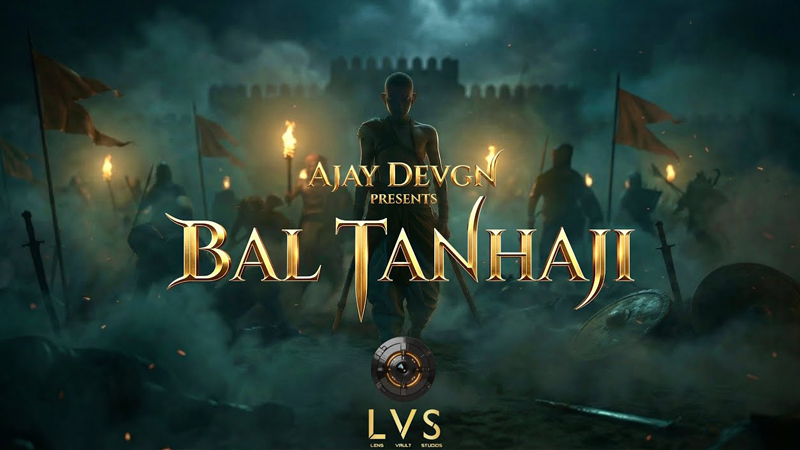
MUMBAI: History is getting a fresh rewrite this time with code, creativity and a longer arc in mind. Lens Vault Studios has announced its first original production, Bal Tanhaji, marking the official entry of the newly launched, tech-driven studio into India’s evolving entertainment landscape.
Arriving six years after the box-office success of Tanhaji: The Unsung Warrior, the new project expands the universe rather than revisiting familiar ground. Bal Tanhaji explores uncharted narrative territory, signalling a clear shift from one-off cinematic spectacles to long-format, world-building storytelling designed for digital-first audiences.
At the heart of this ambition is Prismix Studios, the in-house generative AI and technology arm powering the creative engine behind the show. The studio’s approach blends storytelling with next-generation tools, aiming to reimagine how Indian IPs are created, scaled and sustained beyond theatrical releases.
For Lens Vault Studios chairman Ajay Devgn the new venture represents a deliberate step beyond traditional cinema. The focus is firmly on building long-form intellectual properties across fiction and non-fiction, tailored to changing viewing habits and platform-led consumption. He said the studio intends to explore formats that remain largely untapped, while drawing on the team’s experience with large-scale cinematic storytelling.
Lens Vault Studios founder and CEO Danish Devgn echoed that sentiment, describing Bal Tanhaji as the studio’s first generative-AI-led IP and the starting point of a broader vision. The aim, he noted, is to carry forward the legacy of the Tanhaji universe while connecting with younger audiences through a blend of powerful narratives and emerging technologies.
With Bal Tanhaji, Lens Vault Studios is planting its flag early not just launching a show, but signalling a larger play for cinematic universes that live, grow and evolve across platforms. If this debut is any indication, the future of Indian storytelling may be as much about imagination as it is about innovation.






