I&B Ministry
Prasar Bharati exempt from service tax

In what should come as a relief to pubcaster Prasar Bharati, the Solicitor General of India has clarified that Prasar Bharati need not pay service tax.
It may be recalled that when finance minister Yashwant Sinha presented his budget he had proposed that the pubcaster should be made to pay “since it is a commercial organisation, Prasar Bharati does not need the exemption from the five per cent service tax.”

Following this, Prasar Bharati referred the matter to the information & broadcasting ministry, which in turn sought the solicitor general’s directive on the matter through the law ministry.
Meanwhile, in an unrelated development, the Standing Committee on Information Technology has reportedly criticised the I&B Ministry over its slow completion of projects. The committee slammed the ministry’s tendency to “wake up” to the need to use budgetary allocations towards the end of the financial year. Timely completion of projects will ensure that the public derives the full benefits of broadcasting/telecasting services, the committee said.
The committee noted that out of an outlay of Rs 3,250 million (revised to Rs 2,900 million) provided to the ministry for schemes pertaining to national broadcaster Doordarshan, the ministry utilised only Rs 1,578.6 million till February 2002.





I&B Ministry
India tightens anti-piracy law, blocks sites and Telegram channels
New rules bring jail terms, fines and faster takedowns of illegal content
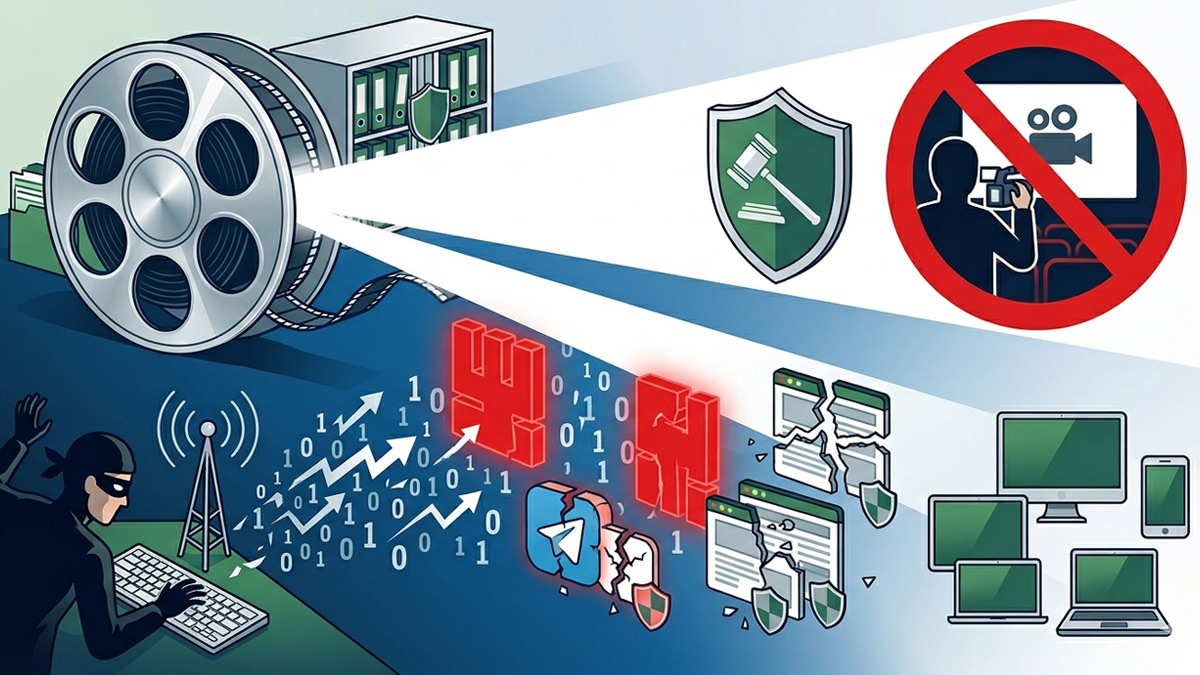
NEW DELHI: The Government of India has stepped up its fight against film piracy, invoking stricter provisions under the Cinematograph Amendment Act 2023 to crack down on unauthorised recording and distribution.
The law now imposes tougher penalties, including jail terms ranging from three months to three years and fines starting at Rs. 3 lakh, which can go up to 5 per cent of a film’s production cost. The provisions target both illegal recording in cinemas and unauthorised online transmission.
In a fresh enforcement push, authorities have notified the Telegram platform to act against piracy, leading to the identification of 3,142 channels allegedly distributing copyrighted content without permission. In parallel, access to around 800 piracy websites has been blocked through internet service providers.
The action has been taken under the Information Technology Act 2000, which empowers the government to direct intermediaries to remove unlawful content. The framework is further reinforced by the Information Technology Rules 2021, requiring platforms to act swiftly when notified of violations.
An institutional mechanism is also in place, allowing copyright holders and authorised representatives to file complaints through designated nodal officers. Once verified, these complaints trigger takedown notices to intermediaries for disabling access to infringing content.
The update was shared in Parliament by Government of India minister of state information and broadcasting l murugan in response to a query from Parimal Nathwani.
The government’s latest move signals a sharper, more coordinated approach to tackling piracy across both physical and digital channels. For the film industry, it is a step towards protecting revenues, while for viewers, it reinforces the shift towards legitimate content consumption.








