News Headline
PKL and JioStar fete India’s kabaddi world champions

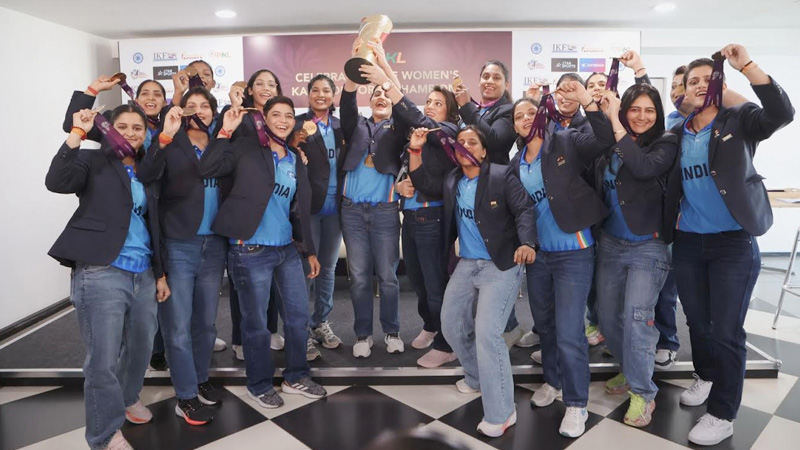
MUMBAI: Mumbai’s sporting establishment rolled out the red carpet on Friday for India’s women’s kabaddi team, fresh from demolishing Chinese Taipei 35–28 in the Women’s Kabaddi World Cup final in Dhaka on November 24. The unbeaten champions didn’t just defend their title, they announced their arrival as an unstoppable force.
The victory tour through Bangladesh was clinical. India swept their group matches before dispatching Iran 33–21 in the semi-final, setting up a showdown with Chinese Taipei, who had themselves marched through undefeated before beating hosts Bangladesh 25–18.

At the felicitation ceremony hosted by the Pro Kabaddi League and JioStar, Ishan Chatterjee, chief executive officer of sports at JioStar, framed the triumph within India’s breakthrough year for women’s sport. “Their success isn’t just about winning a trophy; it builds a talent pipeline for young girls across the country who now look at this team and say, ‘If they can do it, I can do it too,’” he said.

Anupam Goswami, PKL league chairman and business head of Mashal Sports, laid out the long game. “The federation’s commitment—especially in bringing back the Women’s World Cup after 12 years—shows that the sport is moving firmly in the right direction,” he noted, whilst tempering expectations around a standalone women’s league. “When we think about a Women’s Kabaddi League, rushing it isn’t the answer. We need to build it the right way—with players who truly want to be part of it, with a model that makes commercial sense, and with a structure that can support women’s kabaddi for the long run.”

Head coach V Tejeswini Bai, savouring her third medal as part of a coaching setup, emphasised the months of disciplined preparation behind the glory. Skipper Ritu Negi, sidelined by injury during the final, spoke of the team’s collective strength: “Our team is bigger than any one player. What matters is that our players stepped up and executed exactly what was needed.”
Vibhor Vineet Jain, president of the Amateur Kabaddi Federation of India, pointed to kabaddi’s expanding global footprint. “Kabaddi is no longer limited to the subcontinent. Nations like Chinese Taipei and Iran have transformed the competitive landscape,” he observed.

With institutional backing strengthening and a second World Cup trophy gleaming, India’s women have done more than win—they’ve issued a challenge to the world, and an invitation to the next generation. The game is changing. And they’re leading the charge.








NEW DELHI: Hamdard Laboratories gathered a cross-section of India’s achievers in New Delhi on Friday, handing out the Hakeem Abdul Hameed Excellence Awards to figures who have left their mark across healthcare, education, sport, public service and the arts.
The ceremony, attended by minister of state for defence Sanjay Seth and senior officials from the ministry of Ayush, celebrated individuals whose work blends professional success with a sense of public purpose. It was as much a roll call of achievement as it was a reminder that influence is not measured only in profits or podiums, but in people reached and lives improved.
Among the headline awardees was Alakh Pandey, founder and chief executive of PhysicsWallah, recognised for turning affordable digital learning into a mass movement. On the sporting front, Arjuna Awardee and kabaddi player Sakshi Puniya was honoured for her contribution to the game and for pushing women’s participation onto bigger stages.
The cultural spotlight fell on veteran lyricist and poet Santosh Anand, whose songs have echoed across generations of Hindi cinema. At 97, Anand accepted the honour with characteristic humility, reflecting on a life shaped by perseverance and hope.
Healthcare honours spanned both modern and traditional systems. Manoj N. Nesari was recognised for strengthening Ayurveda’s place in national and global health frameworks. Padma shri Mohammed Abdul Waheed was honoured for his research-backed work in Unani medicine, while padma shri Mohsin Wali received recognition for his long-standing contribution to patient-centred care.
Education and social development also featured prominently. Padma shri Zahir Ishaq Kazi was honoured for decades of work in education, while former Meghalaya superintendent of Police T. C. Chacko was recognised for public service. Goonj founder Anshu Gupta received an award for his dignity-centred rural development initiatives, and the Hunar Shakti Foundation was honoured for empowering women and young girls through skill development.
The Lifetime Achievement Award went to former IAS officer Shailaja Chandra for her long career in public healthcare and governance, particularly in the traditional systems under Ayush.
Speaking at the event, Hamdard chairman Abdul Majeed said the awards were a tribute to those who combine excellence with empathy. “These awardees reflect Hakeem Sahib’s belief that healthcare, education and public service must ultimately serve humanity,” he said.
Minister Seth struck a forward-looking note, saying India’s young population gives the country a unique opportunity to become a global destination for learning, health and wellness by 2047.
The ceremony also featured the trailer launch of Unani Ki Kahaani, an upcoming documentary starring actor Jim Sarbh, set to premiere on Discovery on 11 February.
Instituted in memory of Unani scholar and educationist Hakeem Abdul Hameed, the awards have grown into a national platform that celebrates those building a more inclusive and resilient India. For one evening at least, the spotlight was not just on success, but on service with substance.






