Hindi
OK Jaanu: …Live-in romance replayed!

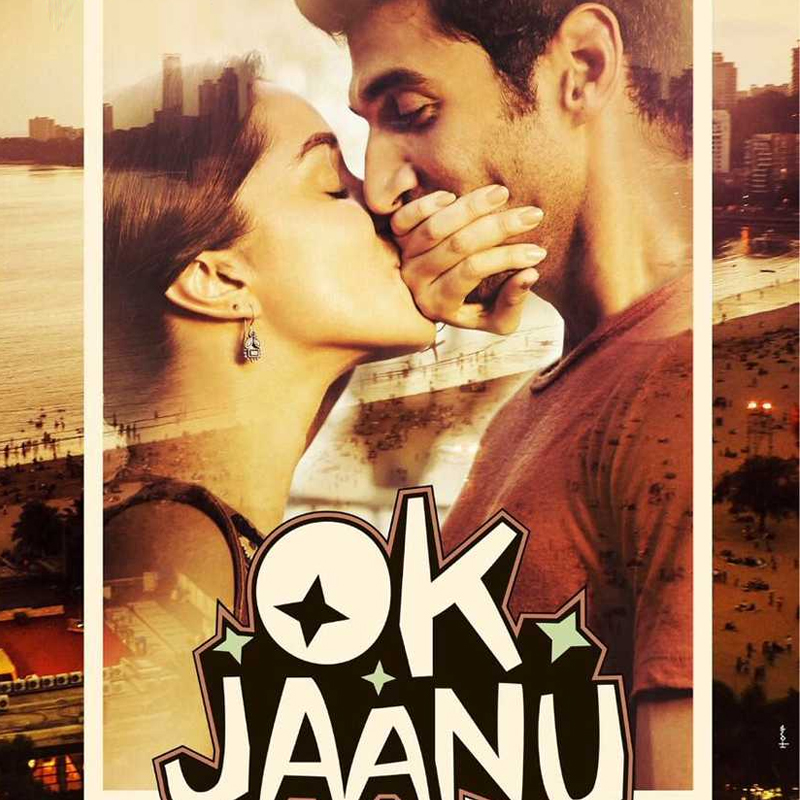
MUMBAI: OK Jaanu is a contemporary love story which eventually settles about halfway between modern-day relationships traditions while conveying the eternal belief that love always triumphs. These kinds of films are made now and again but a love story is a love story and usually has its own appeal if supported by enough emotion and music.
The film is a remake of Mani Ratnam’s Tamil film, O Kadhal Kanmani.
The characters of Aditya Roy Kapur and Shraddha Kapoor have an odd first meeting. Aditya has just alighted from a train from Kanpur and watches Shraddha on the other platform threatening her boyfriend to leave her alone else she will jump on the tracks! Aditya warns her to back off.
They become friends soon after. Both find perfect companionship in each other.
Shraddha comes from a broken home and prefers to stay in a hostel despite having a wealthy mother — the character of Kittu Gidwani. Aditya stays with the character of Naseeruddin Shah and his wife, Leela Samson, both retired judges. Leela suffers from Alzheimer’s and Naseeruddin’s affection for her is exemplary and for the young lovers to emulate.
Both have one thing in common: they don’t believe in the institution of marriage. With no commitment, the friendship flourishes as they hop restaurants, clubs and make merry. But, a relationship between a man and a woman can’t always be platonic. The inevitable happens.
After that, both decide to stay together. Aditya sort of stretches Naseeruddin’s hospitality and asks his permission to let Sharaddha in with him.
Aditya, a video game designer, who dreams of going to the US to earn millions, and Shraddha, an aspiring architect, who plans to move to Paris to study further. Finally, it is time.
Being a remake, it retains a lot of its south flavour. Where it affects the most is in the later parts of the second half when some unnecessary melodrama takes place. In the second half, the film also starts losing much of the fun of the first half and the proceedings start dragging which the director could have contained.
The music may sound alright in the film but lacks the take-home quality. With a leisurely pace of narration, the editing sags. The cinematography is good and Mumbai is well exploited.
As for performances, Naseeruddin and Leela impress. Shraddha is a natural, inhibited. Aditya is passable.
OK Jaanu is a feel-good love story but the stretched second half and limited face value takes it down to an average level. The film’s hopes lie in solo run and an open second week for relief.
Producers: Mani Ratnam, Karan Johar, Apoorva Mehta, Hiroo Yash Johar.
Direction: Shaad Ali.
Cast: Aditya Roy Kapur, Shraddha Kapoor, Leela Samson, Naseeruddin Shah, Karan Nath.
Haraamkhor…an irrelevant enterprise
There seems to be emerging a new genre of films. It can be tentatively called weird cinema.
The kind of cinema where you give up on making sense of what is happening on screen but still wonder as to who thinks up of such ideas. And why? To what purpose? And, mainly, who backs them!?
The opening titles of Haraamkhor declare the film to be based on a true story. But, the makers forget to tell the story. For, there is none.
There is a small town somewhere in the Hindi belt where the character of Nawazuddin Siddiqui is a teacher with a glad eye for just about every girl, mainly his students. In fact, he is married to one of his students, the character of Trimala Adhikari, while also eyeing one of his underage students, Shweta Tripathi.
Shweta leads a lonely life as her father, a local cop, is often out on duty while her mother has left them both while she was a child. She is also attracted to Nawazuddin. Everybody in the town, including Shweta’s father, seems to be oblivious to the duo’s romance and rendezvous.
The only ones with in inkling to what is happening seems to Trimala and two of Shweta’s classmates, the characters of Mohd Samad and Irfan Khan, one of whom is in love with Shweta while the other one helps him devise ways to impress her. The duo is always chasing Shweta.
Shweta and Nawazuddin’s exploits take her to a gynecologist where Shweta is surprised to find the nurse is her father’s girlfriend. In her, Shweta finds a guardian angel. After that, what happens is not quite fathomable and, hence, not possible to report.
Haraamkhor is described as: 1. हरामकीकमाईनेवाला; आलसी; निकम्मा; मुफ़्तख़ोर 2. नमकहराम; पापकीकमाईखानेवाला। and none of the meanings apply here. In this totally irrelevant enterprise, besides miscast Nawazuddin, one sees decent efforts by Shweta Tripathi and the two young actors.
Producers: Feroze Alameer, Anurag Kashyap, Guneet Monga, Achin Jain.
Director: Shlok Sharma.
Cast: Nawazuddin Siddiqui, Shweta Tripathi, Trimala Adhikari, Mohd Samad, Irfan Khan.