News Broadcasting
NGC commissions ‘Seconds From Disaster’ for third time

MUMBAI: Following the success of the first two series of Seconds From Disaster National Geographic Channels International (NGCI) and National Geographic Channel (NGC) have commissioned Darlow Smithson Productions (DSP) to produce a third series of the show.
Each of the 13 one hour shows have been filmed in high definition and investigates some of the world’s most infamous disasters.
The show will use CGI and dramatic reconstructions to recreate the fateful moments that led to each catastrophe. Eyewitness testimony from survivors coupled with visuals and scientific analysis heightens the emotional impact of this series, filmed in locations around Europe and the US.

The show will explore events including the sinking of the Titanic in 1912. That saw over 1500 people perish. The fateful journey of Air Florida Flight 90 crashed into the Potomac River in Washington, DC in 1982 killing 78 people. It also looks at the 1972 Olympic massacre in Munich resulting in the deaths of 11 athletes and one German police officer at the hands of international terrorists; and the devastation of the recent Asian Tsunami which claimed the lives of more than 230,000 people.
Darlow Smithson head of factual Tom Brisley says, “The first two series were highly successful for DSP, NGC and NGCI, and we are delighted that it has become such a strong returning brand. Each series has brought to life disasters with gritty realism through the use of cutting edge CGI effects and reconstructions.
“In the third series particularly, we’ve been able to secure exceptional access to survivors who have been unwilling to talk in the past. In true DSP style, we’ve approached this third series with greater ambition, covering bigger and more complex events than ever before”.
NGCI executive VP content Sydney Suissa says, “Right from its first broadcast, Seconds from Disaster established itself as one of our signature series. The production values combined with powerful storytelling and impeccable research make the series compelling week in and out. I am delighted that we can offer our viewers a third season”.
NGC US executive VP John Ford says, “Viewers have enthusiastically embraced this series because it gives them the opportunity to understand disasters from a scientific point of view, leading to new insights into how these tragic events occurred in the first place. To know exactly what happened, and to see it through the magic of CGI, is a stunning new technique.”






News Broadcasting
Network18 channels lead YouTube news viewership in March 2026
CNN-News18, News18 India and CNBC channels top categories with record views
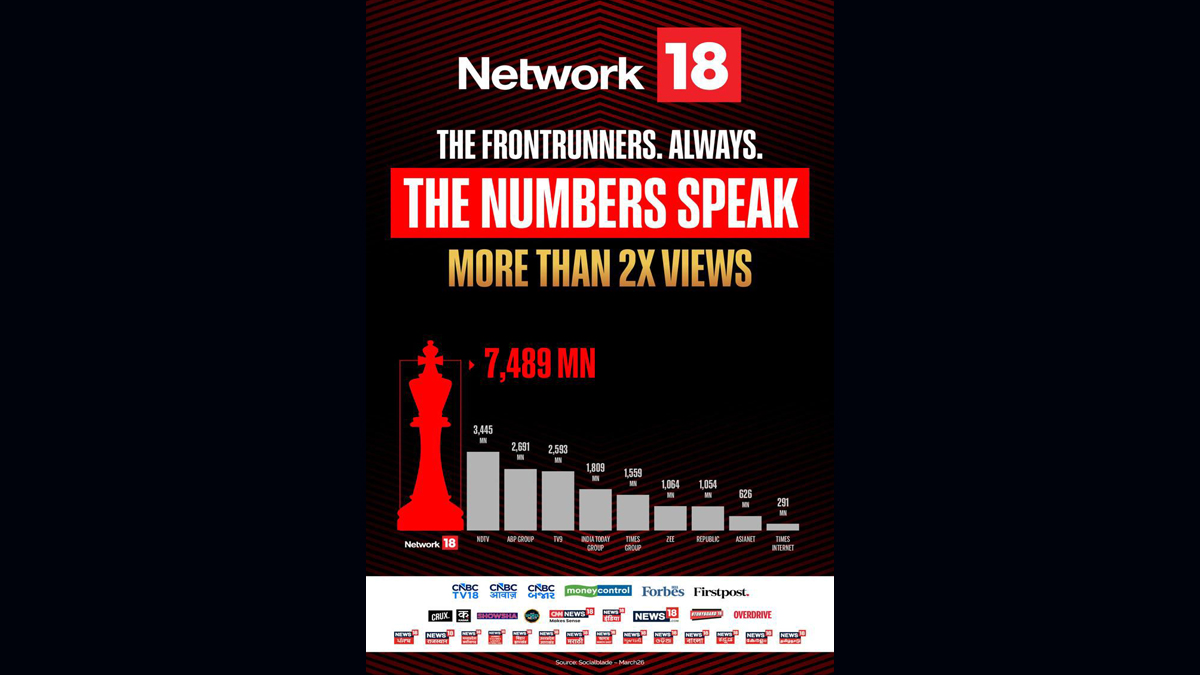
MUMBAI: When the world hit refresh on breaking news, Network18’s channels were already streaming ahead. As geopolitical tensions and war-driven headlines fuelled a surge in global news consumption, the network’s digital playbook delivered big clocking record Youtube viewership across English, Hindi and business news categories in March 2026.
At the forefront was CNN-News18, which emerged as the clear leader in the English news segment with 130 million live and video-on-demand views. The channel edged past competitors such as Times of India (126.5 million), Times Now (101.1 million), India Today (88.2 million) and NDTV (77.5 million), according to Databeings data for March.
In the Hindi news arena, News18 India delivered a commanding performance, racking up a staggering 3,297 million views on YouTube. The channel comfortably outpaced NDTV India, which recorded 3,119 million views, underlining its deep reach and consistent engagement with mass audiences, as per Playboard data.
The network’s dominance wasn’t confined to general news. In the Hindi business segment, CNBC Awaaz topped the charts with 92 million views, narrowly ahead of Zee Business (90 million) and well ahead of ET Now Swadesh (57 million). Meanwhile, its English counterpart CNBC-TV18 posted a strong 58 million views, reinforcing the network’s cross-category strength.
The spike in viewership reflects a broader shift in audience behaviour, with viewers increasingly turning to digital platforms particularly Youtube for real-time updates and in-depth coverage during high-intensity news cycles. For Network18, the numbers signal more than just scale; they underline the effectiveness of a multi-platform strategy that blends speed, credibility and continuous coverage.
In a month where the news never paused, it seems viewers chose to stay tuned where the stream never stopped.






