iWorld
Netflix’s international streaming boosts rev in Q3, op income almost doubles

BENGALURU: Global internet entertainment company Netflix, Inc., (Netflix) reported 30.3 per cent year-over-year (y-o-y) increase in consolidated operating revenues for the quarter ended 30 September 2017 (Q3-17, current quarter) as compared to the consolidated revenue for the corresponding year-ago quarter. Consolidated revenue increased y-o-y to $2,984.86 million from $2,290.19 million.
Global streaming revenue in Q3-17 increased 33.2 per cent y-o-y to $2,874.65 million from $2,351.13 million driven by a 24 per cent increase in average paid memberships and 7 per cent growth in ASP. Netflix’s international streaming revenue increased 55.5 per cent y-o-y to $1,327.44 million from $853.48 million. Domestic streaming revenue increased 18.6 per cent y-o-y to $1,547.21 million from $1,304.33 million. Domestic DVD sales and rental business (DVD business), the company’s initial business model when it started, has been declining. DVD business revenue declined 16.7 per cent y-o-y to $110.21 million from $132.28 million.
Netflix’s operating income almost doubled y-o-y in the current quarter (up 96.8 per cent) to $208.63 million from $106.04 million. Net income more than doubled (up 2.51 times) y-o-y to $129.59 million from $51.52 million. Contribution profit from total streaming increased 51.6 per cent y-o-y to $616.26 million from $406.60 million. Domestic streaming contribution profit increased 16.6 per cent y-o-y to $553.91 million from $475.18 million. International streaming contribution profit was a positive $91.91 million as compared to a loss of $68.58 million in the corresponding year-ago quarter. DVD Business contribution profit declined 8.1 per cent y-o-y to $63.13 million from $68.70 million.

Netflix says that it added a Q3-record 5.3 million memberships globally (up 49 per cent year-over-year) as it continued to benefit from strong appetite for its original series and films, as well as the adoption of internet entertainment across the world.
The company says that it has been focused on growing global operating margin as a primary profitability metric since hitting its 2020 US contribution margin goal of 40 per cent this past Q1. This allows it to avoid near term optimization for specific domestic or international contribution margin targets which could impede its long term growth. For instance, Netflix anticipates its Q4-17 US contribution margin will be 34.4 per cent (a decline both year-on-year and sequentially) as it boosts its marketing investment against a growing content slate. It says it spends disproportionately in the US to generate media and influencer awareness for its programming which it believes, in turn, is an effective way to facilitate word of mouth globally. In its international segment, Netflix says that it is on track to generate positive contribution profit for the full year. As it moves into 2018, the company aims to achieve steady improvement in international profitability and a growing operating margin as its success in many large markets help fund investments throughout Asia and the rest of the world.
This quarter, Netflix says it has launched several new series such as the gritty drama Ozark and comedy Friends from College by Nick Stoller as well as Marvel’s The Defenders and returning seasons of fan favorites like Narcos and Fuller House. The company says that it is also making good strides on original films (as measured by member viewing relative to our investment) with the debut of Death Note (based on the popular Japanese IP), Naked (a romantic comedy featuring Marlon Wayans) and To the Bone (an intense drama starring Lily Collins).
Among other new offerings, Netflix says that it is releasing the second Netflix original series from David Fincher (Mindhunter), new seasons of its globally acclaimed franchises Stranger Things and The Crown, its first Italian and German original shows ( Suburra and Dark) and its most ambitious film yet, Bright, starring Will Smith and directed by David Ayer.







iWorld
Micro-Dramas Surge in India, Redefining Mobile Content Habits
Meta-Ormax study maps rapid rise of short-form storytelling among 18–44 audiences.
MUMBAI: Micro-dramas aren’t just short, they’re the snack that ate Indian entertainment, and now everyone’s bingeing between the sofa cushions. Meta, in partnership with Ormax Media, has released ‘Micro Dramas: The India Story’, a comprehensive study unveiled at the inaugural Meta Marketing Summit: Micro-Drama Edition. The report maps how the vertical, bite-sized format is reshaping content consumption for mobile-first audiences aged 18–44 across 14 states.
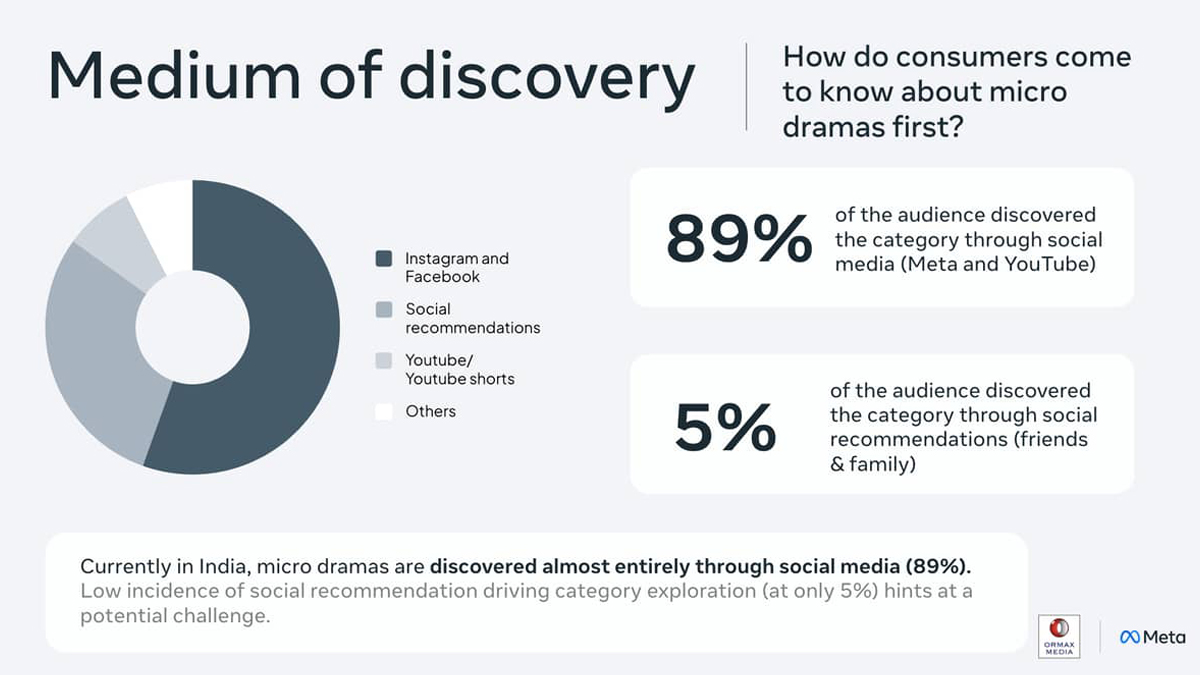
Conducted between November 2025 and January 2026 through 50 in-depth interviews and 2,000 personal surveys, the research reveals that 65 per cent of viewers discovered micro-dramas within the last year proof of explosive adoption. Nearly 89 per cent encounter the format through social feeds and recommendations, making algorithm-driven discovery the primary engine rather than active search.
Key viewing patterns show a median of 3.5 hours per week (about 30 minutes daily) spread across 7–8 short sessions. Consumption peaks between 8 pm and midnight, with additional spikes during commutes and work breaks classic “in-between moments” that the format fills perfectly. Around 57 per cent of viewing happens in ambient mode (while doing something else), and 90 per cent is solo, enabling more intimate, personal storytelling.
Romance, family drama and comedy lead genre preferences. Audiences show growing openness to AI-generated content, 47 per cent find it unique and creative, while only 6 per cent say they would avoid it entirely. Regional languages are surging after Hindi and English, Tamil, Telugu and Kannada dominate consumption.
Meta, director, media & entertainment (India) Shweta Bajpai said, “Micro-drama isn’t a passing trend, it’s rewriting the rules of Indian entertainment. In under a year, an entirely new category of platforms has emerged, built audience habits from scratch, and created a business vertical that is scaling fast.”
Ormax Media founder-CEO Shailesh Kapoor added, “Micro-dramas are beginning to show the early signs of becoming a distinct content category in India’s digital entertainment landscape. When a format aligns closely with how audiences naturally engage with their devices, it has the potential to scale very quickly.”
The study proposes ecosystem-wide responsibility, universal signposting of commercial intent, shared accountability among advertisers, platforms, creators, schools and parents, built-in safeguards, and formal media literacy in schools.
In a feed that never sleeps and a day that never stops, micro-dramas have slipped into the cracks of every spare minute turning 30-second stories into the new national pastime, one vertical swipe at a time.







